Why Get a DevOps Maturity Assessment?
Most engineering teams know they have DevOps gaps but struggle to prioritize. Should you fix the flaky CI pipeline first, or tackle the manual deployment process? Is your security posture a ticking time bomb, or is it good enough for now?
A DevOps maturity assessment gives you clarity. We evaluate your current practices across six critical dimensions, benchmark against industry standards, and deliver a prioritized roadmap that shows exactly where to invest for maximum impact.
Whether you're a startup preparing to scale or an enterprise modernizing legacy systems, understanding your DevOps maturity is the first step toward systematic improvement. Our assessment combines technical review with stakeholder interviews to understand not just what you're doing, but why—and what's blocking you from doing better.
What We Assess
Our assessment covers six critical dimensions of DevOps maturity. Each dimension is scored and benchmarked against industry best practices.
CI/CD & Deployment
How automated is your path from code commit to production? We evaluate build automation, testing coverage, deployment frequency, and rollback capabilities.
- Automated build pipelines
- Test automation coverage
- Deployment frequency
- Mean time to recovery
Infrastructure as Code
Is your infrastructure reproducible and version-controlled? We assess Terraform/IaC adoption, environment parity, and drift management.
- IaC coverage percentage
- Environment consistency
- Configuration management
- Disaster recovery automation
Security & Compliance
Is security integrated into your pipeline or an afterthought? We evaluate DevSecOps practices, vulnerability management, and compliance controls.
- Security scanning in CI/CD
- Secrets management
- Access control & IAM
- Compliance automation
Observability & Monitoring
Can you detect issues before users do? We assess monitoring coverage, alerting quality, and incident response capabilities.
- Metrics & logging coverage
- Distributed tracing
- Alerting effectiveness
- SLO/SLI implementation
Container & Orchestration
How mature is your container strategy? We evaluate Kubernetes adoption, container security, and orchestration practices.
- Container adoption level
- Orchestration maturity
- Image security & scanning
- Service mesh adoption
Culture & Collaboration
Does your team structure support DevOps? We assess collaboration patterns, knowledge sharing, and continuous improvement practices.
- Cross-functional collaboration
- Documentation practices
- Incident post-mortems
- Continuous learning culture
DevOps Maturity Levels
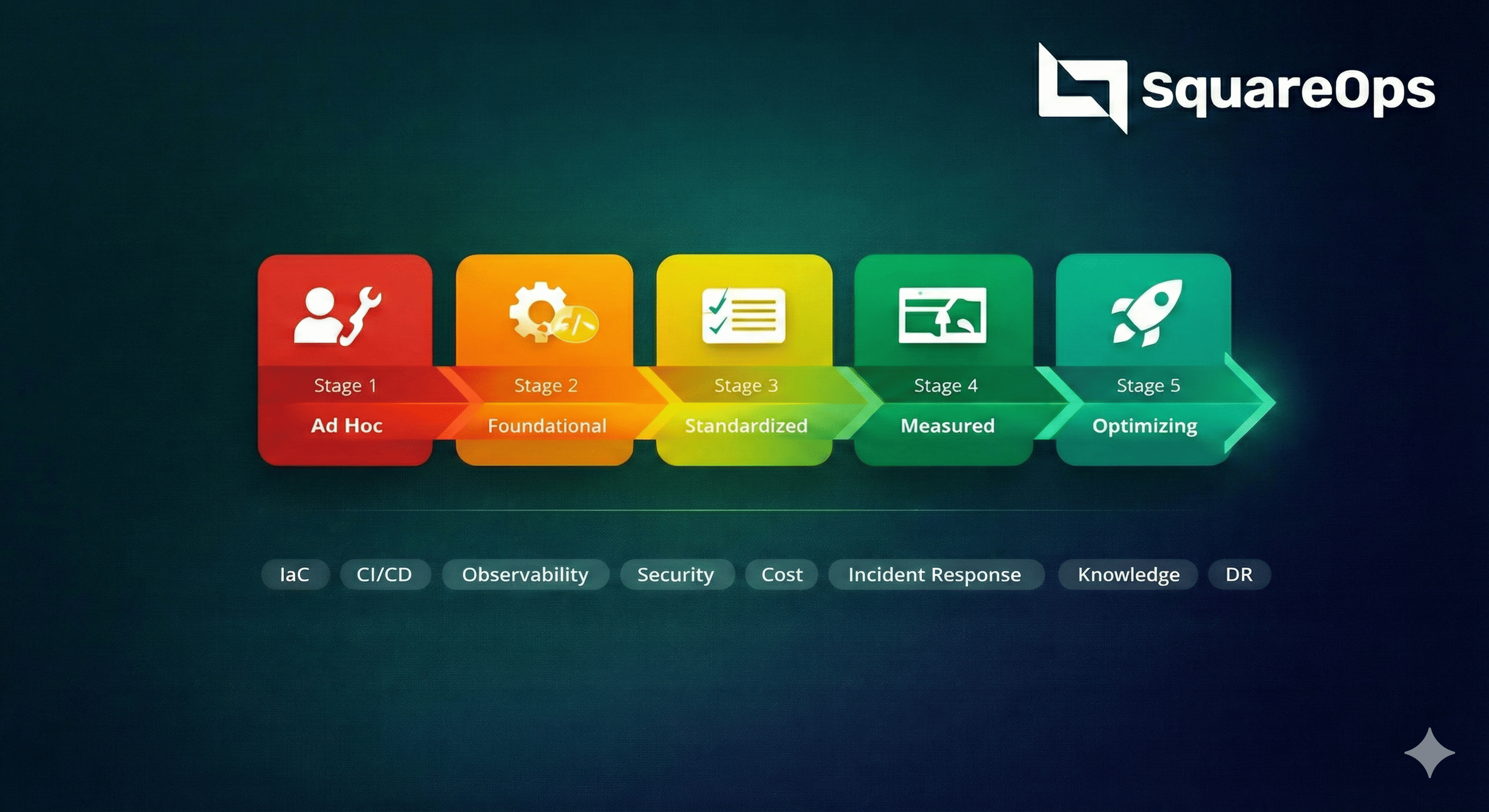
We score each dimension on a 5-level maturity scale. Understanding where you are helps prioritize where to invest.
Level 1: Initial
Ad-hoc processes, manual deployments, minimal automation. High risk, slow delivery, frequent firefighting.
Level 2: Developing
Some automation exists but inconsistent. Basic CI/CD in place but not comprehensive. Reactive monitoring.
Level 3: Defined
Standardized processes across teams. Good automation coverage. Proactive monitoring with defined SLOs.
Level 4: Managed
Metrics-driven improvement. Self-service platform capabilities. Security integrated throughout. High deployment frequency.
Level 5: Optimizing
Continuous improvement culture. GitOps and full automation. Industry-leading practices. Innovation focus.
Ready to assess your DevOps maturity?
Get a free assessment and discover where your biggest opportunities for improvement lie.
Start Free AssessmentOur Assessment Process
A structured approach that respects your time while delivering actionable insights.
We've refined our assessment process over 100+ engagements. It's designed to give you maximum value with minimum disruption to your team.
Discovery Call
30-minute call to understand your business context, current challenges, and goals. We identify the scope and focus areas for the assessment.
Technical Review
We review your infrastructure, pipelines, and tooling. This includes read-only access to your cloud console, CI/CD platform, and monitoring systems.
Stakeholder Interviews
Brief interviews with key team members—developers, ops, and leadership—to understand pain points, constraints, and aspirations beyond what tools can show.
Analysis & Scoring
We analyze findings, score each maturity dimension, and benchmark against similar organizations. Identify quick wins and strategic improvements.
Roadmap Delivery
Comprehensive report with maturity scores, gap analysis, and a prioritized roadmap. Live presentation to walk through findings and answer questions.
What You'll Receive: Assessment Deliverables
Every assessment includes a comprehensive report and personalized roadmap.
Maturity Scorecard
Visual scorecard showing your maturity level (1-5) across all six dimensions. Understand at a glance where you excel and where you need work.
Gap Analysis Report
Detailed findings for each dimension: current state, desired state, and specific gaps. Technical deep-dives with evidence and examples.
Prioritized Roadmap
Actionable improvement plan organized by impact and effort. Quick wins you can implement immediately, and strategic initiatives for long-term transformation.
Industry Benchmarks
See how you compare to similar organizations in your industry and size. Understand what "good" looks like for companies at your stage.
Executive Summary
One-page summary for leadership: key findings, business impact, and recommended investments. Perfect for board presentations or budget discussions.
Common Assessment Findings
These are the most common gaps we find across organizations. Sound familiar?
Manual Deployment Bottleneck
Deployments require specific team members, take hours, and happen only weekly or monthly. Fear of breaking production limits release frequency.
Typical Fix
Implement automated CI/CD pipelines with proper testing and rollback capabilities.
Infrastructure Drift
Production doesn't match what's in code. Manual changes accumulate. Nobody knows the true state of infrastructure.
Typical Fix
Adopt Infrastructure as Code with drift detection and automated remediation.
Reactive Monitoring
You learn about outages from customers, not alerts. When alerts do fire, they're noisy and ignored. No SLOs defined.
Typical Fix
Implement proper observability stack with SLOs, meaningful alerts, and distributed tracing.