Cloud spending across AWS, GCP, and Azure is projected to exceed $800 billion in 2026. For most engineering teams, 30-40% of that spend is waste — idle instances, oversized databases, orphaned storage, and network resources no one is monitoring. FinOps tools exist to find and fix this waste, but choosing the right one matters. The wrong tool shows you dashboards. The right tool shows you what to do.
We evaluated 20 of the most widely used cloud cost management tools across criteria that actually matter to engineering teams: detection depth, actionability, Kubernetes support, multi-cloud coverage, and pricing transparency. This is not a feature matrix pulled from marketing pages — it is based on hands-on experience managing cloud infrastructure for dozens of companies.
How We Evaluated
Every tool on this list was assessed against five criteria:
- Waste detection depth — How many resource types and check types does it cover? Does it go beyond compute into storage, database, and network?
- Actionability — Can you act on recommendations directly, or is it reporting-only?
- Kubernetes support — Does it cover pod-level allocation, node rightsizing, or both?
- Multi-cloud coverage — AWS, GCP, Azure, or all three?
- Pricing and access — Can you try it without a sales call? What does it actually cost?
Quick Comparison: All 20 Tools at a Glance
Before we dive into each tool, here is a summary table showing how all 20 compare on the features that matter most. For detailed SpendZero comparisons, see our full competitor breakdown.
| Tool | Best For | Multi-Cloud | K8s | One-Click Actions | Free Tier |
|---|---|---|---|---|---|
| SpendZero | Full-stack waste detection | AWS, GCP | Yes | Yes | Free scan |
| CloudHealth | Enterprise governance | AWS, Azure, GCP | Limited | No | No |
| Kubecost | K8s cost allocation | Any K8s | Deep | Limited | OpenCost (OSS) |
| CloudZero | Unit economics | AWS, Azure, GCP | Yes | No | No |
| Spot.io | Spot instance automation | AWS, Azure, GCP | Yes (Ocean) | Automated | No |
| Cloudability | Enterprise FinOps | AWS, Azure, GCP | Yes | No | No |
| Finout | Cost allocation | AWS, Azure, GCP | Yes | Limited | No |
| nOps | AWS automation | AWS only | Yes | Yes | Free tier |
| Vantage | Developer-friendly | AWS, Azure, GCP+ | Yes | No | Free tier |
| CAST AI | K8s automation | AWS, Azure, GCP | Deep | Automated | Free tier |
| ProsperOps | RI/SP optimization | AWS | No | Automated | No |
| Harness CCM | CI/CD integrated cost | AWS, Azure, GCP | Yes | Yes | Free tier |
| Infracost | IaC cost estimation | AWS, Azure, GCP | No | No (shift-left) | Free (OSS) |
| Densify | ML rightsizing | AWS, Azure, GCP | Yes | Limited | No |
| Zesty | Storage + RI automation | AWS, Azure | No | Automated | No |
| Antimetal | Group RI buying | AWS | No | Automated | No commitment |
| Anodot | Anomaly detection | AWS, Azure, GCP | Yes | Limited | No |
| Economize | AWS cost reference | AWS, GCP | No | No | Free tier |
| AWS Cost Explorer | Basic AWS visibility | AWS only | No | No | Free (built-in) |
| GCP Cost Management | Basic GCP visibility | GCP only | GKE | No | Free (built-in) |
The 20 Best FinOps Tools in 2026
1. SpendZero — Best for Full-Stack AWS & GCP Waste Detection
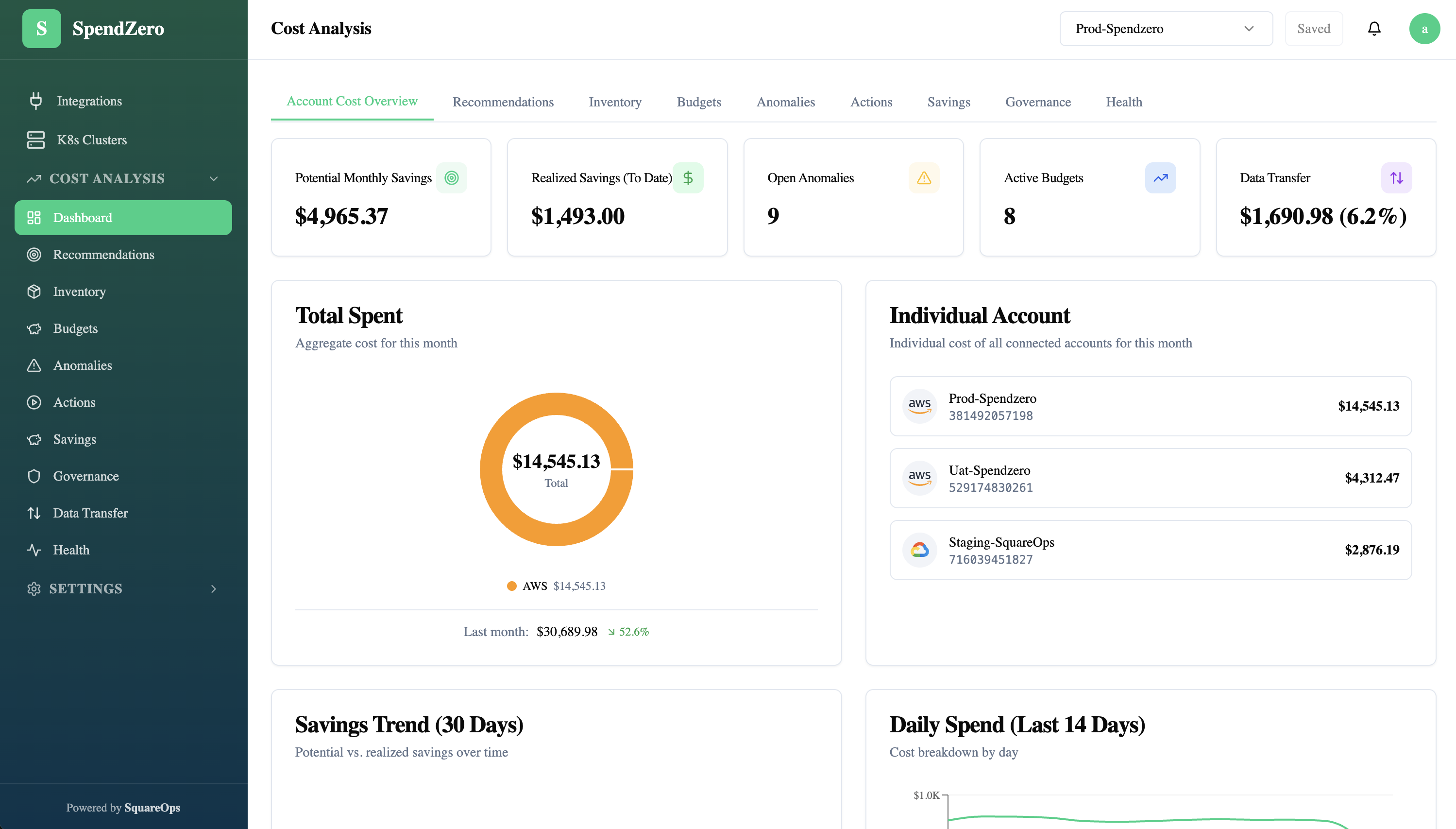
SpendZero is a cloud cost optimization platform built by SquareOps, a team that manages infrastructure for dozens of companies. It runs 37+ automated waste detection checks across 25+ AWS and GCP services — covering compute, storage, database, and network resources.
What sets SpendZero apart is the combination of detection breadth and one-click actions. Most tools stop at showing you a dashboard. SpendZero lets you stop idle EC2 instances, delete unattached EBS volumes, resize oversized RDS databases, and clean up orphaned snapshots — directly from the platform with a full audit trail.
Key strengths:
- 37+ automated waste checks across compute, storage, database, and network
- 25+ services covered: EC2, RDS, EBS, S3, Lambda, ElastiCache, Redshift, ECS, NAT Gateway, CloudFront, Elastic IPs, and more
- One-click remediation with confirmation and audit trail
- Real-time cost dashboard with month-over-month comparison
- Budget alerts via Slack and email
- AWS and GCP support (Azure coming soon)
- Free initial scan — no sales call required
- Optional managed FinOps services from SquareOps
Best for: Engineering teams that want broad waste detection across their full cloud stack with the ability to act immediately.
Limitations: Newer to market than CloudHealth or Kubecost. Kubernetes cost optimization is available but not as deep as Kubecost or CAST AI for pod-level allocation. Azure support is in progress.
Pricing: Free scan to start. Managed FinOps services available for hands-off optimization.

2. CloudHealth (Broadcom) — Best for Enterprise Multi-Cloud Governance
CloudHealth is one of the oldest cloud cost management platforms, now owned by Broadcom after the VMware acquisition. Built for large enterprises needing governance, policy enforcement, and reporting across AWS, Azure, and GCP.
Key strengths: Mature multi-cloud support, strong governance and policy framework, EC2 and RDS rightsizing, Reserved Instance optimization, showback and chargeback reporting.
Best for: Large enterprises (5,000+ employees) with dedicated FinOps teams needing governance and compliance reporting at scale.
Limitations: No one-click actions (reporting-only). Enterprise pricing requires sales engagement. Limited waste detection beyond EC2/RDS. Broadcom acquisition has created product direction uncertainty. Setup takes weeks.

3. Kubecost — Best for Kubernetes Cost Allocation
Kubecost is the go-to tool for Kubernetes cost visibility. Built on the open-source OpenCost project (a CNCF sandbox project), it provides granular cost allocation at the pod, namespace, deployment, and label level.
Key strengths: Pod-level cost allocation, open-source core (OpenCost), namespace and team breakdowns, cluster rightsizing, budget alerts per namespace.
Best for: Teams running significant Kubernetes workloads needing cost-per-service attribution. Especially valuable for platform engineering teams.
Limitations: Zero coverage outside Kubernetes. No storage, RDS, snapshot, or network waste detection. You need a second tool for non-K8s resources. One-click actions limited to enterprise tier.

4. CloudZero — Best for Engineering Cost Intelligence
CloudZero positions itself as a cost intelligence platform for engineering teams. It maps cloud costs to features, products, and teams — not just resource-level spending.
Key strengths: Cost per feature/product/customer attribution, unit economics (COGS analysis), anomaly detection, multi-cloud (AWS, Azure, GCP), strong thought leadership.
Best for: SaaS companies wanting to understand cost per customer or cost per feature for unit economics.
Limitations: Primarily visibility and reporting — no one-click remediation. Enterprise pricing. Their 50,000+ monthly SEO visits come largely from generic AWS reference content, not buyer-intent pages.

5. Spot.io (NetApp) — Best for Spot Instance Automation
Spot.io is a compute optimization platform specializing in Spot instance automation. It intelligently places workloads on Spot instances with automatic fallback to On-Demand when capacity is unavailable.
Key strengths: Fully automated Spot lifecycle management, Ocean for K8s compute optimization, intelligent instance diversification, multi-cloud (AWS, Azure, GCP).
Best for: Teams where compute is the dominant cost driver, especially with batch, CI/CD, or interruption-tolerant workloads.
Limitations: No storage, database, or network waste detection. Misses idle RDS, unattached EBS, orphaned snapshots, NAT Gateway costs entirely. Enterprise pricing.

6. Cloudability (Apptio/IBM) — Best for Enterprise FinOps Reporting
Cloudability, now part of IBM via the Apptio acquisition, is an enterprise FinOps platform focused on cost allocation, showback, and financial reporting across multi-cloud environments.
Key strengths: Mature cost allocation engine, TBM (Technology Business Management) integration via Apptio, multi-cloud support, RI/SP recommendations, strong reporting and dashboarding.
Best for: Large enterprises already using Apptio for IT financial management who want integrated cloud cost visibility.
Limitations: Reporting-focused with no one-click actions. Enterprise pricing with lengthy onboarding. The IBM/Apptio acquisition adds vendor complexity. Less focused on engineering teams, more on finance.

7. Finout — Best for Virtual Tagging and Cost Allocation
Finout is a cloud cost management platform that has gained visibility through aggressive Google Ads spending ($5,481/month on validated buyer keywords). It focuses on cost allocation with virtual tagging — applying cost tags without modifying actual cloud resources.
Key strengths: Virtual tagging (no resource modification needed), cost allocation across teams, K8s cost visibility, multi-cloud, unit cost tracking.
Best for: FinOps teams needing cost allocation and showback without the pain of retroactively tagging resources.
Limitations: More focused on visibility than action. Limited remediation capabilities. Smaller customer base. Pricing requires sales engagement.

8. nOps — Best for AWS-Native Automation
nOps is an AWS-focused cloud cost optimization platform that combines visibility with automated actions. It offers Spot instance management, scheduling, and rightsizing with an automation-first approach.
Key strengths: AWS-native automation (Spot, scheduling, rightsizing), commitment management (RI/SP), K8s cost optimization, ShareSave model (pay from savings), free tier available.
Best for: AWS-only teams wanting automated optimization with a pay-from-savings pricing model.
Limitations: AWS-only (no GCP or Azure). Smaller market presence than CloudHealth or Kubecost. Automation depth varies by service type.

9. Vantage — Best Developer-Friendly Cost Platform
Vantage is a modern cloud cost management platform designed for developers. It supports a wide range of providers beyond the big three — including Datadog, Snowflake, MongoDB Atlas, and more.
Key strengths: Broad provider support (AWS, Azure, GCP, Datadog, Snowflake, MongoDB, etc.), clean developer-friendly UI, Terraform provider, cost reports via API, free tier for small accounts, K8s cost visibility.
Best for: Engineering teams wanting a single pane of glass across cloud and SaaS costs with a modern, developer-oriented interface.
Limitations: Primarily visibility and reporting — limited automated actions. Rightsizing is basic. No deep waste detection like SpendZero's 37+ checks. Enterprise features require paid tiers.

10. CAST AI — Best for Automated Kubernetes Optimization
CAST AI is a Kubernetes cost optimization platform that goes beyond visibility into automated action. It automatically rightsizes pods, selects optimal instance types, and manages Spot instances for K8s workloads.
Key strengths: Automated K8s rightsizing and bin-packing, Spot instance management for K8s, multi-cloud (AWS, Azure, GCP), real-time pod optimization, free tier available.
Best for: Teams running production Kubernetes workloads who want automated node and pod optimization without manual intervention.
Limitations: K8s-only — no coverage for non-containerized resources. Does not detect storage, database, or network waste. Automated changes to production clusters require careful rollout.
Scan Your Full Cloud Stack for Free
Most teams are surprised by how much waste exists outside of compute. An idle m5.xlarge running 24/7 costs $138/month ($0.192/hr x 730 hrs). An orphaned 500GB gp2 EBS volume costs $50/month. A NAT Gateway processing 1TB of data costs $45/month. These add up fast — and most FinOps tools on this list miss them entirely.
Start a free SpendZero scan and see exactly where your cloud money is going across 25+ services. No sales call, no credit card — results in 5 minutes.

11. ProsperOps — Best for RI & Savings Plan Automation
ProsperOps specializes in one thing: automating Reserved Instance and Savings Plan purchasing on AWS. Their algorithm continuously buys and sells commitments to maximize discount coverage while minimizing lock-in risk.
Key strengths: Fully automated RI/SP purchasing, algorithmic commitment management, no upfront commitment from customer, pay-from-savings model.
Best for: AWS-heavy teams spending $50K+/month who want to maximize commitment discounts without manual RI/SP management.
Limitations: AWS-only. Only covers commitment optimization — no waste detection, rightsizing, or K8s support. Complementary to (not a replacement for) tools like SpendZero.

12. Harness Cloud Cost Management — Best CI/CD-Integrated Cost Tool
Harness CCM is the cloud cost module within the broader Harness software delivery platform. If your team already uses Harness for CI/CD, the cost management module integrates naturally.
Key strengths: Integrated with Harness CI/CD pipeline, K8s cost visibility and optimization, auto-stopping for non-production environments, multi-cloud, budget and anomaly alerts.
Best for: Teams already on the Harness platform who want cost management integrated into their delivery pipeline.
Limitations: Most valuable as part of the broader Harness ecosystem — standalone value is lower. Less depth than dedicated FinOps tools for waste detection. Pricing tied to Harness platform.

13. Infracost — Best for Shift-Left Cost Estimation
Infracost takes a fundamentally different approach: it estimates cloud costs before resources are deployed by analyzing Terraform code. It integrates into pull requests to show the cost impact of infrastructure changes.
Key strengths: Cost estimation in Terraform PRs, CI/CD integration, open-source core, supports AWS/Azure/GCP pricing, team cost policies.
Best for: Platform engineering teams using Terraform who want to prevent cost waste at the PR stage rather than detect it after deployment.
Limitations: Only covers Terraform-managed resources. Does not detect runtime waste (idle instances, unused storage). No real-time cost monitoring. Complementary to runtime FinOps tools, not a replacement.

14. Densify — Best for ML-Powered Rightsizing
Densify uses machine learning to analyze resource utilization patterns and recommend optimal instance types. It has been in the rightsizing space for over a decade, originally from the virtualization world.
Key strengths: ML-powered rightsizing with deep utilization analysis, multi-cloud support, container optimization, integration with ServiceNow and ITSM tools, strong enterprise presence.
Best for: Large enterprises with complex infrastructure needing ML-driven rightsizing recommendations integrated with ITSM workflows.
Limitations: Primarily rightsizing-focused — limited waste detection breadth. Enterprise pricing with long sales cycles. No one-click actions natively. More ITSM-oriented than DevOps-oriented.

15. Zesty — Best for Automated Storage & RI Optimization
Zesty (formerly Stratoscale) focuses on automated storage optimization and commitment management. Its Disk product auto-scales EBS volumes, while Commitment Manager handles RI/SP purchases.
Key strengths: Automated EBS volume rightsizing and scaling, RI/SP commitment automation, AWS and Azure support, pay-from-savings pricing.
Best for: Teams with significant EBS storage spend wanting automated volume management, or those needing hands-off RI/SP purchasing.
Limitations: Narrow scope — only covers storage optimization and commitments. No compute rightsizing, K8s support, or broad waste detection. AWS and Azure only.

16. Antimetal — Best for Group RI Buying
Antimetal offers a unique approach: group buying power for Reserved Instances. By pooling demand across multiple customers, they negotiate better commitment rates than individual companies can achieve alone.
Key strengths: Group buying discounts on RIs, no customer commitment required, automated savings, simple onboarding, cost dashboard included.
Best for: Small to mid-size AWS teams spending $10K-100K/month who want RI-level discounts without committing to 1-3 year reservations themselves.
Limitations: AWS-only. Only covers commitment discounts — no waste detection, rightsizing, or K8s support. Savings depend on pool availability. Newer company with smaller track record.

17. Anodot — Best for AI-Powered Cost Anomaly Detection
Anodot (which acquired Pileus Cloud) combines autonomous anomaly detection AI with cloud cost management. Its strength is catching unexpected billing spikes before they become major problems.
Key strengths: AI-powered anomaly detection, real-time billing alerts, multi-cloud (AWS, Azure, GCP), K8s cost visibility, RI/SP recommendations, strong visualization.
Best for: Teams that have been burned by unexpected billing spikes and want AI-driven early warning for cost anomalies.
Limitations: Anomaly detection is reactive (catches spikes after they happen). Limited waste detection compared to SpendZero. Enterprise pricing. Rightsizing recommendations are basic.

18. Economize.cloud — Best for AWS Cost Reference Content
Economize is a cloud cost optimization platform for AWS and GCP. While the product itself offers cost visibility and basic recommendations, Economize is perhaps better known for its extensive technical reference content (9,500+ monthly organic clicks from AWS service keywords).
Key strengths: AWS and GCP cost visibility, basic rightsizing recommendations, free tier for small accounts, clean dashboard UI, extensive educational content library.
Best for: Small teams wanting basic cloud cost visibility with a free entry point on AWS or GCP.
Limitations: Limited waste detection depth — no broad automated checks like SpendZero. No one-click actions. No K8s support. Product features are less differentiated than the educational content.

19. AWS Cost Explorer — Best Free AWS Starting Point
AWS Cost Explorer is the native cost analysis tool built into every AWS account. Free, requires no setup, and provides basic cost visibility.
Key strengths: Free and built-in, no setup required, cost and usage reports with filtering, basic forecasting, RI/SP recommendations, EC2 rightsizing recommendations.
Best for: Small teams just starting with cost visibility. A good starting point before investing in a dedicated FinOps tool.
Limitations: AWS-only. No one-click actions. Basic EC2 rightsizing only. No storage, database, or network optimization. No K8s awareness. No budget enforcement or team-level allocation. You will outgrow it quickly if you spend more than $10K/month.

20. GCP Cost Management — Best Free GCP Starting Point
Google Cloud's built-in cost management tools include billing reports, cost tables, budgets, and the Recommender API. For GCP-only teams, it provides a reasonable starting point.
Key strengths: Free and built-in, billing reports and cost tables, budget alerts, Recommender API (VM rightsizing, idle resource detection), GKE cost allocation, BigQuery export for custom analysis.
Best for: GCP-only teams wanting basic cost visibility. The Recommender API is actually more useful than AWS Cost Explorer's built-in recommendations.
Limitations: GCP-only. Recommendations are fragmented across multiple console pages. No unified waste detection dashboard. No one-click bulk actions. No cross-cloud support. Teams using both AWS and GCP need a multi-cloud tool like SpendZero.
How to Choose the Right FinOps Tool
With 20 tools on this list, the decision can feel overwhelming. Here is a practical framework based on your primary need:
Full-stack waste detection with one-click actions: SpendZero is the broadest option — 37+ checks across 25+ services with immediate remediation. Best if your waste spans compute, storage, database, and network.
Kubernetes cost allocation: Kubecost for pod-level visibility, CAST AI for automated K8s optimization. Many teams pair Kubecost with SpendZero to cover non-K8s resources.
Spot instance automation: Spot.io for compute-heavy workloads. ProsperOps or Antimetal for commitment (RI/SP) optimization specifically.
Enterprise governance and compliance: CloudHealth or Cloudability for large organizations with dedicated FinOps teams.
Unit economics and cost intelligence: CloudZero for SaaS companies needing cost-per-customer analysis. Finout for virtual tagging without modifying resources.
Developer-friendly visibility: Vantage for a modern UI across cloud + SaaS costs. Infracost for shift-left cost estimation in Terraform PRs.
Free starting point: AWS Cost Explorer or GCP Cost Management for single-cloud. Economize for basic multi-cloud visibility.
Common pairings that work well:
- SpendZero + Kubecost (full-stack waste detection + deep K8s allocation)
- SpendZero + Spot.io (storage/database/network + automated compute)
- SpendZero + ProsperOps (waste detection + automated RI/SP purchasing)
- SpendZero + Infracost (runtime waste detection + shift-left prevention)
The Bottom Line
There is no single tool that does everything perfectly. The best FinOps strategy in 2026 often involves two tools — one for broad detection and action, and one for your specific high-spend category (K8s, Spot, commitments).
For most engineering teams managing AWS and GCP infrastructure, the quickest path to real savings is a tool that detects waste across your full stack and lets you act on it immediately. SpendZero was built for exactly this — start a free scan in 5 minutes and see what your cloud is actually wasting across compute, storage, database, and network. No sales call, no credit card.