Introduction
Why Reliability is Critical in Modern Software Systems
In today’s digital-first world, businesses depend on highly available, scalable, and resilient software systems. Downtime, performance issues, and unexpected failures can lead to revenue loss, security risks, and a poor user experience. As systems grow in complexity, ensuring reliability becomes a top priority for DevOps teams and software engineers.
Traditional IT operations teams often struggled with balancing system stability and rapid software releases. DevOps introduced automation and collaboration to accelerate deployments, but unreliable services still pose a major risk. This is where Site Reliability Engineering (SRE) comes into play.
How Site Reliability Engineering (SRE) Bridges the Gap Between DevOps and Operations
SRE, originally pioneered by Google, extends DevOps principles by introducing a software engineering approach to IT operations. The goal of SRE is to improve system reliability through automation, monitoring, and proactive incident management. Unlike traditional operations, where teams react to failures, SREs prevent failures before they happen by implementing:
- Service Level Objectives (SLOs) and Service Level Indicators (SLIs) to measure and maintain reliability.
- Automated infrastructure scaling to handle fluctuating workloads efficiently.
- Incident response strategies that prioritize resolution while learning from failures.
The Impact of SRE on Modern DevOps Practices
By integrating SRE into DevOps workflows, organizations achieve:
- Scalability: Automating infrastructure management for predictable scaling.
- Reliability: Reducing downtime through proactive monitoring and failover strategies.
- Automation: Eliminating repetitive tasks and manual operations.
Understanding Site Reliability Engineering (SRE)
What is SRE?
Site Reliability Engineering (SRE) is a discipline that applies software engineering principles to IT operations to improve system reliability. It originated at Google as a way to ensure scalable and dependable services. SRE teams focus on:
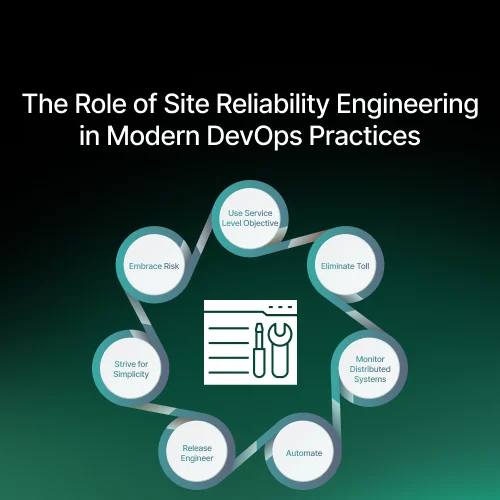
- Automation: Reducing manual toil through scripting and orchestration.
- Scalability: Implementing self-healing infrastructure and horizontal scaling.
- Reliability: Using SLIs, SLOs, and SLAs to define and measure system performance.
SRE vs. DevOps: Key Differences & Similarities
|
Feature |
DevOps |
SRE |
|
Focus |
Collaboration between Dev & Ops |
Reliability and automation |
|
Goal |
Continuous delivery & deployment |
Ensuring system uptime and resilience |
|
Approach |
CI/CD, infrastructure automation |
SLIs, SLOs, incident management |
|
Key Tools |
Jenkins, Docker, Kubernetes |
Prometheus, Terraform, Chaos Monkey |
How SRE Complements DevOps
- Reliability at Scale: SREs enforce SLIs, SLOs, and SLAs to measure and improve reliability.
- Automation & Toil Reduction: SREs automate repetitive operational tasks using Infrastructure as Code (IaC).
- Incident Management: SREs establish structured incident response strategies and postmortems.
Core Principles of Site Reliability Engineering
1. Defining & Measuring Reliability
SLIs, SLOs, and SLAs
- Service Level Indicators (SLIs): Quantitative measurements of system performance (e.g., request latency, error rate).
- Service Level Objectives (SLOs): Target thresholds for SLIs (e.g., 99.9% uptime goal).
- Service Level Agreements (SLAs): Formal contracts defining service commitments to customers.
Example SLI Calculation (Request Latency in Prometheus)
rate(http_requests_total{job="my-service", status="200"}[5m])
2. Eliminating Toil with Automation
- Using Terraform & Ansible to automate infrastructure provisioning.
- Implementing self-healing mechanisms with Kubernetes.
- Automated incident response with Runbooks and Playbooks.
3. Observability & Monitoring
- Prometheus & Grafana for real-time monitoring.
- ELK Stack or Loki for log aggregation and analysis.
- OpenTelemetry for distributed tracing.
Example Prometheus Alert for High Latency
					alert: HighLatency
expr: histogram_quantile(0.99, rate(http_request_duration_seconds_bucket[5m])) > 0.5
4. Incident Response & Postmortems
- Developing Incident Response Playbooks
- Blameless Postmortems for continuous learning.
5. Capacity Planning & Performance Optimization
- Horizontal & Vertical Pod Autoscaling in Kubernetes.
- Cost-aware resource allocation strategies.
How SRE Enhances Modern DevOps Practices
1. Enforcing Reliability in CI/CD Pipelines
- Canary and Blue-Green Deployments to minimize failure impact.
- Automating rollbacks based on real-time SLO breaches.
Example Jenkinsfile for Canary Deployment
					pipeline {
  agent any
  stages {
    stage('Deploy Canary') {
      steps {
        sh 'kubectl apply -f canary-deployment.yaml'
      }
    }
  }
}
2. Infrastructure as Code & Automation
- Using Terraform, Pulumi, and Kubernetes Operators for automated provisioning.
- Automated scaling with Horizontal Pod Autoscaler (HPA).
3. Chaos Engineering for Reliability
- Using Chaos Monkey or LitmusChaos to inject failures and test system resilience.
Example Chaos Engineering Test in Kubernetes
					apiVersion: litmuschaos.io/v1alpha1
kind: ChaosEngine
metadata:
  name: pod-delete-experiment
spec:
  experiments:
    - name: pod-delete
      spec:
        components:
          nodeSelector:
            kubernetes.io/hostname: "worker-node-1"
4. Security & Compliance in SRE
- Implementing Zero Trust Security Architecture (ZTA).
- Automating security scans with DevSecOps pipelines.
Example Security Scan in CI/CD Pipeline
					stages:
  - name: Security Scan
    steps:
      - name: Run Trivy
        script: trivy image my-app:latest
Real-World Case Studies of SRE in DevOps
1. Google’s Approach to SRE: Scaling Reliability Across Millions of Users
Google pioneered Site Reliability Engineering (SRE) as a way to ensure highly available, scalable services. Their approach includes:
- Defining SLIs and SLOs to measure system performance and reliability.
- Automating deployments to minimize manual toil and errors.
- Incident response playbooks that enable faster recovery during failures.
Google’s global-scale infrastructure demands rigorous capacity planning, failure detection, and automated recovery to handle billions of requests per day while maintaining high SLO compliance.
2. Netflix’s Chaos Engineering: Ensuring Fault Tolerance in Distributed Systems
Netflix introduced Chaos Engineering as an essential SRE practice to test and improve system resilience. Their strategy involves:
- Using Chaos Monkey to randomly terminate instances in production and ensure services remain available.
- Injecting latency failures to observe system behavior under degraded network conditions.
- Redundant service architecture to minimize downtime during failures.
By constantly testing for failures, Netflix has created a self-healing, highly available streaming platform that can handle millions of simultaneous users.
3. Uber’s Infrastructure Resilience: Handling High Traffic with Automated Incident Management
Uber operates a high-volume, real-time platform requiring rapid response to failures. Their SRE team focuses on:
- Real-time monitoring using Prometheus & OpenTelemetry.
- Automated failover mechanisms to reroute traffic when service disruptions occur.
- Dynamic scaling strategies to handle peak ride requests efficiently.
Uber’s automated incident management system helps maintain service availability while reducing operational burdens on engineers.
Future Trends in Site Reliability Engineering
1. AI-Driven SRE: Using Machine Learning for Predictive Analytics in Incident Management
As SRE matures, AI and Machine Learning (ML) are transforming reliability engineering by enabling:
- Automated anomaly detection using ML-powered observability tools.
- Predictive failure analysis based on historical incident data.
- AI-driven root cause analysis (RCA) for faster problem resolution.
Example: AI-Enhanced Prometheus Alerting
					apiVersion: monitoring.coreos.com/v1
kind: PrometheusRule
metadata:
  name: ai-prediction-rule
spec:
  groups:
  - name: predictive-alerts
    rules:
    - alert: HighFailureRate
      expr: job:build_failures:rate5m > 0.1
2. Serverless Reliability Strategies: Adapting SRE for Knative, AWS Lambda, and Google Cloud Run
Serverless computing is reshaping how SRE ensures reliability in modern cloud environments:
- AWS Lambda & Google Cloud Run remove infrastructure management, requiring SREs to focus on event-driven observability.
- Knative enables auto-scaling serverless workloads with built-in failover.
- Automated tracing and monitoring are essential to detect failures in serverless architectures.
Example: Configuring Knative Auto-Scaling
					apiVersion: serving.knative.dev/v1
kind: Service
metadata:
  name: my-app
spec:
  template:
    spec:
      containers:
        - image: gcr.io/my-project/my-app
      autoscaling.knative.dev/minScale: "1"
      autoscaling.knative.dev/maxScale: "10"
3. GitOps for SRE: Managing Reliability Through ArgoCD & FluxCD
GitOps is emerging as a best practice for managing infrastructure and reliability using ArgoCD & FluxCD:
- Declarative infrastructure management ensures consistency across deployments.
- Automated rollbacks prevent configuration drift and misconfigurations.
- Version-controlled SLO and monitoring policies streamline reliability tracking.
Example: ArgoCD Application for Managing SRE Configurations
					apiVersion: argoproj.io/v1alpha1
kind: Application
metadata:
  name: sre-monitoring
spec:
  project: default
  source:
    repoURL: https://github.com/my-org/sre-configs.git
    targetRevision: HEAD
    path: monitoring
  destination:
    server: https://kubernetes.default.svc
    namespace: monitoring
Conclusion
Site Reliability Engineering (SRE) is essential for scaling reliability, reducing toil, and automating infrastructure in modern DevOps environments. By integrating SLIs, SLOs, and SLAs, automating deployments, and implementing self-healing infrastructure, organizations can ensure high availability and resilience in their software systems.
Key takeaways:
- SRE enforces reliability through automated monitoring and failover strategies.
- Machine learning and AI are revolutionizing incident detection and response.
- GitOps, serverless strategies, and predictive analytics are shaping the future of SRE.
Looking to integrate SRE best practices into your DevOps workflows? SquareOps offers expert SRE consulting and automation solutions to help your organization scale reliability, enhance automation, and improve system resilience. Contact SquareOps today to elevate your SRE strategy and ensure high-performance cloud infrastructure!