The FinOps Tools Landscape
Cloud cost optimization has become essential for every engineering team. As cloud spending grows, so does the number of tools promising to cut your bill. But these tools vary widely in scope, setup complexity, pricing model, and the type of team they serve. This finops tool comparison helps you find the best aws cost optimization tool for your needs.
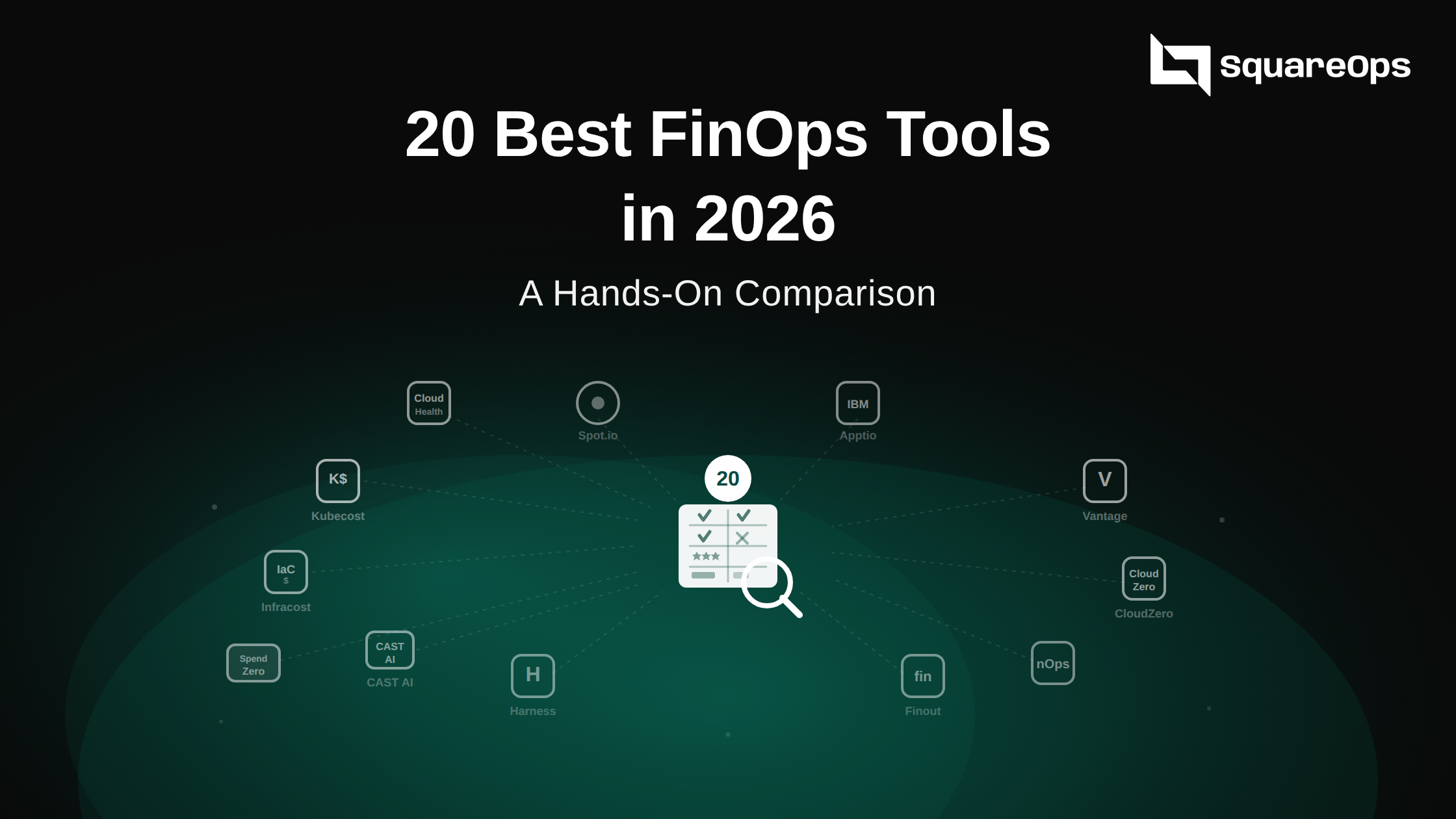
This finops platform comparison covers four leading approaches to cloud cost management: SpendZero, CloudHealth (by VMware/Broadcom), Spot.io (by NetApp), and Kubecost. Whether you are evaluating a CloudHealth alternative, Spot.io alternative, or Kubecost alternative, the right choice depends on your infrastructure, team size, and goals.
Four Tools, Four Approaches
A quick look at what each tool focuses on and who it is built for.
SpendZero
Engineering-led multi-cloud cost optimization. 37+ automated waste detection checks across 25+ cloud services on AWS and GCP, one-click actions to fix waste, and a free scan in 5 minutes. Built for DevOps and platform teams that want results fast. Learn more about SpendZero.
CloudHealth (VMware)
Enterprise-focused FinOps platform with policy-driven governance, multi-cloud support, and extensive reporting. Requires significant setup time, dedicated FinOps teams, and enterprise sales engagement. Strong for large organizations with complex governance needs.
Spot.io (NetApp)
Spot instance automation and infrastructure optimization. Specializes in reducing compute costs through intelligent Spot instance management. Strong for compute-heavy workloads but limited in storage, database, and network waste detection.
Kubecost
Kubernetes-specific cost monitoring and allocation. The standard for pod-level cost visibility in K8s clusters. Open source core with paid enterprise features. Excellent for K8s, but does not cover non-Kubernetes AWS resources.
Feature-by-Feature Comparison
A side-by-side look at what each tool offers across the capabilities that matter most for cloud cost optimization.
| Feature | SpendZero | CloudHealth | Spot.io | Kubecost |
|---|---|---|---|---|
| Setup Time | 5 minutes | Hours / Days | Hours | 15 minutes |
| AWS Waste Detection | 37+ checks | Limited | Basic | N/A |
| Kubernetes Cost | Yes | Limited | Yes | Core Focus |
| Multi-Cloud | AWS & GCP (Azure coming) | AWS, Azure, GCP | AWS, Azure, GCP | Any K8s |
| One-Click Actions | Yes | No | Spot automation | Limited (Enterprise) |
| Rightsizing | EC2, RDS, ElastiCache, Redshift | EC2, RDS | Spot-focused | Pod-level |
| Storage Optimization | EBS, S3, Snapshots | Limited | No | No |
| Budget Alerts | Yes | Yes | No | Yes |
| Anomaly Detection | Yes | Yes | No | No |
| Self-Serve SaaS | Yes (Free scan) | No (Sales-led) | No (Sales-led) | Open source + paid |
| Pricing | Free scan + affordable | Enterprise pricing ($$$) | Enterprise pricing ($$) | Free (OSS) + paid |
| Managed Service Option | Yes (SquareOps) | No | No | No |
SpendZero vs CloudHealth Full SpendZero vs CloudHealth comparison →
CloudHealth (now part of VMware/Broadcom) is one of the original enterprise FinOps platforms. It offers multi-cloud governance, policy-driven cost management, and extensive reporting capabilities. For large enterprises with dedicated FinOps teams and the budget to match, CloudHealth is a proven choice.
But CloudHealth comes with tradeoffs. Setup takes hours to days. You need to go through an enterprise sales cycle just to get started. And the platform is designed for policy administrators, not the engineers who actually manage the infrastructure.
SpendZero is built for engineering teams that want immediate results. Connect your AWS account in 5 minutes, get a waste report with estimated savings, and start fixing issues with one-click actions. No sales calls, no complex onboarding, no enterprise pricing.
Setup & Pricing
SpendZero takes 5 minutes with self-serve onboarding and a free scan. CloudHealth requires hours/days of setup plus enterprise contracts.
SpendZero AdvantageOne-Click Actions
SpendZero lets you fix waste directly with one-click actions. CloudHealth provides reports and policies but not direct action execution.
SpendZero AdvantageBuilt for Engineers
SpendZero is built for DevOps and platform engineering teams. CloudHealth targets FinOps teams and finance stakeholders with enterprise governance workflows.
SpendZero AdvantageMulti-Cloud
CloudHealth has years of multi-cloud (AWS, Azure, GCP) maturity. SpendZero supports AWS and GCP today with Azure on the roadmap.
CloudHealth StrengthManaged Service
SpendZero is backed by SquareOps managed services for hands-on optimization. CloudHealth is a self-service platform only.
SpendZero AdvantageSpendZero vs Spot.io Full SpendZero vs Spot.io comparison →
Spot.io (by NetApp) is a strong tool for one specific problem: Spot instance automation. If your primary cloud cost challenge is managing compute costs through intelligent Spot instance placement and fallback strategies, Spot.io does that well.
However, Spot.io's focus on compute optimization means it misses the broader picture. It does not detect idle RDS databases, unattached EBS volumes, orphaned snapshots, unused Elastic IPs, or NAT Gateway waste. These non-compute resources often represent 30-40% of total cloud waste.
SpendZero covers the full stack. With 37+ checks across 25+ cloud services on AWS and GCP, it catches waste in compute, storage, database, and network layers. And with one-click actions, you can fix issues directly instead of just seeing reports.
Full-Stack Coverage
SpendZero covers 25+ cloud services across AWS and GCP — compute, storage, database, and network. Spot.io focuses primarily on compute (Spot instances).
SpendZero AdvantageNon-Compute Waste
SpendZero detects EBS, S3, snapshot, EIP, NAT Gateway waste and rightsizes EC2, RDS, ElastiCache, and Redshift. Spot.io does not cover storage, database, or network optimization.
SpendZero AdvantageSpot Automation
Spot.io excels at fully automated Spot instance management with intelligent fallback across all workload types. SpendZero supports Spot for K8s clusters (user-managed).
Spot.io StrengthPricing & Access
SpendZero offers a free scan with transparent pricing — no sales cycle required. Spot.io requires enterprise sales engagement to get started.
SpendZero AdvantageSpendZero vs Kubecost Full SpendZero vs Kubecost comparison →
Kubecost is the standard for Kubernetes cost visibility. If your entire infrastructure runs on Kubernetes and you need pod-level cost allocation, namespace-level budgets, and cluster efficiency metrics, Kubecost is an excellent tool. Its open-source core makes it accessible, and the enterprise version adds multi-cluster support.
But most organizations do not run everything on Kubernetes. If you have EC2 instances for legacy workloads, RDS databases, EBS volumes, Lambda functions, or any of the dozens of other AWS services, Kubecost simply does not see them. That means a significant portion of your cloud waste goes undetected.
SpendZero covers the full cloud picture that Kubecost misses — across both AWS and GCP. With Kubernetes cost optimization already built in, SpendZero offers both K8s visibility and full-stack cloud waste detection in one platform.
Coverage Scope
SpendZero covers 25+ cloud services across AWS and GCP (EC2, RDS, EBS, Lambda, and more). Kubecost covers Kubernetes clusters only.
SpendZero AdvantageDetection & Actions
SpendZero runs 37+ waste checks with one-click remediation across all services. Kubecost focuses on pod right-sizing with limited actions in the enterprise tier.
SpendZero AdvantageNon-K8s Visibility
SpendZero detects waste in RDS, EBS, ElastiCache, Redshift, NAT Gateway, CloudFront, and more. Kubecost has no visibility into non-K8s resources.
SpendZero AdvantageK8s Allocation
Kubecost offers deep pod-level cost allocation, namespace budgets, and cluster efficiency metrics. SpendZero covers K8s at the cluster and node level.
Kubecost StrengthManaged Service
SpendZero offers a managed FinOps service where SquareOps experts implement optimizations. Kubecost is a self-service tool only.
SpendZero AdvantageSee How SpendZero Compares — On Your Own Infrastructure
Start a free scan and see what SpendZero finds in your cloud accounts. No sales call required.
Start Free ScanBest Cloud Cost Optimization Tool: Who Should Use What
Whether you are comparing CloudHealth vs Kubecost, Spot.io vs SpendZero, or any other combination — the right tool depends on your infrastructure, team, and goals. Here is a straightforward guide.
Choose SpendZero if...
You want instant cloud waste detection with 37+ automated checks and one-click fixes across AWS and GCP. You are a DevOps or platform engineering team that values fast time-to-value over enterprise features. You want a free scan without going through a sales cycle.
Best for
Engineering teams, startups, mid-size companies, anyone who wants to stop wasting money on cloud today. Try SpendZero.
Choose CloudHealth if...
You are a large enterprise with a dedicated FinOps team, multi-cloud governance requirements, and the budget for an enterprise platform. You need policy-driven cost management with executive reporting and chargeback/showback across business units.
Best for
Large enterprises with 50+ engineers, dedicated FinOps teams, and multi-cloud governance needs.
Choose Spot.io if...
Your primary cloud cost challenge is compute optimization and you want automated Spot instance management. You run compute-heavy workloads where Spot pricing can significantly reduce costs and you need intelligent fallback strategies.
Best for
Teams with large compute fleets, batch processing workloads, and CI/CD pipelines where Spot instances are viable.
Choose Kubecost if...
Your infrastructure is 100% Kubernetes and you need pod-level cost allocation, namespace budgets, and cluster efficiency metrics. You want an open-source foundation with the option to upgrade for multi-cluster support.
Best for
Kubernetes-native teams where all workloads run on K8s and non-K8s resource cost is not a concern.