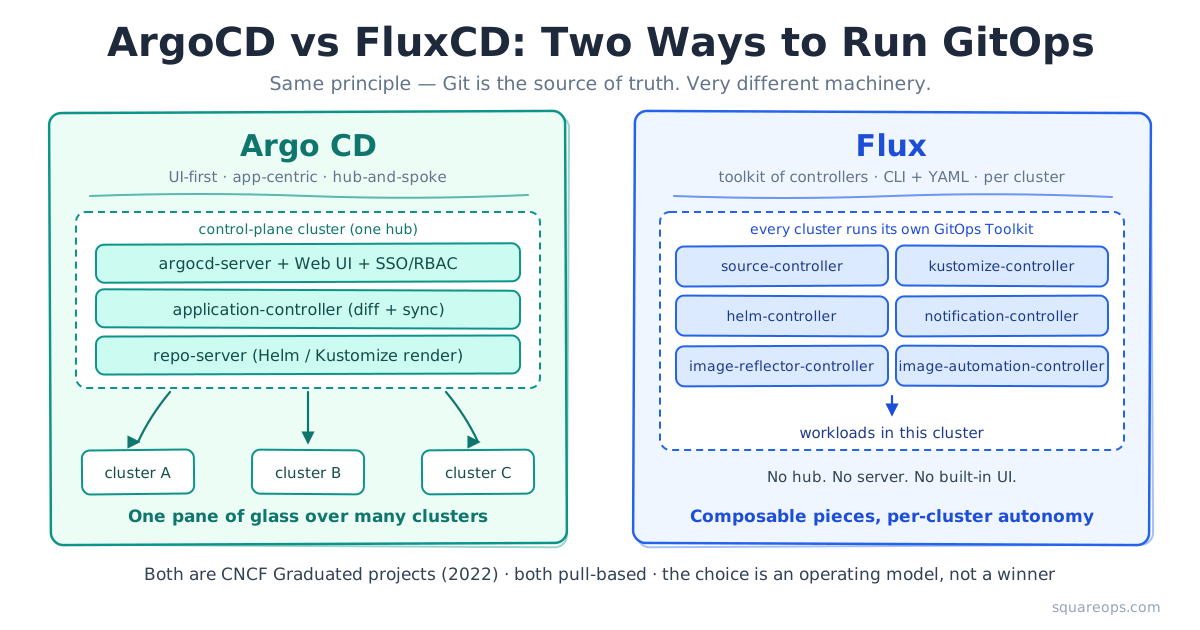
ArgoCD vs FluxCD, in one paragraph: both engines do the same job — continuously reconcile a Kubernetes cluster to whatever Git says it should be — so the honest difference is shape, not capability. Argo CD is UI-first and app-centric: a server, a web dashboard, built-in SSO and its own RBAC model, with an Application resource as the unit of work. Flux is a toolkit: six small controllers (the GitOps Toolkit) that live inside each cluster, driven by CLI and YAML, lighter to run, more composable, with container image update automation built in. Both are CNCF Graduated. The rest of this comparison shows where each genuinely pulls ahead, and ends with a decision tree you can run in ten minutes.
TL;DR: Choose Argo CD when application teams need a dashboard, self-service and per-team RBAC, or when one platform team runs a fleet from a single pane of glass. Choose Flux when you want a small, composable controller set per cluster, real Helm releases with drift correction, and image automation that writes back to Git without extra components. Both graduated in CNCF in 2022, both are Apache-2.0, and neither is a wrong answer. Argo CD is by far the more widely deployed; Flux is the leaner one to operate.
In this comparison:
- ArgoCD vs FluxCD at a glance
- How do ArgoCD and FluxCD differ architecturally?
- Do your application teams need the ArgoCD UI?
- How do ArgoCD and FluxCD handle Helm and Kustomize?
- Which GitOps engine automates container image updates?
- Multi-cluster and multi-tenancy at scale
- Argo Rollouts vs Flagger: progressive delivery
- When FluxCD is the better choice
- When ArgoCD is the better choice
- What does each GitOps engine cost to run?
- How do you choose between ArgoCD and FluxCD?
- Migrating between them — and running both
Picking the engine is the easy half. Wiring it into repo structure, environments, secrets and on-call is the half that decides whether GitOps sticks. Our GitOps implementation services cover both — book a consultation if you want a second opinion before you commit.
ArgoCD vs FluxCD at a Glance
| Dimension | Argo CD | Flux |
|---|---|---|
| What it is | An application delivery platform: API server, controllers and a web UI | A GitOps Toolkit: six composable controllers, driven by CLI and YAML |
| Core custom resources | Application, ApplicationSet, AppProject | GitRepository/OCIRepository, Kustomization, HelmRelease, ImagePolicy, Alert |
| Web UI | First-party dashboard with a live resource tree, diffs and one-click sync or rollback | No official UI; ecosystem options (Capacitor, Headlamp plugin, IDE extensions) or a vendor UI |
| Auth and RBAC | Built-in SSO (OIDC, OAuth2, LDAP, SAML) plus its own RBAC policy layer | Kubernetes RBAC only — no separate user database to run |
| Multi-tenancy | AppProject boundaries and RBAC scoping inside one instance | Namespace plus service-account impersonation per tenant |
| Multi-cluster | Hub-and-spoke: one instance registers and syncs many clusters | Flux runs in every cluster; fleets are managed with an operator or a config repo |
| Helm handling | Renders the chart and applies the output — no Helm release history in-cluster | helm-controller performs real Helm releases, with drift detection and correction |
| Kustomize handling | Native | Native, via kustomize-controller with server-side apply |
| Image update automation | Not in core — Argo CD Image Updater is a separate argoproj-labs project | Built in: image-reflector and image-automation controllers commit new tags back to Git |
| Notifications | Part of the project: triggers, templates and roughly 20 services | notification-controller, which also receives inbound webhooks to trigger syncs |
| Progressive delivery | Argo Rollouts, a sibling project under the same Argo umbrella | Flagger, a Flux sub-project |
| Runtime footprint | argocd-server, repo-server, application-controller, dex and redis | Six controllers, no API server and no cache tier |
| CNCF status | Graduated (December 6, 2022) | Graduated (November 30, 2022) |
| Community signal (Aug 2026) | ~23.9K GitHub stars; latest release v3.5.1 | ~8.3K GitHub stars; latest release v2.9.4 |
| Best fit | Many application teams that need visibility and self-service | Platform teams that want lean, automated, independent clusters |
Every row traces back to one early decision each project made: Argo CD chose to be a product with a front door, Flux chose to be a set of primitives. Both carry the same maturity signal — Flux graduated on November 30, 2022 and Argo on December 6, 2022.
How Do ArgoCD and FluxCD Differ Architecturally?
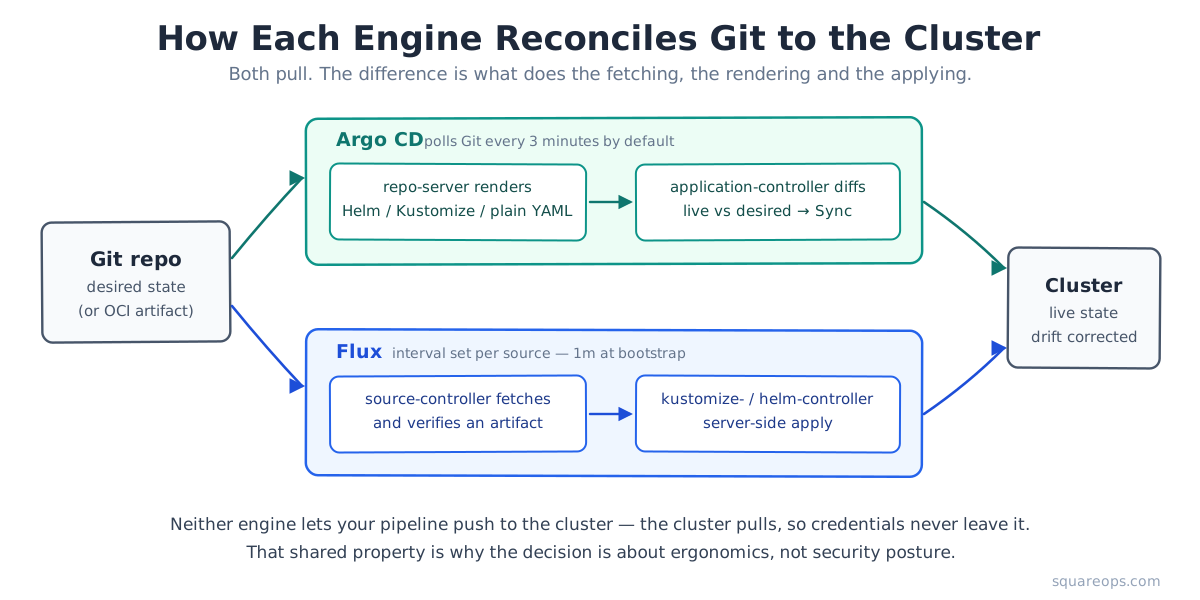
Argo CD runs as a small platform. The official Argo CD documentation describes a controller that compares live cluster state against Git and marks anything that diverges as OutOfSync. In practice that is five moving parts: an API server fronting the UI and CLI, a repo-server that clones and renders manifests, the application controller that diffs and syncs, Dex for SSO and Redis for caching. The unit of work is the Application CRD, pointing at a repo path and a destination cluster and namespace.
Flux has no equivalent centre. It ships as the GitOps Toolkit: source-controller fetches and verifies artifacts from Git, OCI registries, Helm repositories or S3-compatible buckets; kustomize-controller and helm-controller apply them; notification-controller handles alerts and inbound webhooks; and two image controllers handle registry scanning and Git write-back. Each is a normal Kubernetes controller reconciling its own CRD. There is no server to log into and no user model beyond Kubernetes RBAC.
Both are pull-based, which matters more than the differences: your pipeline never holds cluster credentials, because the cluster fetches its own desired state. Both satisfy all four principles the CNCF GitOps Working Group codified at OpenGitOps, so security posture is not the differentiator people often assume it is.
Do Your Application Teams Need the ArgoCD UI?
This question decides most ArgoCD vs FluxCD evaluations, and it is worth answering honestly rather than aspirationally.
If developers outside the platform team will ever ask “did my change actually deploy?”, the Argo CD dashboard answers it without a kubectl session or a Slack message. It renders a live tree of every resource an application owns, shows the exact diff between Git and the cluster, and lets a permitted user sync, roll back or restart a workload. Add SSO and Argo CD’s RBAC layer and a team gets read access to its own namespace and nothing else. Argo CD 3.0 tightened those defaults further, making log access a first-class RBAC permission rather than something implied by application read access.
Flux’s answer is that a UI is not the engine’s job. Status lives in CRD conditions, so flux get all -A, kubectl, or whatever dashboard your platform already runs. The community maintains several interfaces — Capacitor, a Headlamp plugin, IDE extensions — and vendor distributions ship their own, but none is the project’s official front door. For a platform team of six that lives in the terminal, that is a non-issue. For 200 developers who have never run kubectl, it is the whole argument.
How Do ArgoCD and FluxCD Handle Helm and Kustomize?
Kustomize is a tie: both render it natively and correctly. Helm is where they differ in a way that shows up in production.
Argo CD treats a chart as a template engine. It runs the equivalent of helm template, then applies the rendered manifests itself. The upside is one consistent sync and diff model for every source type. The trade-off is that no Helm release is stored in the cluster, so helm list shows nothing and chart behaviour that depends on release state differs from a stock Helm workflow.
Flux’s helm-controller does the opposite: a HelmRelease is a real install or upgrade driven through the Helm SDK, with release history, rollback semantics and drift detection that puts a manually edited resource back the way the chart declared it. If your organisation already packages everything as charts and expects helm rollback to mean something, Flux fits the existing mental model with less friction.
Neither approach is objectively better. If you are still deciding how charts, values and environments should be laid out, that repo design matters more than the engine — it is what we spend the most time on during GitOps consulting engagements, and the same discipline we apply to Terraform at scale.
Which GitOps Engine Automates Container Image Updates?
Flux, without qualification. Its image update automation is two first-party controllers: image-reflector-controller scans your registry and records available tags, image-automation-controller writes the selected tag back to Git as a commit. CI can stop at “build and push”, and the deployment record still lives in Git history rather than a pipeline log.
Argo CD does not ship this in core. The equivalent is Argo CD Image Updater, a separate argoproj-labs project that is actively maintained but carries a limitation by design: it updates applications generated by Helm, Kustomize or a config-management plugin, not plain-manifest applications.
Many teams sidestep the question entirely by having CI commit the new tag — a pattern we implement often in CI/CD consulting work and cover in our guide to managing Jenkins pipelines in Kubernetes. If that is your model, this row is a tie and should not swing the decision.
Multi-Cluster and Multi-Tenancy at Scale
Argo CD scales outward from a hub. One instance registers many clusters, and ApplicationSet generators template applications across them, so “deploy this to every production cluster tagged eu” is a few lines of YAML rather than a loop in a pipeline. The scale is real: in the Argo CD user survey published by the CNCF in July 2025, 42% of respondents ran more than 500 applications per instance — up from 15% two years earlier — and 25% connected one instance to more than 20 clusters. That is a survey of Argo CD users, not neutral market share, but the direction is clear.
Flux scales by repetition. Every cluster runs its own controllers and reconciles its own path in a repo, giving genuine blast-radius isolation: a broken hub cannot stop deployments everywhere, because there is no hub. The cost is that fleet-wide visibility and upgrades become your problem, usually solved with the Flux Operator or a cluster-of-clusters repo layout.
A rule of thumb from our managed Kubernetes engagements: below roughly ten clusters, either model works. Above that, the question is whether you want one system to secure and scale, or N systems that fail independently.
Argo Rollouts vs Flagger: Progressive Delivery Compared
Neither engine does canaries by itself; each has a sibling that does. Argo Rollouts replaces the Deployment with a Rollout that understands canary and blue-green strategies, analysis against your metrics provider and manual promotion gates — and it renders inside the Argo CD UI, so promotion happens where the deployment is already visible. Flagger leaves your Deployment alone and drives the shift through a service mesh or ingress controller, promoting or rolling back automatically on metric analysis.
Both are mature and both work with either engine, so this rarely decides anything — unless you have standardised on a mesh, where Flagger has less to install, or you want humans clicking “promote” in a UI, where Rollouts plus Argo CD is the tighter loop.
When FluxCD Is the Better Choice
Flux is the better engine when the operating model is decentralised or the footprint has to be small:
- Edge, air-gapped or heavily isolated clusters. Six controllers, no server, no cache tier, no user database, nothing exposed for a human to log into.
- Helm-heavy estates. Real releases with drift correction keep your existing Helm workflows and tooling meaningful.
- Image automation as a platform feature. Registry scanning and Git write-back are first-party, supported and declarative.
- Autonomous teams that own their clusters. Per-cluster controllers mean per-cluster blast radius and no shared control plane to argue over.
- Teams that prefer composing controllers. If your platform is already CRDs and reconciliation loops, Flux is one more well-behaved controller set, not a new system.
- Regulated environments needing a hardened supply chain. ControlPlane — whose founding engineer Stefan Prodan is the original author of Flux and the GitOps Toolkit — ships a FIPS-compliant distroless distribution with 24/7 support, so “who do we call” has an answer.
The honest counterweight: Flux’s smaller community means fewer blog posts, fewer Stack Overflow answers and a smaller hiring pool. Weaveworks, its original commercial sponsor, shut down in 2024; the project survived because CNCF graduation meant it never depended on one vendor, and cadence has stayed steady — v2.9.4 shipped in August 2026 — but the ecosystem around it is thinner than Argo’s.
When ArgoCD Is the Better Choice
Argo CD is the better engine when many people who are not platform engineers need to see and touch deployments:
- Developer self-service. The dashboard is the product: sync status, live diffs, resource health, logs and rollback in one place, gated by SSO and RBAC.
- Platform-as-a-service operating models. One hub, many tenants,
AppProjectboundaries and ApplicationSet templating across a fleet. - Enterprise identity requirements. OIDC, SAML, LDAP and GitHub or GitLab login are built in, not bolted on.
- Ecosystem gravity. More adopters, more integrations, more people who have already debugged your problem, and commercial distributions from multiple vendors.
- Audit and demo value. A screen showing exactly what is running, where it came from and who synced it is disproportionately useful in an audit.
The honest counterweight: Argo CD is more to run. Five components, a Redis dependency, an RBAC model separate from Kubernetes’, and a high-availability guide full of tuning knobs — controller sharding, repo-server scaling, monorepo caching, reconciliation rate limits and jitter. That buys real capability, but a two-person platform team may not want to spend it. If you are standing Argo CD up for the first time, our step-by-step Argo CD tutorial covers installation and the app-of-apps pattern, and Argo CD consulting and support exists for the version where someone else runs it.
Stuck between the two? We have run both in production, in regulated and startup environments. A short architecture review usually settles it in one call — see how we run GitOps implementations or talk to an engineer.
What Does Each GitOps Engine Cost to Run?
Both are free. Argo CD and Flux are Apache-2.0 open source under the CNCF, so the licence line is zero either way — which makes the real comparison operational effort, and there they diverge.
Flux costs less to operate. Six controllers, no server, no Redis, no separate user store. Upgrades are a controller image bump and the surface area you can misconfigure is small. Most teams run it without anyone owning it full-time.
Argo CD costs more to operate but saves other people’s time. You are running an API server, a UI, an SSO integration, a cache and a controller that needs sharding as application count grows. Budget a meaningful slice of a platform engineer for the first quarter. What you get back is the support load that never reaches you because a developer could see the answer themselves.
Commercial support exists on both sides — vendor distributions of Argo CD, ControlPlane’s enterprise distribution for Flux, and managed integrations such as Azure’s AKS and Arc Flux extension. All quote-based. The cheaper path for most mid-size teams is an internal platform team with outside help for the first build, which is how our DevOps consulting services and site reliability engineering engagements are usually structured.
How Do You Choose Between ArgoCD and FluxCD?
Run the questions below in order and stop at the first honest yes. The tree is deliberately short, because two or three factors decide it and the rest is preference.
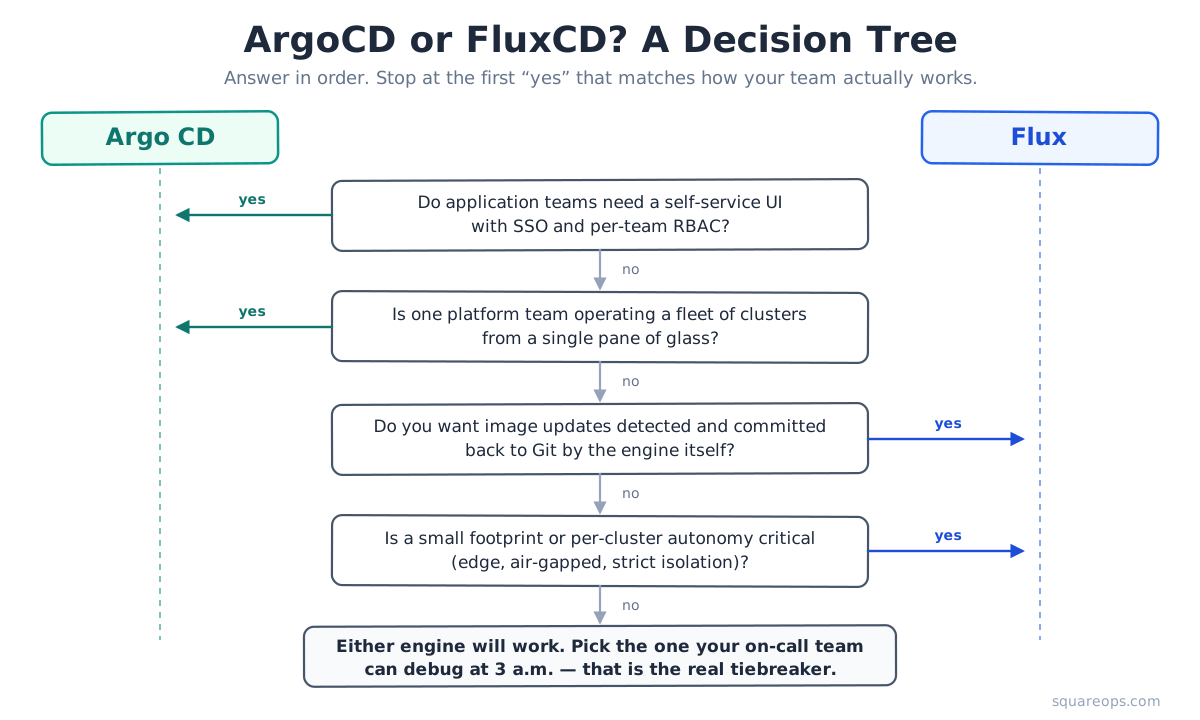
Two tiebreakers worth naming. The context first: 82% of container users now run Kubernetes in production according to the 2025 CNCF Annual Survey, and 58% of the organisations it classes as cloud-native innovators use GitOps principles extensively, against 23% of less mature adopters. Either engine puts you in the first group.
The practical one: pick the engine your on-call rotation can debug at 3 a.m. An engine your team understands beats the one that scored better in an evaluation matrix, every time.
Migrating Between Them — and Running Both
Migration is more tractable than it sounds, because the manifests are the asset and both engines read the same YAML, Helm charts and Kustomize overlays. What you rewrite is the wrapper: Argo CD Application resources become Flux Kustomization and HelmRelease resources, or the reverse. The careful part is ownership metadata — each engine tracks what it manages differently — so a cutover means letting one engine adopt the other’s resources without pruning live workloads. Do it one non-production namespace at a time, with pruning disabled until the diff is clean.
Running both is also legitimate: Flux managing platform layers such as CNI, ingress, monitoring and operators, with Argo CD giving application teams a UI over the workloads on top. The rule that keeps this sane is one owner per resource. Two reconcilers fighting over the same object is an unpleasant incident, and the most common self-inflicted GitOps failure we are called in to unpick.
Whichever way it lands, the parts that decide whether GitOps survives contact with a real organisation are identical for both engines: repo structure, environment promotion, secrets, drift policy, and how an emergency change happens at 2 a.m. without someone quietly breaking the model. Those process decisions are what our GitOps implementation services deliver, alongside the pipeline that feeds them — shown end to end in our walkthrough of microservice delivery on Kubernetes with Jenkins, Helm and ArgoCD.
Rolling out GitOps this quarter? SquareOps designs the repo structure, installs and hardens Argo CD or Flux, wires in secrets, progressive delivery and alerting, and hands your team a model they can run. We will also tell you plainly when your current setup does not need replacing. Book a free consultation or explore our GitOps implementation services.