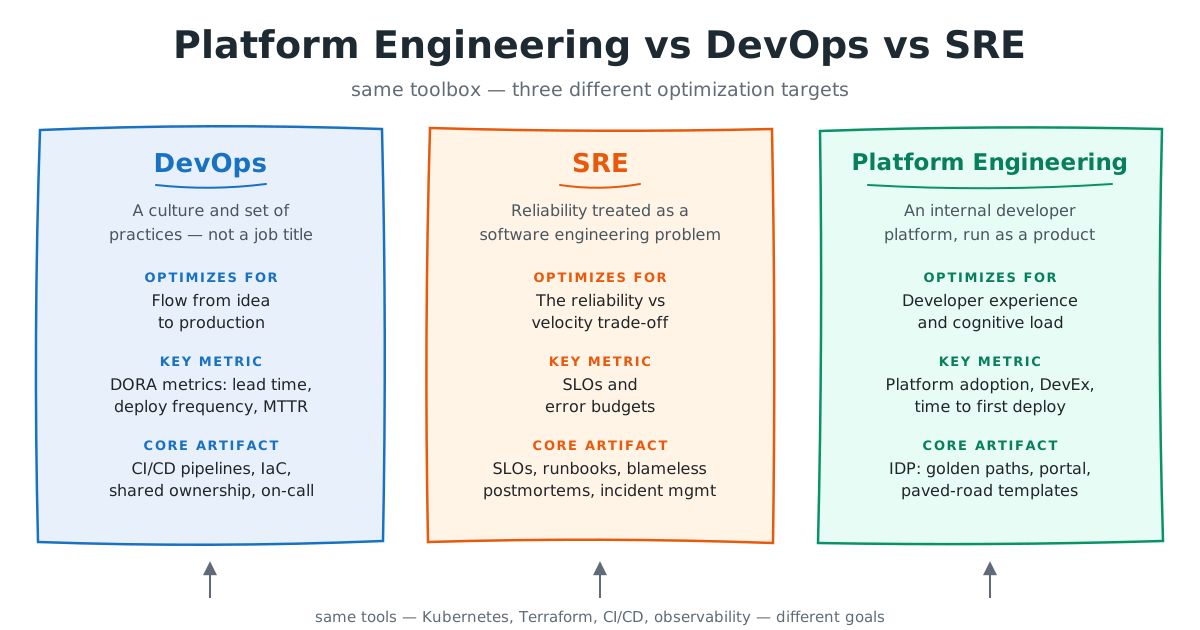
TL;DR: DevOps is a culture and set of practices that unifies building and running software. Site reliability engineering (SRE) applies software engineering to reliability, governed by SLOs and error budgets. Platform engineering packages both into an internal developer platform (IDP) that engineers consume self-service, run as an internal product. They are complementary layers, not competing job titles — and most organizations past roughly 80 engineers end up needing all three.
The platform engineering vs DevOps vs SRE question comes up in almost every scaling conversation we have with engineering leaders — usually phrased as "which one should we hire for?" That framing is the wrong question, and this guide explains why: the three disciplines share one toolbox (Kubernetes, Terraform, CI/CD, observability) but optimize for different outcomes, appear at different stages of organizational maturity, and fail in different ways when you conflate them.
In this guide:
- What is the difference between platform engineering, DevOps and SRE?
- Platform engineering vs DevOps vs SRE: side-by-side comparison
- DevOps: the operating culture underneath both
- Platform engineering vs DevOps: what actually changes?
- How is platform engineering different from SRE?
- How do platform engineering, DevOps and SRE work together?
- Which discipline does your organization need first?
- Team structure and job titles: who owns what
Deciding between a platform team, SRE hires, or neither?
SquareOps designs, builds and operates internal platforms and reliability practices for scaling engineering teams — start with a conversation about your current setup.
What is the difference between platform engineering, DevOps and SRE?
All three disciplines exist to resolve the same underlying tension — shipping software fast without breaking it — but each attacks a different part of the problem.
DevOps is a culture and a set of practices, not a job title. It emerged around 2009 as a reaction to the "wall of confusion" between developers who wanted to ship and operations teams who wanted stability. Its answer is shared ownership ("you build it, you run it"), automation of the delivery pipeline, and fast feedback loops. Its scoreboard is the four DORA metrics: deployment frequency, lead time for changes, change failure rate, and time to restore service.
Site reliability engineering is what Google got when it "asked a software engineer to design an operations team," as the Google SRE book famously puts it. SRE turns reliability into an engineering problem with explicit budgets: a service targeting 99.9% availability has 0.1% of unreliability to "spend," and when that error budget is exhausted, feature launches slow down until reliability recovers. Google even caps operational toil at 50% of an SRE's time — the other half goes to engineering the toil away.
Platform engineering treats internal infrastructure as a product. A dedicated team builds and operates an internal developer platform — golden-path templates, self-service environments, paved-road CI/CD — so product teams consume infrastructure the way they would consume a SaaS product. The CNCF platforms whitepaper defines a platform as "an integrated collection of capabilities defined and presented according to the needs of the platform's users," and names its central purpose: reducing the cognitive load on product teams.
The one-line version: DevOps tells you how to work, SRE tells you how reliable to be, and platform engineering gives everyone a paved road to do both at scale.
Platform engineering vs DevOps vs SRE: side-by-side comparison
| Dimension | DevOps | SRE | Platform engineering |
|---|---|---|---|
| What it is | Culture and practices for the whole delivery lifecycle | Engineering discipline for production reliability | Product discipline: an internal platform for developers |
| Core question | "How do we ship faster, together?" | "How reliable must this be, and at what cost?" | "How do we make the right way the easy way?" |
| Primary customer | The delivery process itself | End users, via availability | Internal developers |
| Primary metrics | DORA four keys (lead time, deploy frequency, change failure rate, MTTR) | SLOs, error budgets, toil percentage | Platform adoption, developer experience, time to first deploy |
| Team structure | Not a team — a way every team works | Central or embedded reliability team | Dedicated product team with a roadmap and users |
| Typical artifacts | CI/CD pipelines, infrastructure as code, automated tests | SLOs, runbooks, blameless postmortems | IDP, golden paths, service catalog, templates |
| When it emerges | Day one | ~20–80 engineers, when downtime hurts revenue | ~80+ engineers, when duplicated infra work compounds |
| Typical tooling | GitHub Actions, Jenkins, Terraform, Docker | Prometheus, Grafana, PagerDuty, incident tooling | Backstage, Port, Crossplane, Argo CD, Humanitec |
| Failure mode when misapplied | A "DevOps team" that is just a rebranded ops silo | Gatekeeping releases under a new name | A platform nobody adopts |
Notice that the tooling rows overlap heavily — a platform engineer and an SRE might both spend Tuesday writing Terraform. The difference is never the tool; it is the metric each discipline is accountable for. That is why "we already use Kubernetes, so we do platform engineering" is a non-sequitur.
DevOps: the operating culture underneath both
DevOps predates the other two disciplines as a mainstream term, and it remains the foundation: SRE and platform engineering are both ways of implementing DevOps promises at scale, not alternatives to them. The practices are familiar — version-controlled infrastructure, automated pipelines, GitOps-style deployments, monitoring as a first-class concern, and blameless culture when things break.
The best-known failure mode is also cultural: renaming the operations team "the DevOps team" and changing nothing else. As platformengineering.org notes in its own comparison, many organizations simply rebranded existing teams — which reintroduces the silo DevOps was meant to remove, now with a trendier name. If a single team "does DevOps" on behalf of everyone else, ticket queues return, ownership blurs, and the four key metrics stall.
SRE is frequently confused with DevOps because both automate operations. The short distinction: DevOps optimizes the flow of change, SRE governs the safety of change. We keep the full two-way breakdown — shared principles, diverging metrics, hiring implications — in our dedicated guide to how SRE and DevOps differ and where they overlap, so this article stays focused on where platform engineering fits against both.
Platform engineering vs DevOps: what actually changes?
The honest answer: platform engineering is what DevOps becomes when "you build it, you run it" stops scaling. With five teams, every squad owning its own pipelines, Helm charts and AWS accounts is empowering. With twenty-five teams it means twenty-five slightly different CI configurations, twenty-five ways to provision a database, and senior engineers spending their weeks on undifferentiated plumbing. The cognitive load lands on product developers, and it shows up as slower onboarding and inconsistent security posture.
The practical difference between platform engineering and DevOps shows up in three places:
- Ownership model. DevOps distributes infrastructure ownership to every team. Platform engineering re-centralizes the undifferentiated parts — pipelines, environments, guardrails — into a product, while product teams keep owning their services in production.
- Interface. DevOps gives teams tools; platform engineering gives them golden paths: a template that takes a new microservice from repo to production with security scanning, observability and cost tagging already wired in.
- Accountability. A DevOps culture is everyone's job, which at scale can mean no one's job. A platform team has a roadmap, users and adoption metrics — if developers route around the platform, that is a product failure the team must fix.
The industry has voted on this: Gartner projected that by 2026, 80% of large software engineering organizations will run platform engineering teams as internal providers of reusable services and tools — up from 45% in 2022. The 2024 DORA report adds an evidence base and a warning: internal developer platforms measurably improve individual productivity, team performance and organizational performance, but poorly implemented platforms can reduce change stability and throughput. A platform built without treating developers as customers becomes the new bottleneck.
On tooling: the portal-and-orchestrator market has matured fast, with products like Backstage, Port and Atmosly (disclosure: Atmosly is built by SquareOps) covering the self-service layer, which shifts the real decision to scope. We maintain a current market overview in our guide to the top platform engineering and IDP companies, and a cost model in build vs buy for internal developer platforms — short version: building in-house rarely pays off below roughly a hundred engineers.
How is platform engineering different from SRE?
Platform engineering vs SRE is the subtler comparison, because both are dedicated teams staffed with infrastructure-minded software engineers, often using identical tools. The clean way to separate them is by customer and by metric.
SRE's customer is the end user. An SRE team is accountable for what production does at 3 a.m.: whether the checkout service meets its 99.95% SLO, how fast incidents are detected and resolved, whether the error budget justifies shipping this week's risky migration. Its instruments are SLOs, error budgets, observability pipelines, capacity plans and postmortems.
Platform engineering's customer is the internal developer. A platform team is accountable for what happens before production: how long a new hire takes to ship a first change, how many manual steps a new service needs, whether teams adopt the paved road voluntarily. Its instruments are templates, service catalogs, developer surveys and adoption dashboards.
The overlap is real and useful: a good platform team bakes SRE's hard-won defaults into the golden path, so every new service is born with dashboards, alert rules, sane resource limits and an SLO scaffold — reliability by default rather than by heroics. Conversely, SREs are often the platform's most demanding users, pushing for deployment safety features like progressive rollouts and automated rollback. But when one team is asked to be both simultaneously, incident response always wins the week, and the platform roadmap silently dies. That is the most common reason internal platforms stall — and why teams that cannot yet fund both often pair an in-house platform effort with external 24x7 production support to keep the pager from consuming the roadmap.
How do platform engineering, DevOps and SRE work together?
The three disciplines are not stages you graduate between — in a healthy scaled organization they run concurrently, at different layers of the same delivery machine.
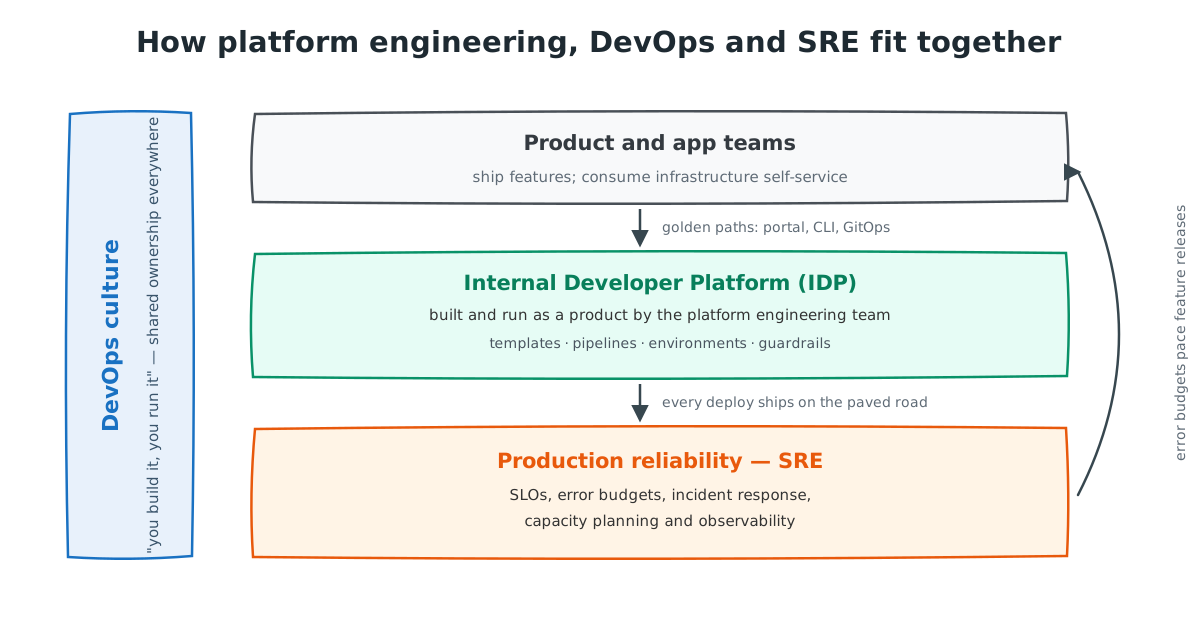
Walk one change through the system. A product team spins up a new payments microservice from the platform's template: repository, CI/CD pipeline, Terraform-provisioned staging environment, security scanning and observability arrive in minutes, not weeks — that is platform engineering. The team writes the code, reviews it, ships it, and carries the pager for it — that is DevOps culture doing its job. In production, the service runs against an SLO agreed with the SRE function; when a bad deploy burns error budget, the budget policy (not an executive escalation) decides that the next release slows down while the team hardens the service — that is SRE.
Remove any layer and the system degrades predictably. No platform: every team hand-rolls infrastructure and the DORA metrics diverge wildly between squads. No SRE: velocity wins every argument until a multi-day outage wins one instead. No DevOps culture: the platform and the SLOs exist, but developers throw code over the wall and treat both as someone else's problem.
Which discipline does your organization need first?
Sequence beats ideology here. The pattern we see across engagements maps cleanly to organization size and maturity:
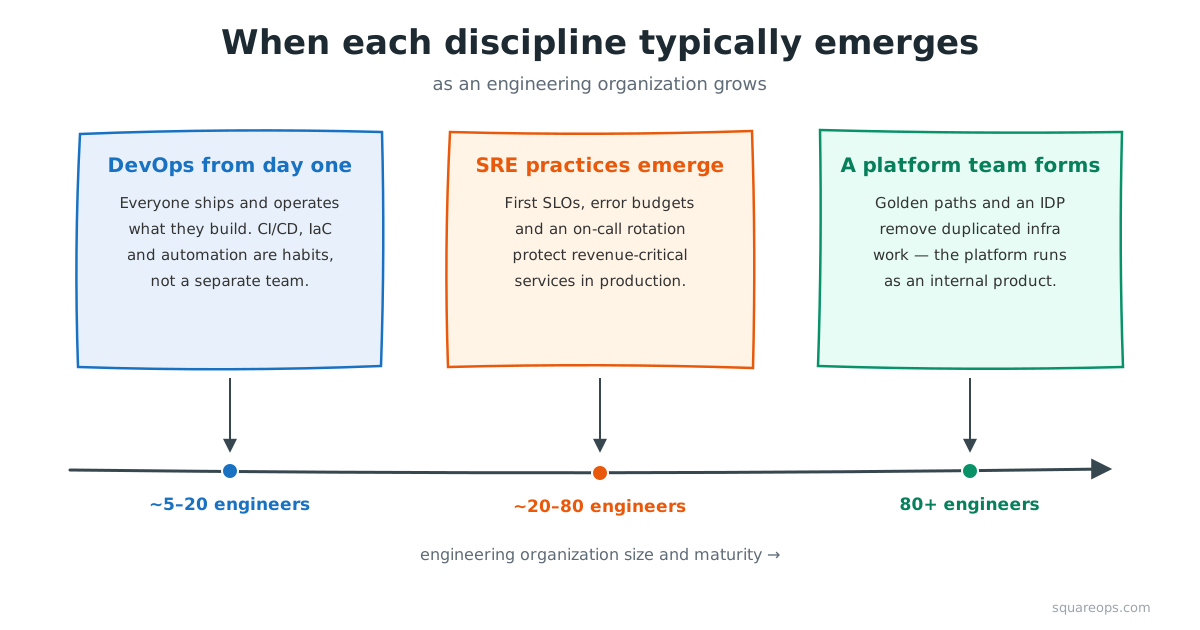
- Under ~20 engineers: DevOps practices only. Everyone ships and operates their own work; CI/CD and infrastructure as code are habits, not a team. A dedicated platform team at this size is premature abstraction — you would be building a product for five users.
- ~20–80 engineers: formalize SRE for what makes money. Define SLOs and error budgets for revenue-critical services, stand up a real on-call rotation, and run blameless postmortems. This can be two engineers with a reliability mandate — or a managed SRE partner — long before it is a department.
- ~80–300 engineers: fund a platform team. This is the range where duplicated infrastructure work visibly outgrows the fully-loaded cost of a small dedicated team, and where golden paths stop being a nice-to-have and start being how you keep 15 squads consistent, secure and fast.
- 300+ engineers: platform as a product organization. The platform gets a product manager, a roadmap and internal SLAs of its own; SRE typically splits into a central function plus embedded reliability engineers; DevOps remains the cultural baseline every team is measured against.
The verdict: adopt DevOps culture at any size, add SRE discipline when downtime has a revenue number attached, and create a platform team when the cost of duplicated infrastructure work exceeds the cost of a team dedicated to removing it. If you are unsure which side of those thresholds you are on, an outside-in DevOps maturity assessment answers it faster than an internal debate.
Not sure which threshold you have crossed?
SquareOps runs structured DevOps maturity assessments that benchmark your delivery, reliability and platform gaps — and sequence what to fix first.
Team structure and job titles: who owns what
Job titles blur these lines daily, so it helps to map titles to the discipline actually being practiced. A "DevOps engineer" is usually an infrastructure and automation engineer enabling delivery — the title is industry shorthand, even though DevOps itself is not a role. A "site reliability engineer" owns SLOs, incident response and the engineering work that reduces toil. A "platform engineer" builds and operates the IDP, and increasingly sits alongside a platform product manager whose job is to make sure the platform solves problems developers actually have.
Structurally, three rules of thumb hold up well in practice:
- Platform teams stay small and product-shaped. A single-digit percentage of engineering headcount, treating everyone else as customers — adoption is earned, not mandated.
- SRE authority comes from the error budget, not the org chart. If SREs can be overruled on reliability every time a launch date looms, you have an ops team with a new title.
- Nobody "owns DevOps." The moment one team does, every other team stops. DevOps health is measured in the DORA metrics of the product teams themselves, with delivery hygiene like secure CI/CD practices built into every team's path to production rather than policed after the fact.
Get all three disciplines working as one system
Talk to the team that builds platforms, runs 24x7 SRE and automates delivery for engineering organizations from 20 to 500+ engineers.