
DexKor
SaaSHow SquareOps Took DexKor From Zero Infrastructure to Production on AWS EKS in One Week
How SquareOps took DexKor, a SaaS team of under ten with no DevOps hire, from zero infrastructure to production on AWS EKS in one week.
A catalog that shows what is in your cluster is not a platform. Atmosly provisions the cluster, ships the code into it, and keeps it running — on one control plane, with one audit trail and one permissions model.
Spin up fresh or import the EKS, GKE and AKS clusters you already have; Atmosly manages both the same way. Every request runs through the guardrail flow you design, so nothing risky ships unreviewed.
Create EKS, GKE or AKS clusters from a catalog, or import any cluster — public or private, on-prem or bare-metal — and manage it the same way.
Node pools, ingress, cert-manager, observability and secrets add-ons, version-pinned and installed through your guardrails.
Databases, caches, queues and buckets provisioned next to the cluster from the same catalog, scoped to the environment.
Cost caps, region and instance allow-lists and security baselines. Auto-approve under threshold, escalate above, revert in one click.
Build pipelines in a visual editor or commit them as YAML — same engine. GitOps-native with drift detection, multi-stage promotion, approval gates, post-deploy hooks and one-click rollback.
Point Atmosly at a service that is already running. It reads it, packages it as a deployable blueprint and wires a full pipeline around it. No Jenkinsfile rewrite.
Drag-and-drop or YAML. Native GitOps with drift detection and sync controls, multi-stage promotion, approval gates, full audit trail.
Roll back to any prior release with the audit trail intact. Post-deploy hooks and synthetic checks catch regressions before users do.
Run your entire CI/CD on Atmosly, or keep ArgoCD, GitHub Actions or Jenkins and let Atmosly handle CD and post-deploy. Your choice.
Everything a developer needs to ship is behind a catalog with your policies pre-applied — environments, charts, cloned stacks and the services already running.
Every PR gets its own governed environment: seed data, RBAC, network policies and resource defaults inherited from prod. Auto-expires on merge.
Duplicate a complete environment — services, config, databases — for a new tenant, region or load test, without re-wiring anything.
Signed, vetted charts — Postgres, Redis, Kafka, monitoring, ingress — with your security policies and resource defaults pre-applied.
Every service with its owner, pipeline, environments and current health — read from what is running, not maintained by hand.
Atmosly provisions the infrastructure and runs the pipelines, so it already knows your estate. One read-only view shows every cluster and environment, which cloud account each one sits in, and what is deployed where.
Atmosly shows you what is running and what has drifted. It does not tell you why something broke, and it does not fix it. Incidents and root cause are in Alert6, security is in Verity, and cost is in SpendZero.
Connect once. The same clusters and accounts light up in Verity, SpendZero and Alert6 — each built for the team that owns that problem.
Attack paths, risk-ranked fixes and continuous compliance evidence for clusters and cloud accounts.
Explore VerityWaste detection, namespace-level cost visibility and one-click savings across clusters and cloud accounts.
Explore SpendZeroAlert correlation, AI investigation and controlled remediation across your whole stack, with on-call and RCA.
Explore Alert6"We kept telling ourselves we'd hire a DevOps person next quarter. Two years in, we never did. We ship around 30 times a day across all our tenants and nobody's sitting there babysitting a pipeline."
"We finally retired the dozen one-off CI pipelines we'd hand-built per service — now every team ships on the same standard pipeline themselves, without waiting on DevOps. That was an afternoon, not a migration."
Real engagements delivered by SquareOps.
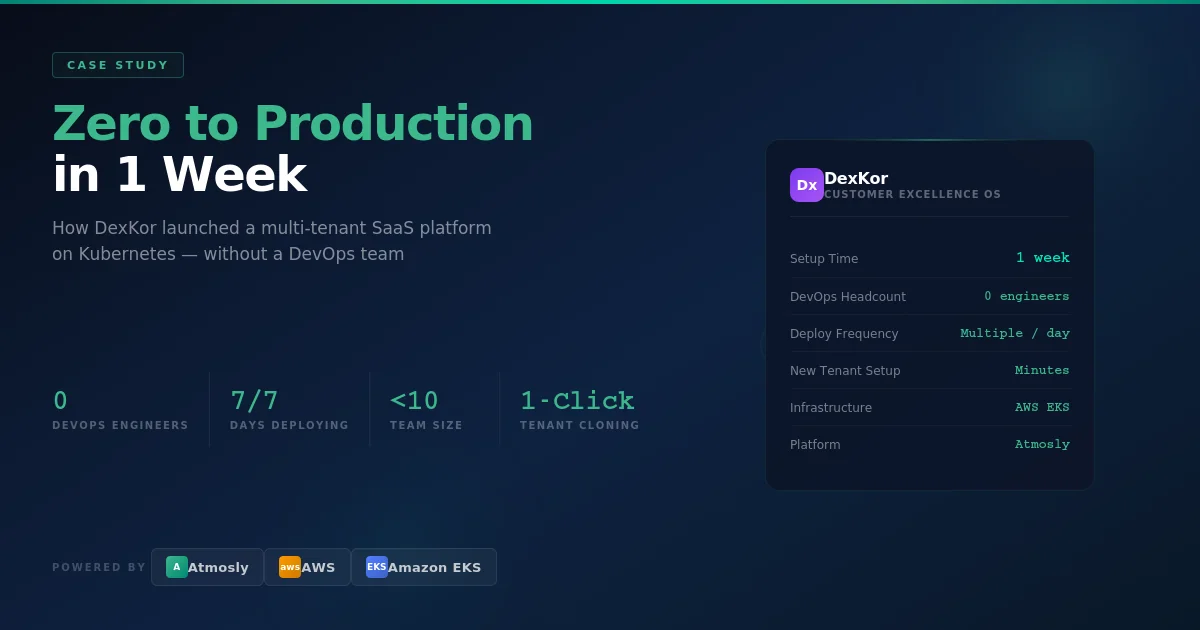
How SquareOps took DexKor, a SaaS team of under ten with no DevOps hire, from zero infrastructure to production on AWS EKS in one week.
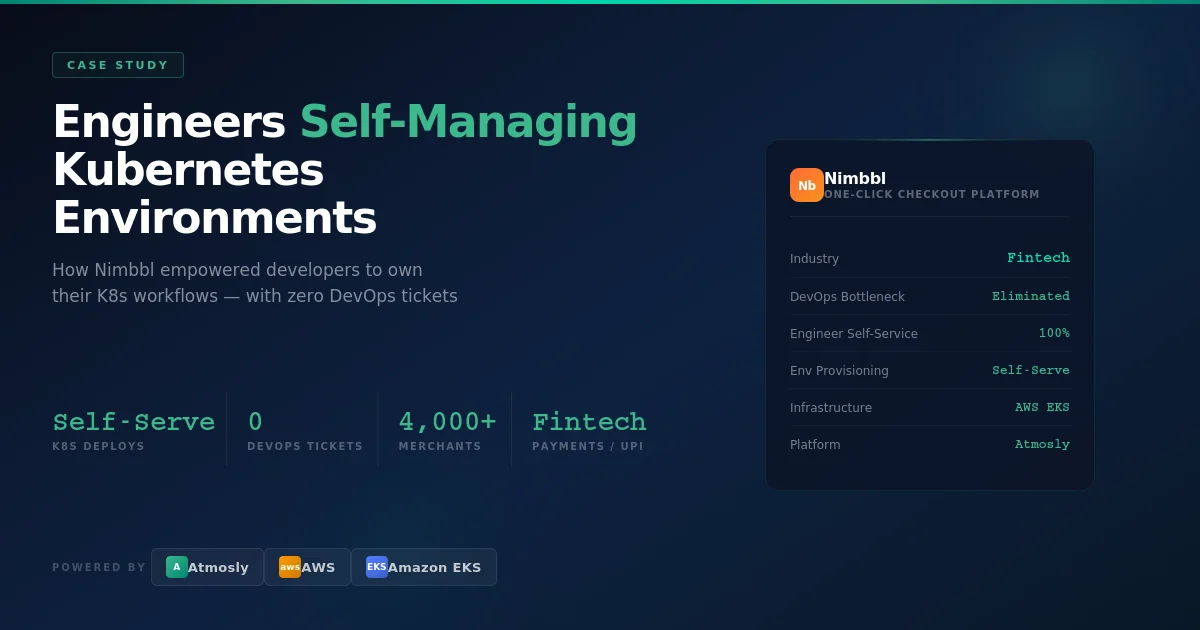
How SquareOps helped Nimbbl's 40-person engineering team self-manage non-prod Kubernetes environments on AWS EKS, with standard pipelines.

How SquareOps moved 32nd Avenue's valet parking, restaurant and ERP workloads to AWS EKS with Karpenter autoscaling and CI/CD for faster, safer releas…
Not covered? An engineer replies within one business day.
consult@squareops.comMost customers are in exactly that spot. Automation runs the pipeline; Atmosly answers different questions — how to onboard service #21 without copy-pasting the last twenty, how a developer gets an environment without a ticket, how a rollback happens without a war room. It sits alongside your automation, not in place of it.
Those tools stay. The gap is the integration between them, which is custom-built and brittle. Atmosly is the connective layer: provisioning, pipeline, environments and a view of what is running in one UI with one audit trail and one permissions model.
Into their own products. Kubernetes and cloud security — CIS benchmarks, attack paths, compliance evidence — is Verity. Kubernetes and cloud cost — rightsizing, showback, idle detection — is SpendZero. Incident management and SRE — alert correlation, AI investigation, root cause, controlled remediation, on-call — is Alert6. Atmosly shows what is running and what has drifted; it does not detect, diagnose or fix incidents. Connect a cluster once and it is available to all of them.
You don't switch. Import one cluster, pick one workload, see value in a day. If it doesn't earn its place in two weeks you walk away with no migration to undo.
Read-only by default; agent-based or API-based, your choice. Atmosly reads events, metadata and configuration only — customer data never leaves the cluster. ISO 27001 certified. Enterprise can self-host the control plane.
No — that is the point. DexKor runs multiple clusters with zero platform engineers. Atmosly is the platform team's work, as software.
EKS, GKE, AKS and any conformant Kubernetes cluster, including on-prem and bare-metal, managed in one pane of glass.
Read-only import, 30-day trial of Growth, no credit card. If it doesn't earn its place in two weeks, there is no migration to undo.
Connect a cluster free