Introduction
DevOps can look overwhelming from the outside. Job posts list Kubernetes, Terraform, CI/CD, three clouds, observability stacks and now AI agents, all in one role. Most beginners stall because they don't know where to start or in what order to learn.
The good news: DevOps is learnable in stages, and every stage builds on the last. You don't need to master everything before you're useful. You need solid foundations, a few core tools and real projects that prove you can ship software reliably.
The field is also changing fast. Google's 2025 DORA report found that 90% of technology professionals now use AI at work and 90% of organisations run at least one internal platform. Beginners who learn the fundamentals and these new practices stand out.
This guide gives you a practical 2026 roadmap: what DevOps really is, the skills to learn in order, the tools that matter, hands-on projects, certifications, common mistakes and answers to the questions beginners ask most.
What DevOps is (and what it isn't)
DevOps is a set of cultural practices and tools that brings software development and IT operations together, so teams can deliver changes quickly, safely and often. It is not a single tool, a job title you can buy, or a team that sits between developers and operations. For a fuller definition, see our explainer on what DevOps is.
A helpful way to remember its pillars is the CALMS model:
- Culture: shared ownership of outcomes, blameless post-incident reviews and trust between teams.
- Automation: builds, tests, infrastructure and deployments run as code, not by hand.
- Lean: small batches, short feedback loops and less waste.
- Measurement: decisions based on data, not opinion.
- Sharing: knowledge, tools and responsibilities spread across the team.
How DevOps success is measured
The industry standard is the set of DORA metrics:
| Metric | What it tells you |
|---|---|
| Deployment frequency | How often you ship to production |
| Lead time for changes | How long a commit takes to reach production |
| Change failure rate | How often a deployment causes a problem |
| Failed deployment recovery time | How quickly you recover when it does |
Keep these four in mind as you learn. Every tool in this guide exists to improve at least one of them.
The DevOps learning roadmap, step by step
Learn in this order. Each stage takes roughly four to eight weeks of steady practice, so a motivated beginner can be job-ready in about 9 to 12 months.

Stage 1: Linux, networking and the command line
Almost every server, container and pipeline runs on Linux. Learn file permissions, processes, systemd, package managers, SSH and Bash scripting. Add networking basics: IP addressing, DNS, HTTP and HTTPS, ports, load balancers and firewalls. The free Linux Foundation intro course is a solid start.
Stage 2: Git and a scripting language
Git is the source of truth for everything in DevOps, including infrastructure and configuration. Practise branching, merging, rebasing and pull requests. Then learn one language well: Python for automation, or Go if you want to work close to cloud-native tooling.
Stage 3: CI/CD
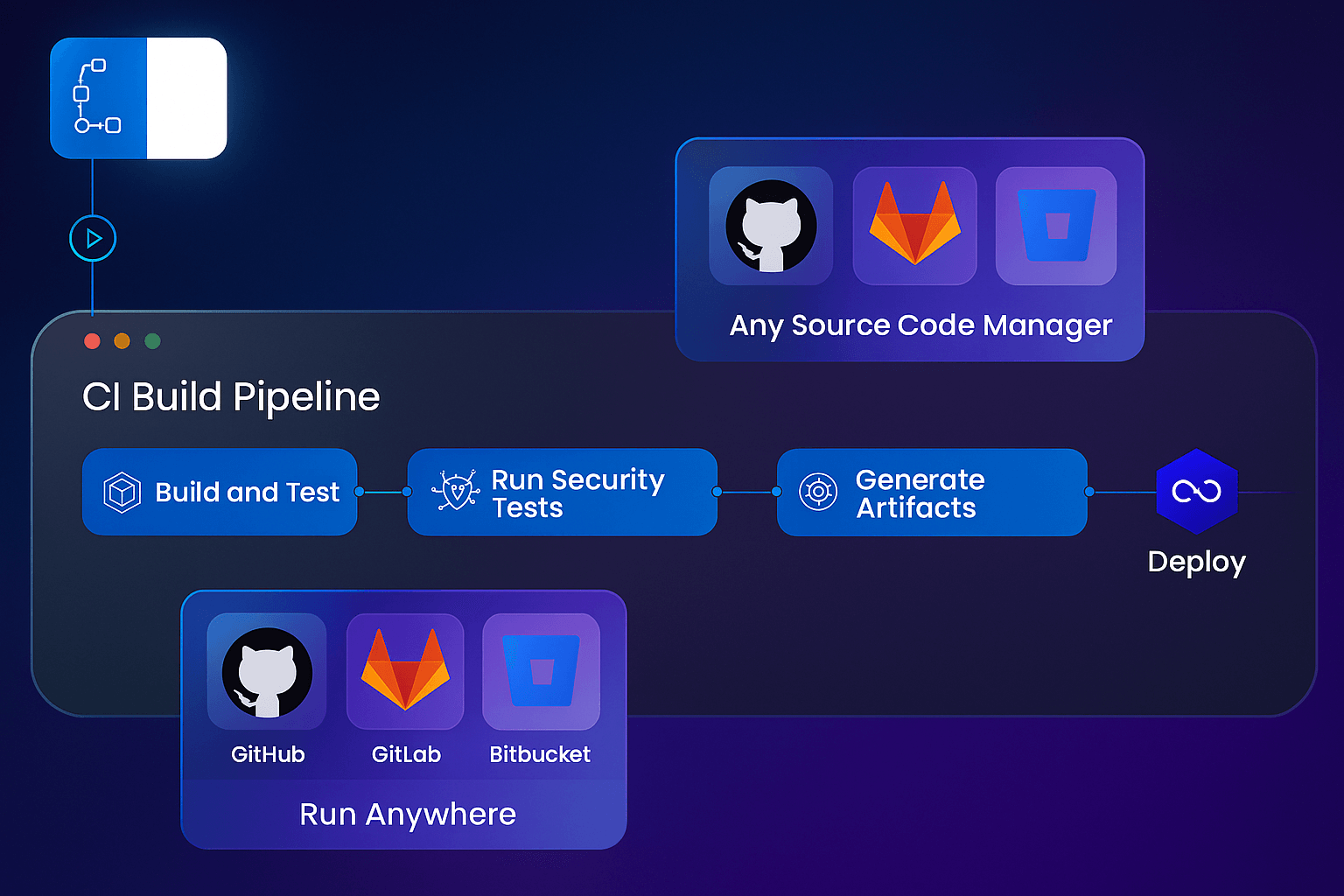
Continuous integration and delivery automate building, testing and releasing code. Start with GitHub Actions or GitLab CI/CD, because both are free and widely used. Build a pipeline that runs tests on every pull request and deploys on every merge. Our CI/CD consulting page shows how teams use these pipelines in production, and our guide to release automation with GitLab pipelines walks through a complete real-world example.
Stage 4: Containers
Learn Docker: images, Dockerfiles, multi-stage builds, volumes and Compose. Understand why containers make "it works on my machine" disappear. Then learn image hygiene: small base images, non-root users and vulnerability scanning.
Stage 5: A cloud platform
Pick one provider, usually AWS because it has the largest market share, and learn IAM, networking (VPCs and subnets), compute, storage, managed databases and billing. Go deep on one cloud before touching a second.
Stage 6: Infrastructure as Code
Define infrastructure in code so it is repeatable and reviewable. Terraform remains the most requested skill, and OpenTofu is its open-source, community-driven fork. Learn modules, state, workspaces and plan-and-apply workflows.
Stage 7: Kubernetes
Kubernetes is the standard platform for running containers at scale. The current release is v1.37, shipped in August 2026. Learn Pods, Deployments, Services, ConfigMaps, Secrets, Ingress or the Gateway API, and Helm charts. Practise locally with kind or minikube before using a managed service; our managed Kubernetes page explains what changes in production.
Stage 8: Observability and security
Learn the three signals: metrics, logs and traces. Start with Prometheus and Grafana, then instrument an app with OpenTelemetry. In parallel, learn DevSecOps basics: secret management, dependency scanning, image scanning and least-privilege access.
Core DevOps tools to learn in 2026
You don't need every tool. Learn one from each category well; the concepts transfer.
| Category | Start with | Also worth knowing |
|---|---|---|
| Version control | Git, GitHub or GitLab | Bitbucket |
| CI/CD | GitHub Actions | GitLab CI/CD, Jenkins |
| Containers | Docker | Podman, Buildpacks |
| Orchestration | Kubernetes (kind, minikube, EKS) | Amazon ECS, Nomad |
| Infrastructure as Code | Terraform | OpenTofu, Pulumi, AWS CDK |
| Configuration | Ansible | Helm, Kustomize |
| GitOps delivery | Argo CD | Flux |
| Observability | Prometheus, Grafana | OpenTelemetry, Loki, Datadog |
| Security | Trivy, Gitleaks | Snyk, OPA, Sigstore |
| Cloud | AWS | Azure, Google Cloud |
If you want a visual map of where each fits, the community-maintained roadmap.sh DevOps roadmap is an excellent companion to this guide.
DevOps trends beginners should know in 2026
The fundamentals above don't change quickly, but the way teams apply them does. These trends shape what employers ask for today.
Platform engineering and golden paths
Instead of every developer wiring their own pipelines, platform teams build an internal developer platform (IDP) with self-service templates, often using Backstage. DORA's 2025 research found 90% of organisations now have at least one internal platform. Learn the idea of a "golden path" from our guide to golden paths in platform engineering, and see how teams roll this out through platform engineering services.
AI-assisted DevOps
AI coding assistants and agents now draft pipelines, explain failed builds, write Terraform and triage incidents. DORA's key finding is that AI acts as an amplifier: it makes strong teams faster and exposes weak practices in struggling ones. For beginners, AI is a powerful tutor, but you still need to understand and review what it produces. Tools that connect agents to your systems through the Model Context Protocol (MCP) are becoming common in DevOps workflows.
DevSecOps and software supply chain security
Security now "shifts left" into every pipeline: secret detection, dependency scanning, signed images and software bills of materials (SBOMs). Frameworks such as SLSA and the OWASP Top 10 CI/CD Security Risks are worth reading early.
GitOps
With GitOps, Git holds the desired state of your environments and a controller such as Argo CD keeps clusters in sync. Rollbacks become a git revert.
FinOps and sustainability
Cloud bills are a board-level topic. Engineers who can rightsize workloads, use autoscaling and read a cost report are in demand. The FinOps Foundation offers free introductory material.
Hands-on projects to build your portfolio
Employers hire for proof, not course certificates. Build these five projects in order, publish them on GitHub with a clear README and architecture diagram, and write a short post about what you learned.

- Automated static website. Host a site on cloud object storage with a CDN, and deploy it from a CI pipeline on every push.
- Containerised web app with CI. Dockerise a small API and database, run tests and image scans in CI, and push the image to a registry.
- Infrastructure as Code. Provision a VPC, a small cluster or VM and a managed database with Terraform, with remote state and a plan in every pull request.
- Kubernetes with GitOps. Deploy your app to a Kubernetes cluster using Helm and Argo CD, with readiness probes, autoscaling and a one-command rollback.
- Observability and on-call drill. Add Prometheus, Grafana and OpenTelemetry tracing, define an SLO, create an alert, then break something on purpose and write a blameless post-incident review.
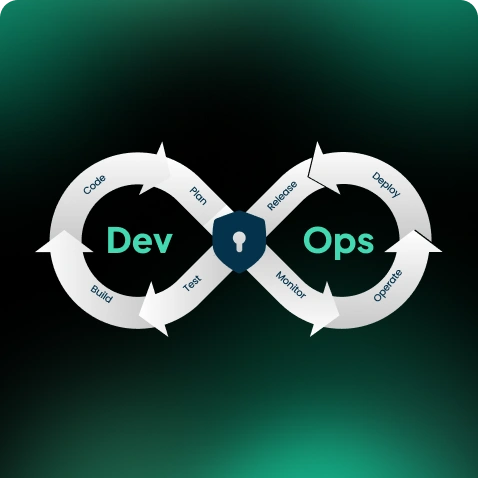
Together these show the full lifecycle: code, build, test, secure, deploy, observe and improve.
Certifications, career paths and common mistakes
Certifications worth considering
Certifications won't replace projects, but they help you pass resume filters and give your study a structure.
| Certification | Level | Good for |
|---|---|---|
| AWS Certified Cloud Practitioner | Entry | Cloud basics and vocabulary |
| HashiCorp Terraform Associate | Associate | Infrastructure as Code |
| Certified Kubernetes Administrator (CKA) | Intermediate | Hands-on Kubernetes operations |
| AWS Certified DevOps Engineer – Professional | Advanced | Senior AWS DevOps roles |
Where DevOps can take you
Most people enter through roles such as junior DevOps engineer, cloud support engineer or build and release engineer. From there, common paths are site reliability engineer (SRE), platform engineer, cloud architect, DevSecOps engineer and, increasingly, MLOps or AI infrastructure engineer. Developers and system administrators often move into DevOps fastest because they already own half the skills.
Common beginner mistakes
- Tool hopping. Learning ten tools shallowly instead of one per category deeply.
- Skipping fundamentals. Jumping to Kubernetes without Linux and networking makes every problem harder to debug.
- Tutorial loops. Watching courses without building and breaking things yourself.
- Ignoring security and cost. Public buckets, hard-coded secrets and forgotten resources are costly habits.
- Forgetting the culture. DevOps is about collaboration; communication and writing skills matter as much as YAML.
Conclusion
Your DevOps journey doesn't start with Kubernetes; it starts with Linux, Git and the habit of automating anything you do twice. Build the foundations, add one tool per category, prove your skills with real projects, and keep the DORA metrics in mind as the reason behind every choice.
The 2026 landscape rewards engineers who combine strong fundamentals with platform thinking, security awareness and smart use of AI. Start this week: set up a Linux VM, push your first repository and build your first pipeline.
Want to see how experienced teams put all of this into practice? Explore SquareOps DevOps services to see the platforms, pipelines and operations we build for startups and enterprises every day.