Almost nobody needs "Terraform consulting" in general. They need one of four quite different things — and the vendors who do them well are not the same vendors. Naming which one you actually need is the fastest way to cut a long shortlist down to a short one.
This guide separates those four jobs, profiles the consulting firms and automation platforms that serve each, and covers the question every Terraform buyer now has to answer in 2026: whether to stay on Terraform or move to OpenTofu.
Four Jobs People Call "Terraform Consulting"
Vendors will quote for all four regardless of which one you have. It is worth being precise before the first call.
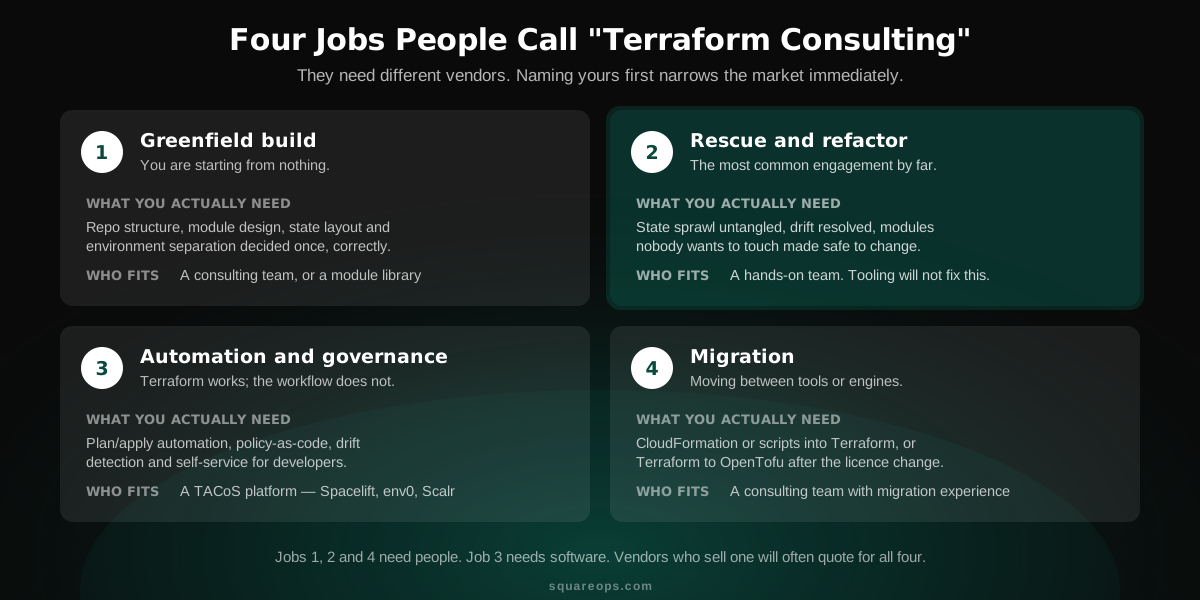
The distinction that matters commercially: jobs 1, 2 and 4 need people. Job 3 needs software. Buying a Terraform automation platform when what you actually have is three years of module debt and a state file nobody understands will not help. The platform will faithfully automate a broken workflow.
In our experience the second job — rescue and refactor — is by a wide margin the most common. Teams rarely go looking for Terraform help while things are going well.
Terraform Consulting Firms
These are teams that write and fix Terraform with you.
Gruntwork
Best for: Teams that want a battle-tested module library rather than bespoke code
Gruntwork's model centres on reusable infrastructure code plus supporting services, and the company was one of the founding backers of the OpenTofu fork alongside Spacelift, env0, Harness and Scalr. For teams who would rather adopt proven module patterns than commission their own, this is a genuinely different proposition from hourly consulting.
Consider carefully if: your environment is already built and unconventional. Library-led approaches work best when you can adopt the opinions that come with them.
InfraCloud Technologies
Best for: Cloud-native infrastructure engineering alongside Kubernetes work
InfraCloud brings deep cloud-native credentials — CNCF-certified consultants and contributions to more than 50 open source projects — with Terraform sitting inside a broader infrastructure and Kubernetes practice rather than standing alone.
SquareOps Technologies
Best for: AWS-centric Terraform at scale, and rescue engagements
SquareOps is an AWS Advanced Tier Services Partner with the DevOps Competency and Service Delivery designations for Amazon EKS and Amazon RDS. Terraform is the delivery mechanism for everything we run, not a separate service line — it underpins our DevOps consulting services, managed Kubernetes and cloud-native architecture work alike.
The verifiable part matters more than the claim: our Terraform modules are published publicly on GitHub — including squareops/terraform-aws-vpc and a full EKS reference architecture — so you can read the code before you talk to anyone. Most firms in this category have no public code at all.
Our own view of what good looks like is set out in Terraform best practices at scale and state management for teams and CI/CD. If those match how you want your infrastructure run, we are probably a fit. If they do not, that is useful to know before a call rather than after.
Consider carefully if: your estate is primarily Azure or on-premises VMware. Our depth is on AWS, and a generalist with stronger Azure coverage may serve you better.
Global system integrators
TCS, Infosys, Wipro and Accenture all run large IaC practices. Appropriate for multi-year enterprise programmes; generally oversized for a module refactor.
Terraform Automation Platforms (TACoS)
If your job is number three — the workflow rather than the code — you are shopping for software, not consultants. These platforms handle plan/apply orchestration, policy enforcement, drift detection and developer self-service.
| Platform | Strongest for | Pricing model |
|---|---|---|
| Spacelift | Multi-IaC orchestration across Terraform, OpenTofu, Terragrunt, Pulumi and CloudFormation. OPA policy, Blueprints for self-service. | Concurrency-based — you pay for parallel run slots |
| env0 | Multi-IaC with advanced RBAC, secrets management and policy. Founded by an original OpenTofu initiative member. | Three packages as of August 2026 — Cloud Compass at $1,500/month covering up to 100 active environments, then Cloud Navigator and Cloud Pilot on custom quotes priced per successful apply or per environment |
| Scalr | Terraform and OpenTofu only — a drop-in replacement for HCP Terraform's remote backend model | Per-run |
| HCP Terraform | First-party option, deepest Terraform integration, and the only one with Stacks | Per-resource |
| Atlantis | Open source, zero licence cost, pull-request-driven workflow | Free — you absorb the maintenance. No drift detection. |
One practical warning worth repeating: concurrency-based pricing caps how many runs you can execute in parallel. That model tends to bite hardest during an incident, when you are pushing fixes across many workspaces at once and the slot limit throttles recovery. Model your worst day, not your average one.
The OpenTofu Question
Any consultant you engage in 2026 should have a clear, reasoned position on this. If they do not, that tells you something.
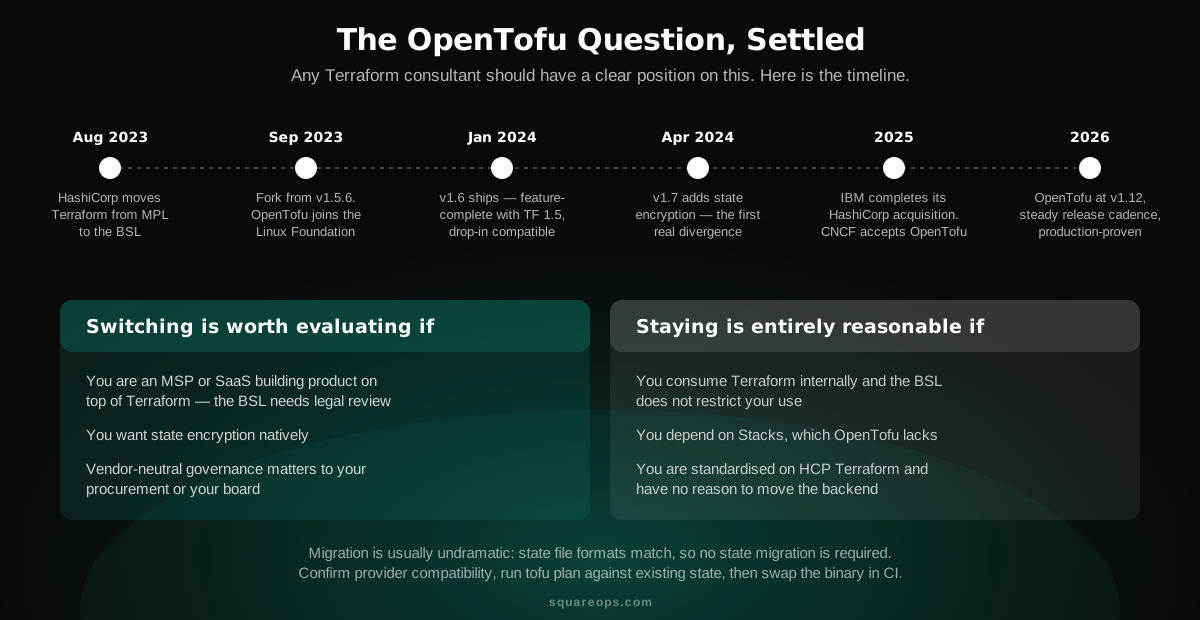
The short history: in August 2023 HashiCorp moved Terraform from the MPL v2.0 to the Business Source License. Within weeks a coalition including Gruntwork, Spacelift, env0, Harness and Scalr forked the last MPL release, and the project became OpenTofu under the Linux Foundation. Version 1.6 shipped in January 2024, feature-complete with Terraform 1.5 and drop-in compatible. Version 1.7 added native state encryption — the first meaningful divergence. IBM has since completed its acquisition of HashiCorp, making Terraform an IBM product, and the CNCF accepted OpenTofu in 2025. OpenTofu reached v1.12 in 2026 on a steady release cadence.
The licensing point that actually matters: if you consume Terraform internally, the BSL almost certainly does not restrict you. If you are a managed service provider or a SaaS company building product on top of Terraform, it warrants genuine legal review. That is the dividing line, and it is a business question rather than a technical one.
On the technical side the ecosystem has largely stopped forcing a choice. Spacelift, env0, Scalr and Harness support both engines. tflint, tfsec and checkov run against both. The Terraform Language Server treats .tf and .tofu files interchangeably. Modules from either registry work with either engine. Stacks is the one significant capability Terraform has that OpenTofu does not.
Migration itself is usually undramatic: the state file formats match, so no state migration is needed. Confirm your provider dependencies, run tofu plan against existing state, check for unexpected diffs, then swap the binary in CI. Our full assessment is in OpenTofu vs Terraform 2026.
How to Evaluate a Terraform Consultant
- Ask to see code. Public modules, a sanitised repository structure, anything real. Terraform quality is legible in a way most consulting output is not — read it before you buy.
- Ask how they structure state. There is no single right answer, but there are wrong ones. A consultant who cannot explain their reasoning on blast radius and environment separation has not thought about it.
- Ask what they would do about drift. Detection alone is table stakes. Ask what happens after detection — who reconciles it, and how.
- Ask their OpenTofu position and why. The reasoning matters more than the answer.
- Confirm the code lands in your repositories. Modules, pipeline config and policy definitions in your Git from day one, not delivered at the end.
- Ask what they will not do. A firm that claims equal depth across AWS, Azure, GCP, on-prem and edge is describing a sales territory, not a capability.
What It Costs
- Assessment — a time-boxed review producing a findings report and remediation plan. Useful when you do not yet know how deep the problem goes.
- Project-based refactor — fixed scope to restructure modules, consolidate state or build a greenfield foundation. Priced by estate size and current condition.
- Embedded or retained — ongoing capacity as part of a broader DevOps engagement. Usually the most economical route if Terraform work is continuous rather than a one-off.
- Platform licensing — a separate budget line from consulting, and worth modelling against your peak concurrency rather than typical usage.
Indian providers generally price materially below equivalent US firms for comparable scope, which is the main reason US and European teams engage them for this category of work.
Making the Decision
Name the job first. If it is a workflow problem, shortlist platforms and skip the consultants. If it is a code or state problem, shortlist teams and skip the platforms — no amount of orchestration fixes modules nobody can safely change.
Then read their code, ask about state, and ask what they will not take on.
If you are running Terraform on AWS and want a team whose infrastructure code you can inspect before committing, review our Terraform consulting services, browse our case studies, or talk to our Terraform team. We will assess your current modules and state layout and give you a candid view of what needs changing — including when the answer is a platform rather than a consulting engagement.
For related reading, see our reviews of managed DevOps and SRE companies in India and AWS managed service providers in India.