
DexKor
SaaSHow SquareOps Took DexKor From Zero Infrastructure to Production on AWS EKS in One Week
How SquareOps took DexKor, a SaaS team of under ten with no DevOps hire, from zero infrastructure to production on AWS EKS in one week.
An internal developer platform is the self-service layer between developers and infrastructure. The disappointment is that most stop at the catalog: they show the work without doing it.
Engineers provision an environment or ship a service on their own, without filing a ticket and waiting on the platform team.
A paved, repeatable way from code to production, so every team ships the same governed way instead of inventing its own.
Standards and policy encoded once and enforced automatically: autonomy for developers, control for the platform team.
Portal-first platforms catalog a stack you still build and run behind them. Atmosly is the stack, already working.
Prefer to keep your portal? Atmosly coexists: it powers the workflows while Backstage or Port stays the front door.
Not a portal pointing at these capabilities. The capabilities themselves, working out of the box.
Import any cluster, public, private or air-gapped, and let developers request clusters, node groups, databases and add-ons from curated blueprints. Every action is scoped, audited and reversible, so self-service never means a free-for-all.
Turn any running workload into a deployable blueprint, ship it through visual or GitOps pipelines, and clone a full environment for previews on demand. Developers get a paved road, never a blank page.
Standards are encoded once and enforced on every action: spend caps, region and instance allow-lists, approval flows, scoped RBAC and SSO. Every provision, deploy and rollback lands in one audit trail.
Each part of the Atmosly IDP is a product that does the work. Explore the capabilities behind provision, ship and govern.
Import any cluster, public, private or air-gapped, read-only in minutes.
ExploreDatabases, node groups and add-ons developers request from blueprints.
ExploreCurated, signed charts with your defaults pre-applied, deployed and tracked.
ExploreVisual and GitOps CI/CD from code to production, with one-click rollback.
ExploreTurn any running service into a deployable blueprint and CD pipeline.
ExploreIsolated preview environments cloned from production, on demand.
ExploreScheduled ops, spend caps and allow-lists, scoped and audited.
ExploreEvery service with owner, pipeline and environments, read from what is running.
ExploreBuilding a usable IDP in-house means staffing a platform team and waiting for golden paths, then maintaining it forever.
Real engagements delivered by SquareOps.
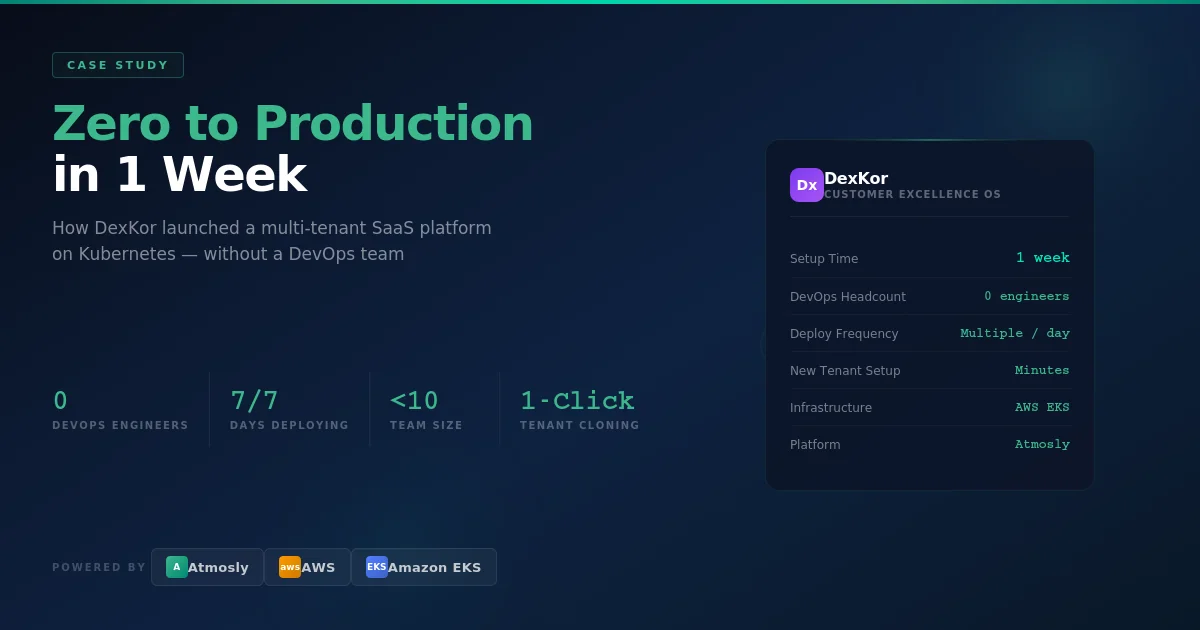
How SquareOps took DexKor, a SaaS team of under ten with no DevOps hire, from zero infrastructure to production on AWS EKS in one week.
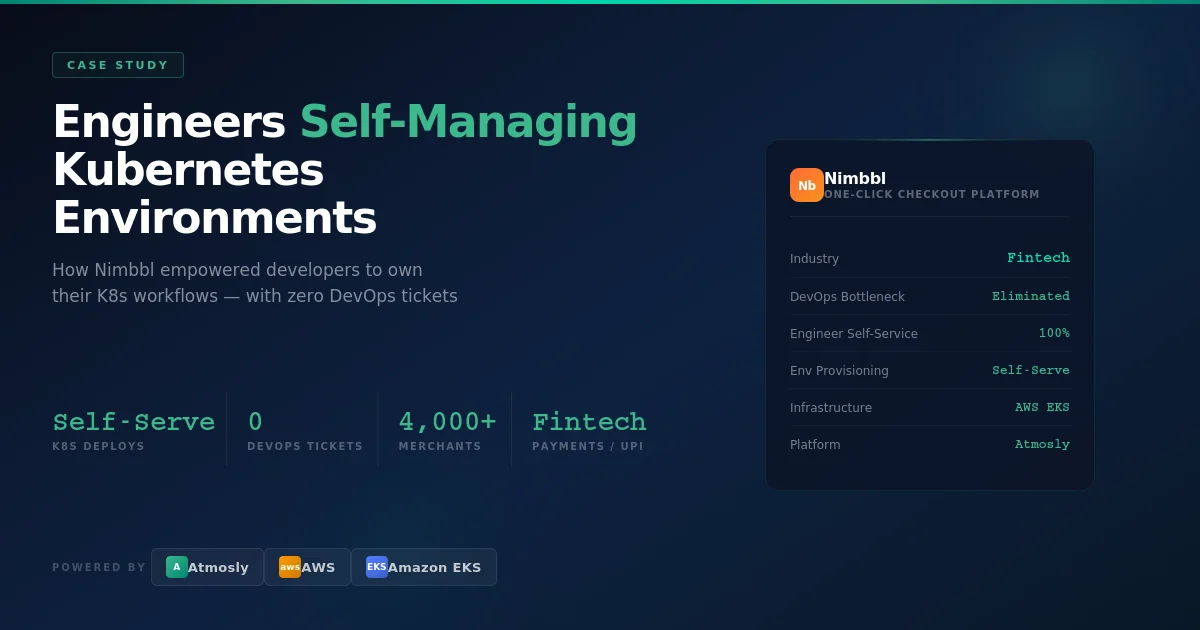
How SquareOps helped Nimbbl's 40-person engineering team self-manage non-prod Kubernetes environments on AWS EKS, with standard pipelines.


How SquareOps moved 32nd Avenue's valet parking, restaurant and ERP workloads to AWS EKS with Karpenter autoscaling and CI/CD for faster, safer releas…
Not covered? An engineer replies within one business day.
consult@squareops.comAn internal developer platform is the self-service layer between developers and infrastructure. It gives engineers golden paths to provision environments and ship code on their own, while the platform team encodes standards and guardrails centrally. The goal is developer autonomy without every request becoming a ticket.
A portal IDP, such as Backstage, Port or Cortex, is a catalog and dashboard that sits on top of other tools and visualizes them. An execution IDP like Atmosly does the work itself: it provisions infrastructure and ships code directly, so the platform is the thing operating, not a front door to a stack you still assemble.
Yes, for teams that want the platform to run things rather than catalog them. Atmosly ships with the execution layer already working: provisioning, guardrails, CI/CD and environment cloning. It can also coexist, powering the workflows while a portal stays the front door.
Building in-house typically means a dedicated platform team and roughly a year before developers see golden paths, then a permanent cost center. Buying gives you the same self-service and governance in days, on the clusters you already run.
No. Atmosly delivers the provisioning and delivery a platform team would build, as software you set up yourself. Larger teams use it to scale a small platform team across many clusters instead of growing headcount.
It doesn't require ripping anything out. Atmosly runs on standard Kubernetes, GitOps and Helm, and reads a running workload to turn it into a deployable blueprint. You adopt it workload by workload.
A PaaS like Heroku or Cloud Run abstracts the infrastructure away entirely. An internal developer platform keeps you on your own Kubernetes and cloud, adding self-service and golden paths on top, so you keep portability and governance.
At minimum: self-service provisioning, a paved code-to-production path, and centralized guardrails. Atmosly adds cluster and cloud-resource provisioning, CI/CD, environment cloning, RBAC and one audit trail under one control plane.
Into their own SquareOps products. Incident response and AI SRE is Alert6, Kubernetes and cloud security is Verity, and cost optimization is SpendZero. Connect a cluster once and it is available to all of them.