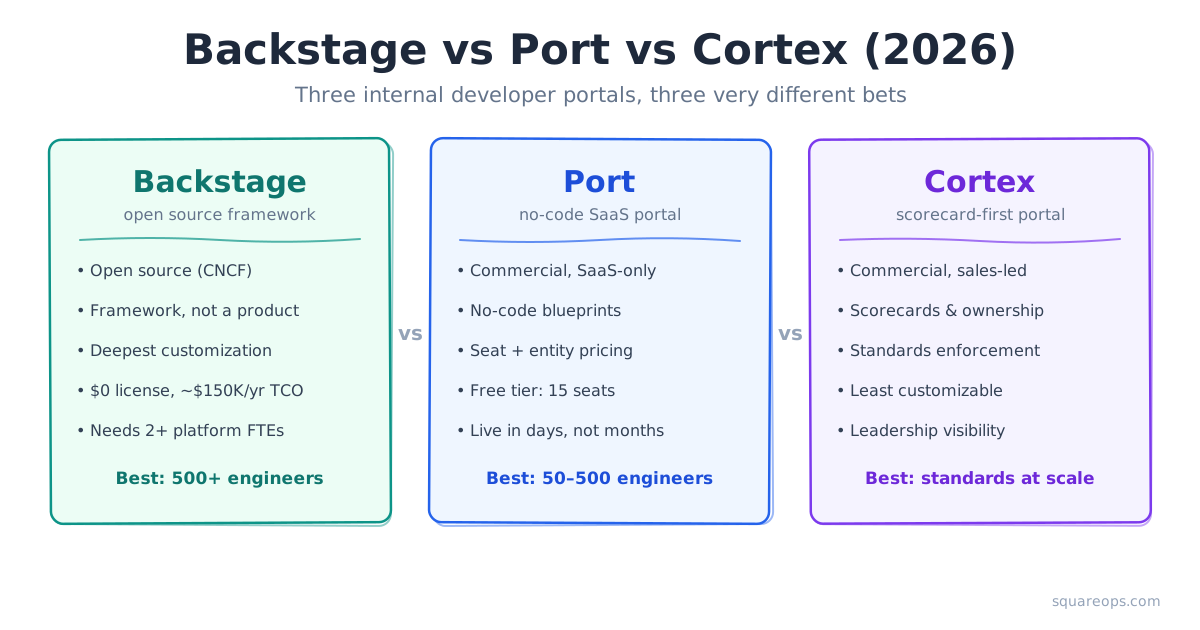
Short answer: choose Backstage if you have 500+ engineers, deep customization or data-residency requirements, and at least two full-time platform engineers to sustain it. Choose Port if you want a portal live in days on a SaaS, seat-based model — the fastest route for most 50–500 developer teams. Choose Cortex if scorecards, service ownership and standards enforcement matter more to you than customization. The rest of this comparison shows the working: pricing, real total cost of ownership, and a verdict by org size.
TL;DR: Backstage, Port and Cortex are the three internal developer portals on almost every 2026 shortlist, and they make three different bets. Backstage is an open source framework (CNCF incubating) that is free to license and expensive to run — a widely cited industry estimate puts its true cost of ownership near $150K per year for a roughly 20-developer organisation. Port is a SaaS-only, no-code portal priced per seat plus entities, with a free tier covering 15 users. Cortex is scorecard-first: the strongest of the three at standards and ownership, and the least customizable. Org size decides most of the rest.
In this comparison:
- Backstage vs Port vs Cortex at a glance
- What is the real difference between Backstage, Port and Cortex?
- Backstage in depth
- Port in depth
- Cortex in depth
- How much do they actually cost?
- The verdict by org size
- What if you don’t need a portal at all?
- Implementation reality
Choosing a portal is step one of a platform build, not the whole project. If you would rather have a team that has run this evaluation before, our platform engineering services cover discovery, tool selection and the golden paths underneath — book a consultation.
Backstage vs Port vs Cortex at a Glance
| Dimension | Backstage | Port | Cortex |
|---|---|---|---|
| What it is | Open source portal framework created by Spotify, CNCF incubating | Commercial no-code portal, SaaS | Commercial scorecard-first portal |
| License & hosting | Free license, self-hosted — you run and upgrade it | SaaS-only; dedicated tenancy for enterprise | SaaS, sales-led |
| Pricing model | $0 license; you pay in engineering time | Per seat + entity allowances; free tier (15 seats) | Custom quote, no public pricing |
| Customization | Deepest — a full plugin framework | High — no-code blueprint data model | Lowest of the three — opinionated by design |
| Time to first value | Months | Days to weeks | Weeks |
| Scorecards & standards | Via plugins, manual effort | Built in, flexible | Core strength — the product’s centre of gravity |
| Best fit | 500+ engineers with a staffed platform team | 50–500 engineers who want speed | Leadership-driven standards programmes |
Every row in that table traces back to one architectural decision each vendor made early: Backstage chose to be a framework, Port chose to be a product, and Cortex chose to be an opinion. The rest of this article unpacks what each choice costs you and buys you.
What Is the Real Difference Between Backstage, Port and Cortex?
All three tools solve the same surface problem: engineering organisations lose track of what services exist, who owns them, how healthy they are and how a developer gets a new one. All three answer with a software catalog, self-service actions and a layer of documentation. The differences are structural, not cosmetic.
Backstage is a framework. The official docs describe it as “an open framework for building developer portals” — and the word building is doing real work in that sentence. You do not install Backstage and use it; you build your portal on top of it, staff its plugin surface, and own its upgrade cycle indefinitely.
Port is a product. It is a hosted, no-code portal where a blueprint-based data model lets you define any entity type and relationship without writing portal code. You trade away self-hosting and some deep customization for a working portal within days.
Cortex is an opinion. Its core belief is that a portal should drive engineering standards — scorecards, production-readiness checks, ownership accountability — rather than be a blank canvas. You adopt Cortex’s model; you do not rebuild it into your own.
One more thing the three have in common, and it matters for budgeting: a portal is the interface layer of a platform. It catalogs what exists and triggers actions that run somewhere else. The pipelines, provisioning and operations underneath are a separate build — a distinction we cover in depth in our guide to the top platform engineering and IDP companies in 2026.
Backstage: The Open Framework You Staff, Not Buy
Backstage was created at Spotify, open-sourced in 2020, and donated to the CNCF — it was accepted in September 2020 and has held incubating status since March 2022, with thousands of contributors across well over a thousand organisations. It is the category default: when a company says “we’re building an internal developer portal,” Backstage is usually the first name in the room.
Its strengths are real. The plugin architecture means Backstage can represent almost anything — services, data pipelines, ML models, mobile releases — and the catalog, TechDocs and Scaffolder templates are battle-tested at genuine scale. If you have strict data-residency requirements, self-hosting is a feature, not a burden. And no commercial portal matches its ceiling for customization.
The cost is where honesty matters. The license is $0, which makes Backstage read as the cheap option in a budget meeting. It is not. The vendor-neutral community internaldeveloperplatform.org estimates Backstage’s true cost of ownership at approximately $150,000 per year for around 20 developers once you count the platform engineers who deploy, extend and maintain it. The widely repeated field guidance — do not adopt Backstage without at least two full-time engineers committed to it — remains sound in 2026. Plugin upkeep, breaking changes and framework upgrades do not stop after launch.
Choose Backstage when you have 500+ engineers, a staffed platform team, an open source mandate, or compliance needs that rule out SaaS. Look elsewhere when you cannot commit those two engineers — an unstaffed Backstage rollout is the most common failure mode in this category, and it is why our Backstage consulting and implementation engagements start with an honest staffing assessment rather than a deployment.
Port: SaaS-Only, No-Code, Priced Per Seat
Port is the strongest “buy” option in the portal layer. Its blueprint data model lets you define entity types — services, environments, clusters, incidents, anything — and wire relationships between them without writing code, and its self-service actions are production-grade rather than a demo feature.
Two facts define the commercial shape. First, Port is SaaS-only: there is no standard self-hosted edition. Enterprise customers with data-residency or security requirements are offered dedicated tenancy and Private Link connectivity rather than an on-premises install. Second, pricing is seat-plus-entity: per the official pricing page, the free tier covers up to 15 seats, 10,000 entities and 500 automation runs; the Basic plan is $30 per seat per month (up to 50 seats); Standard is $40 per seat per month (up to 200 seats); Enterprise is custom. A “seat” is any authenticated user or service account, and entity and automation allowances scale by tier — worth modelling before you commit, because a large catalog consumes entities fast.
Choose Port when you want a working portal this month rather than next quarter, your team is 50–500 engineers, and nobody is volunteering to maintain portal plugins as a career. The free tier also makes it the lowest-risk evaluation in the category: 15 seats is enough for a genuine pilot. Look elsewhere when a hard self-hosting requirement or an open source mandate is on the table — Port simply does not offer that deployment model, and pretending otherwise wastes an evaluation cycle.
Cortex: Scorecard-First and the Most Opinionated
Cortex approaches the portal from the opposite direction. Where Backstage starts with a catalog and Port starts with a data model, Cortex starts with a question engineering leadership actually asks: are our services meeting the bar? Its scorecards grade services against standards — production readiness, security posture, operational maturity, migration progress — and its current positioning leans hard into that: standardize best practices and golden paths “for humans and agents,” so everything that ships meets your bar, with production-readiness checks before critical events.
The trade-off is deliberate: Cortex is the least customizable of the three. You adopt its model of scorecards, ownership and service maturity rather than building your own abstractions on top of it. For a leadership team that wants visibility and enforcement across hundreds of services, that opinionation is precisely the value — the tool arrives with a point of view instead of a blank canvas. For a platform team that wants to model unusual entities or build custom workflows, it will feel confining sooner than Port or Backstage will.
Pricing is sales-led: there is no public price list, and evaluation runs through a demo and a custom quote, typically on an annual contract. That is normal for enterprise software, but it does make Cortex the hardest of the three to budget for from the outside.
Choose Cortex when the driving force behind the portal is engineering standards — a migration you need to track to completion, an SRE maturity push, compliance evidence, or an executive who wants a dashboard of service health that is actually enforced. Look elsewhere when you need deep customization, a free evaluation path, or self-hosting.
How Much Do Backstage, Port and Cortex Actually Cost?
Run the numbers side by side and the “free” option inverts.
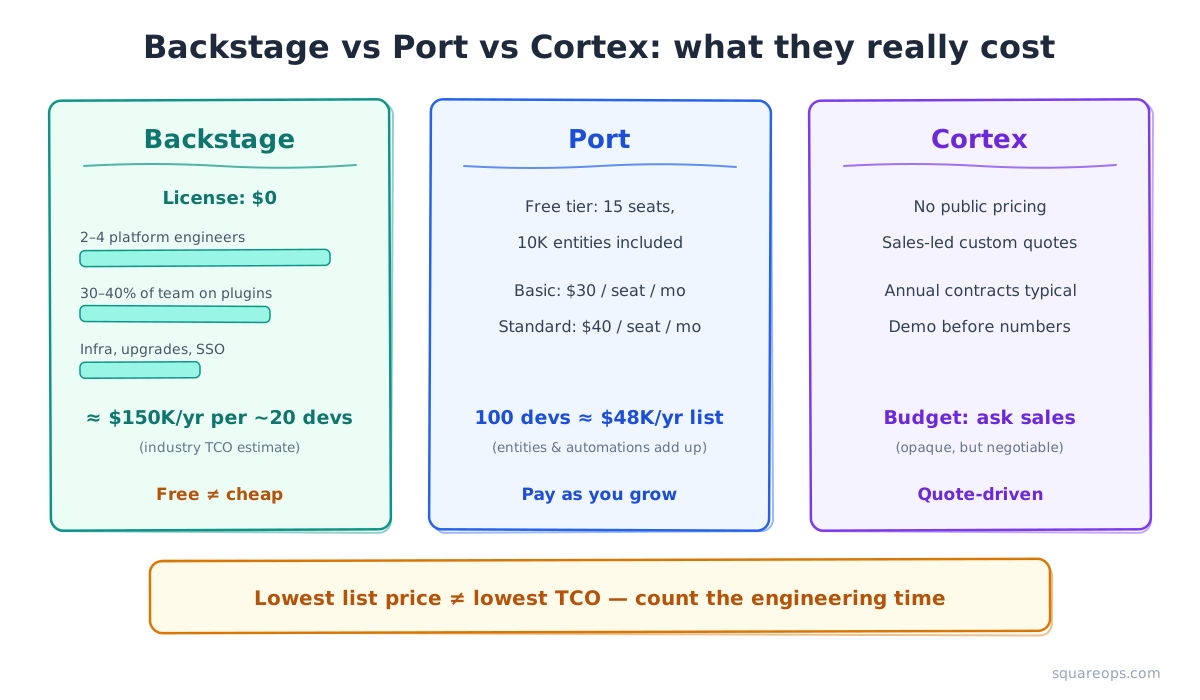
Backstage: $0 license, then engineering time. Using the internaldeveloperplatform.org estimate of roughly $150K per year per ~20 developers, a mid-size rollout costs more than most commercial portal contracts — and that spend recurs, because plugin maintenance and upgrades are ongoing, not one-off. The money also comes out of your scarcest budget: senior platform engineers who could otherwise be building golden paths, hardening DevOps delivery or improving reliability.
Port: list price is easy to model. A 100-engineer organisation on the Standard tier is 100 × $40 × 12 ≈ $48,000 per year before enterprise add-ons — with the caveat that entity counts and automation runs are metered per tier, so a sprawling catalog or heavy automation usage pushes you up-tier. The free tier (15 seats, 10K entities) is a genuine $0 pilot.
Cortex: unpriced publicly. Budget conversations start at a demo, and contracts are typically annual. If procurement predictability matters, get the quote early in the evaluation, not after the pilot.
The honest crossover: below roughly 200–300 developers, a SaaS portal is almost always cheaper than staffing Backstage properly — the two-FTE minimum alone outweighs the subscription. Past 500 developers, per-seat SaaS pricing grows linearly while Backstage’s engineering cost grows much more slowly, and the economics flip. In our own platform engagements, the teams that regret their choice are rarely the ones that picked the “wrong” portal — they are the ones that priced the license and forgot to price the people.
Which Internal Developer Portal Should You Choose by Org Size?
Startups (under 50 engineers): Port’s free tier, or nothing yet
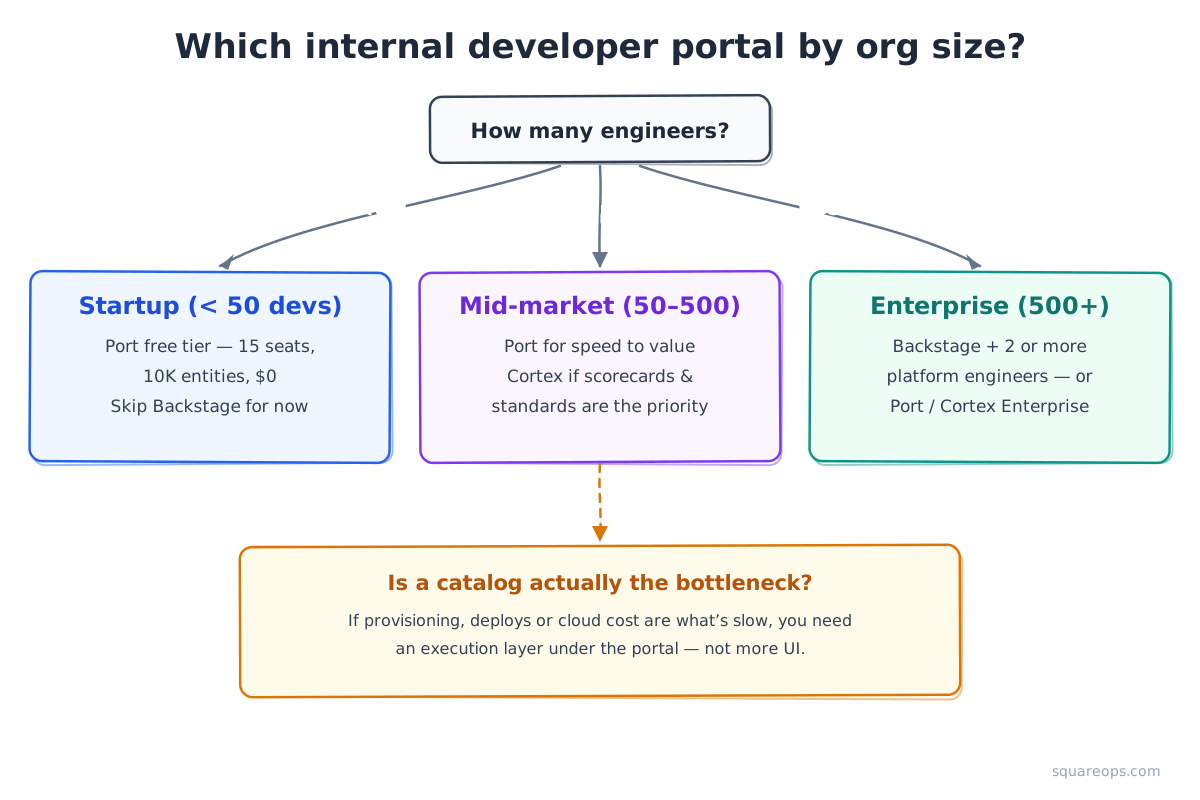
At this size a portal is rarely the constraint. If you want one, Port’s free tier — 15 seats, 10,000 entities — costs nothing and takes an afternoon. What you should not do is adopt Backstage: dedicating one of your ten engineers to portal maintenance is a luxury no startup budget survives. Most teams under 50 engineers get more from fixing provisioning, CI/CD and reliability directly than from cataloguing what little there is to catalog.
Mid-market (50–500 engineers): Port by default, Cortex if standards are the pain
This is Port’s home turf: enough services for a catalog to matter, not enough headcount to staff a framework. Time-to-value favours Port decisively. The exception is when the portal project is really a standards project in disguise — a production-readiness push, an audit, a migration that needs tracking to 100%. In that case Cortex’s scorecard-first model does the job with less configuration than replicating scorecards in Port, and far less than building them in Backstage.
Enterprise (500+ engineers): Backstage if you staff it, hybrid if you can’t
At enterprise scale the calculus reverses. Per-seat SaaS pricing across thousands of engineers becomes a serious line item, customization demands grow, and a dedicated platform team is usually already in place — Backstage’s natural habitat. The requirement stands: two or more full-time engineers, permanently. Enterprises that cannot commit that should look at Port’s Enterprise tier or Cortex rather than running Backstage under-staffed. A hybrid is also increasingly common and entirely reasonable: Backstage as the catalog and docs layer, Cortex for scorecards and operational maturity on top.
Unsure which side of these lines you fall on? We run vendor-neutral portal evaluations as part of our platform engineering services, and hands-on Backstage consulting and implementation when the framework route is the right one — talk to us.
What If You Don’t Need a Developer Portal at All?
Worth asking before any of the three: is a catalog actually your bottleneck? Portals index what exists and trigger actions that run elsewhere — if the slow part of your engineering org is provisioning environments, fragile deploys or opaque Kubernetes costs, a portal will document the problem, not fix it. That execution layer is where Atmosly (built by SquareOps) sits: Kubernetes provisioning, CI/CD, cost optimization and SRE automation, not a service-catalog replacement. To be plain about it: if a software catalog is what you need, Backstage, Port or Cortex is the better tool — Atmosly’s own Backstage comparison says exactly that. The two layers complement rather than compete.
Implementation Reality, Whichever Portal You Pick
The portal decision gets the attention; the layer underneath decides whether developers actually use it. A self-service action is only as good as the automation it triggers — which in practice means Terraform modules that are safe to run repeatedly (we compared the strongest partners in our Terraform consulting companies guide), pipelines worth templating via CI/CD consulting, and a GitOps implementation so the portal’s “deploy” button reconciles declaratively instead of shelling into clusters.
And once golden paths exist, someone has to operate what they produce. Ownership data in a catalog goes stale unless an on-call practice keeps it honest — the same reason our site reliability engineering team treats catalog accuracy as an operational metric, not a documentation chore. If your services run on managed Kubernetes, the operating model matters as much as the portal; our comparison of managed Kubernetes service providers covers that side of the build.
Picking a portal in the next quarter? We will tell you which of the three fits your org — including when the answer is “none yet.” SquareOps runs portal evaluations, Backstage builds and the platform layer underneath as one engagement. Book a free consultation or start with our platform engineering services.