Searching for "managed Kubernetes" returns two entirely different kinds of thing: software platforms you buy and operate yourself, and engineering teams who operate Kubernetes on your behalf. Both call themselves managed Kubernetes. They solve different problems, and choosing the wrong category is the most common and most expensive mistake in this evaluation.
This guide separates the two, profiles the leading providers and platforms in each, and gives you a scope checklist to hold any shortlist against. It is written for engineering leaders already running Kubernetes in production who have decided they need outside help.
Platforms and Providers Are Not the Same Category
A Kubernetes management platform is software. You license it, install it, configure it, and your engineers use it to manage clusters more effectively. Rafay, Spectro Cloud, Platform9 and Rancher sit here. The platform improves your team's leverage — it does not replace your team.
A managed Kubernetes service provider is an engineering team. You contract them, and they operate your clusters: upgrades, on-call, incident response, capacity, cost. The deliverable is an outcome under an SLA, not a licence key.
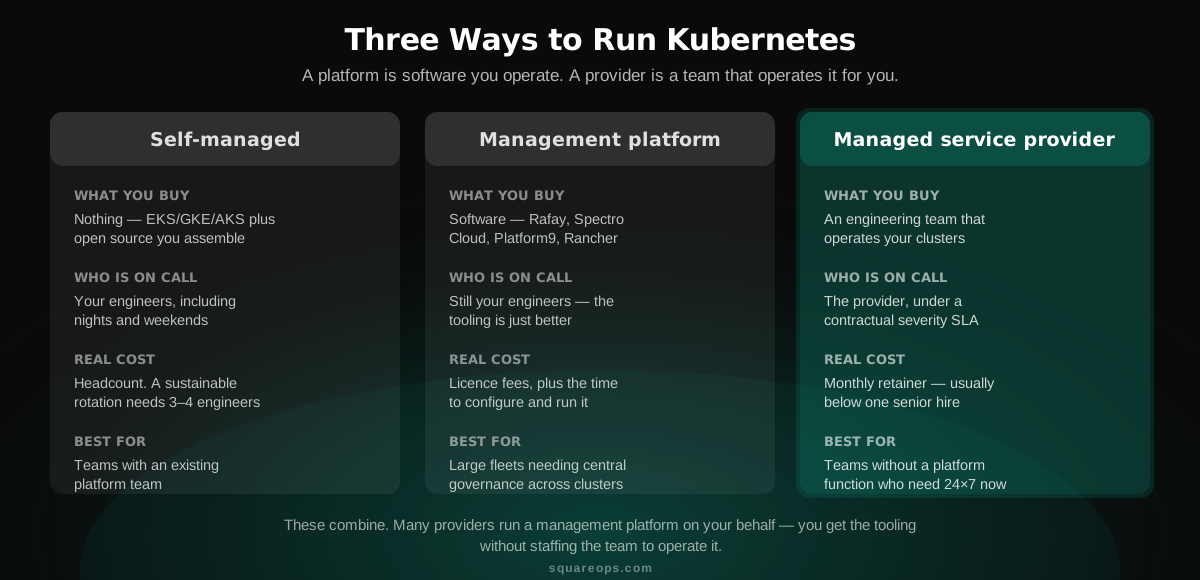
The distinction matters because the failure modes differ. Buy a platform when what you actually needed was a team, and you have added a licence cost and a new system to learn while your engineers still carry the pager. Buy a service when you already have a mature platform team, and you may be paying for capability you have in-house.
The two also combine. Many providers operate a management platform on your behalf, which is often the right answer for teams that want the tooling without staffing the function to run it.
Managed Kubernetes Providers at a Glance
| Provider | Best fit | Engagement model | Kubernetes-specific credential |
|---|---|---|---|
| SquareOps Technologies | Cloud-native SaaS and FinTech platforms running production EKS that need continuous operations plus a self-service layer | Ongoing managed operations with 24×7 SRE, delivered with cost management in the same contract | AWS Service Delivery designation for Amazon EKS; DevOps Competency; ISO 27001 certified |
| InfraCloud Technologies | Cloud-native engineering depth, policy and runtime security | Consulting and implementation led | CNCF-certified consultants; 50+ open source project contributions |
| OpsTree Global | Kubernetes adoption inside a broader platform engineering programme | Project and programme delivery | AWS Advanced Tier Services Partner |
| Global system integrators | Multi-year enterprise programmes with global delivery requirements | Large-scale managed contracts | Broad AWS Premier Tier partnerships |
The rest of this section explains what sits behind each of those rows, and where each is the wrong choice.
Leading Managed Kubernetes Service Providers
These are teams that operate clusters for you, rather than software you operate yourself.
1. SquareOps Technologies
Best for: Cloud-native SaaS and FinTech platforms running production Kubernetes on AWS that need continuous operations rather than project delivery.
SquareOps is an AWS Advanced Tier Services Partner holding the DevOps Competency and a Service Delivery designation for Amazon EKS — a narrow, audited credential specific to Kubernetes on AWS rather than a general partnership badge. The company is ISO 27001 certified, which matters when your own SOC 2 or PCI-DSS scope includes the party operating your clusters.
The operating model. Everything is automation-first, and the specifics are worth stating because they are what distinguishes an engagement from a staffing arrangement:
- Clusters defined in Terraform, with the modules living in your repositories rather than the vendor's. There is no hand-built infrastructure to inherit if the engagement ends.
- Deployments through GitOps — ArgoCD or Flux reconciling declared state, so a change that is not in Git does not survive the next sync. This is also why cost and configuration fixes actually hold rather than reverting silently.
- Policy enforced at admission through OPA or Kyverno, rather than by convention or code review. Unbounded resource requests, missing probes and privileged containers get rejected before they reach a cluster.
- Reliability managed against SLOs and error budgets, not uptime percentages measured after the fact. Error budget burn drives what gets prioritised in a given month.
Scope is bundled deliberately. Managed Kubernetes is delivered together with 24×7 SRE and cloud cost management in a single engagement rather than three contracts. That is not a packaging preference — cluster sprawl, reliability and cost drift are the same operational problem observed from different angles. A provider who runs your clusters but has no mandate over cost will not stop your bill growing, and a cost consultant with no operational access cannot apply what they recommend.
The product layer. SquareOps also builds Atmosly, an internal developer platform for Kubernetes. This matters structurally: engagements can include the developer self-service layer — golden paths, environment provisioning, cost visibility per namespace — rather than only the operations underneath it. Most service providers in this category do not ship a product; most platform vendors do not operate your clusters. Doing both is unusual, and it is the main reason to shortlist SquareOps over a pure services firm.
Strengths: EKS Service Delivery designation rather than a generic partnership tier · ISO 27001 held in-house rather than inherited from a parent · Terraform and GitOps as the default rather than an upgrade · an IDP available as part of the engagement · operations, reliability and cost under one contract.
Consider carefully if: you are running Kubernetes on bare metal, at edge across hundreds of sites, or you need an on-premises VMware replacement. Those are platform problems, and Spectro Cloud or Platform9 will serve you better. Equally, if you need a multi-year enterprise transformation programme with delivery centres on three continents, a global system integrator is the right shape and we are not.
2. InfraCloud Technologies
Best for: Cloud-native engineering depth and Kubernetes consulting
InfraCloud describes itself as the first Kubernetes service provider in India and second in APAC, has contributed to more than 50 open source projects in the cloud-native space, and employs CNCF-certified consultants. Their expertise spans Kubernetes consulting and implementation alongside cloud-native security tooling such as Calico, OPA and Falco.
Strengths: Verifiable open source contribution record, deep policy and runtime security expertise, strong consulting practice.
Consider carefully if: you want continuous 24×7 operational ownership rather than engineering-led consulting and implementation. The engagement shape is different, and that difference shows up in who carries the pager.
3. OpsTree Global
Best for: Kubernetes adoption alongside broader platform engineering
An AWS Advanced Tier Services Partner operating across India, the USA and global markets, OpsTree covers Kubernetes adoption within a wider practice spanning cloud platform engineering, observability and data engineering. Their published work includes a GCP-to-AWS production migration for AgriTech platform DeHaat without service disruption.
Strengths: Delivery scale, proven complex migration experience, breadth across the platform stack.
4. Global system integrators
TCS, Infosys, Wipro and HCLTech all operate substantial Kubernetes practices. They are the right answer for multi-year enterprise programmes with global delivery requirements and procurement processes to match, and generally the wrong one for a fifty-service platform that needs someone on-call next month. The evaluation question is not capability — it is whether your engagement is large enough to command senior attention.
Leading Kubernetes Management Platforms
If what you need is software rather than a team, these are the platforms most often shortlisted. Summarised briefly here — for a deeper feature-level comparison see the 15-platform comparison on the Atmosly blog.
| Platform | Strongest for | Worth knowing |
|---|---|---|
| Atmosly | Teams who want multi-cluster management together with developer self-service, Kubernetes cost intelligence and an AI SRE assistant (Astra) in one platform rather than assembled from separate tools | Built by SquareOps, who publish this guide. Focused on cloud-managed Kubernetes — not an on-premises or bare-metal fleet manager the way Rancher and Spectro Cloud are |
| Rafay | Governance-first multi-cluster operations, policy via OPA, zero-trust access, scales to large fleets | Often considered heavyweight for mid-sized teams whose main goal is shipping code |
| Spectro Cloud (Palette) | Declarative cluster profiles managing the whole stack including the OS — strong for edge and bare metal | That control comes with configuration overhead; it rewards teams who want depth |
| Platform9 | Managed Kubernetes across on-prem, hybrid and edge with a SaaS management model; frequently a VMware alternative | Smaller market presence than OpenShift; the SaaS control model does not suit every enterprise |
| Rancher | Open source multi-cluster management with a long track record | Licensing changes under SUSE have prompted some teams to re-evaluate |
| OpenShift | Enterprise distribution with integrated security, compliance and developer tooling | Comprehensive but priced accordingly; your ops team still runs upgrades |
| CAST AI | Kubernetes cost optimisation specifically — automated right-sizing and spot management | A cost tool rather than a full management platform |
Disclosure: Atmosly is our own product. It is listed here because it competes for the same evaluations as Rancher and Rafay, and readers should weigh it with that in mind.
On Gartner Peer Insights, Platform9 and Rafay both carry ratings in the mid-to-high fours — worth reading directly rather than relying on the headline score, since review volume in this category is low enough that individual accounts carry weight.
What Managed Kubernetes Should Actually Cover
Scope varies enormously between providers using identical language. Hold any shortlist against these eight areas and get each confirmed in writing, because the gaps will not be in the same places for any two vendors.
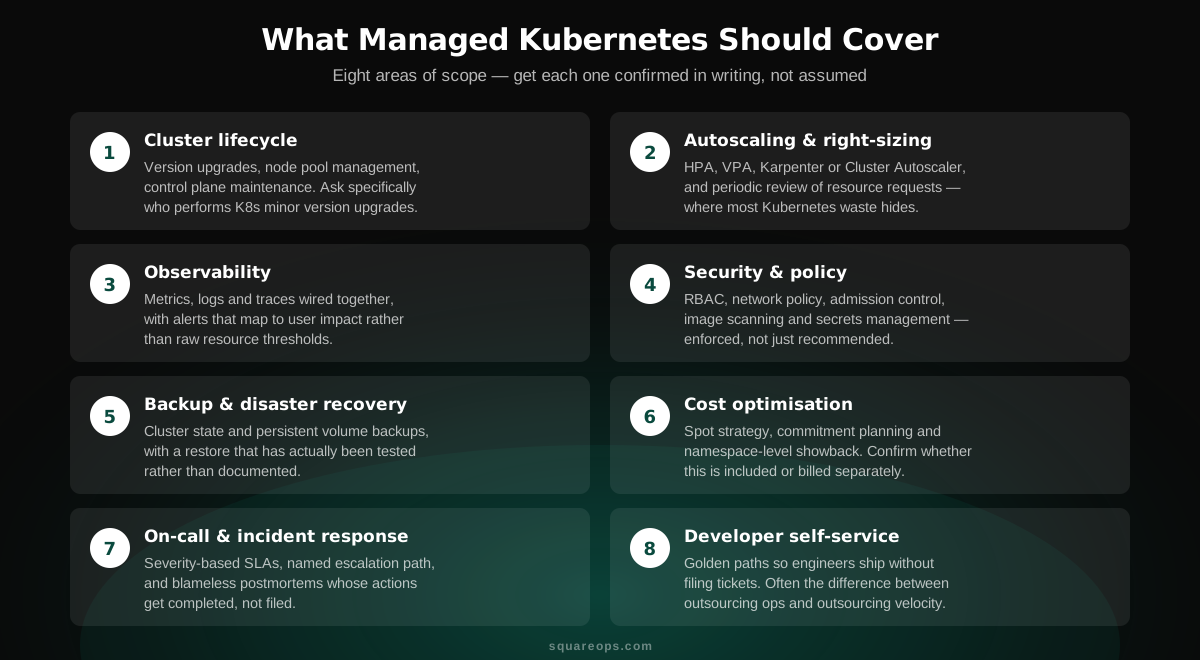
1. Cluster lifecycle and upgrades. Kubernetes minor versions arrive roughly three times a year and each carries a support window. Ask directly who performs the upgrade, how it is tested, what the rollback plan is, and whether add-ons and CRDs are in scope. "We'll advise you on upgrades" is not the same as "we perform them", and the difference will be obvious the first time a deprecated API breaks a workload. On EKS specifically, ask what happens if a cluster lapses into extended support — the control plane rate multiplies, and it happens by calendar rather than by decision.
2. Autoscaling and capacity. Confirm which layer is in scope. Horizontal pod autoscaling, vertical recommendations and node provisioning are three different problems, and a provider covering only the first will leave the largest saving untouched. Ask specifically whether they will run Karpenter or Cluster Autoscaler, and who owns the consolidation policy.
3. Observability. Establish who owns the monitoring stack, who tunes alert thresholds, and what happens to alert noise. A provider inheriting an alerting setup nobody has pruned will either page constantly or start ignoring it. Ask what their alert-to-incident ratio looks like on comparable accounts.
4. Security and policy. RBAC review, admission control, image scanning, network policies and secrets management should each be named explicitly. "Security best practices" in a proposal means nothing enforceable. If your own compliance scope covers the provider, confirm their certifications rather than assuming.
5. Backup and disaster recovery. Etcd snapshots, persistent volume backups, and a tested restore path. Ask when they last performed a restore, not whether backups run — those are very different questions and only one of them has ever surprised anyone.
6. Cost management. Most Kubernetes waste sits in resource requests set once at deployment and never revisited. Confirm whether the provider reviews requests periodically or only reacts when something is throttled, and whether they have a mandate to change them or merely to report. A report nobody actions is not cost management.
7. On-call and incident response. Establish the response SLA by severity, who is actually paged, whether it is a named team or a rota you never meet, and what the escalation path is at 3am on a Sunday. Ask for a recent post-incident review — redacted is fine. How a provider writes about their own failures tells you more than any capability slide.
8. Developer self-service. A provider who runs your clusters well but leaves developers filing tickets for a namespace has outsourced operations without improving delivery. If velocity is part of why you are doing this, make golden paths explicit in scope: environment provisioning, preview environments, and who can deploy what without asking.
What Managed Kubernetes Costs
Pricing follows three broad shapes, and comparing across them is where most evaluations go wrong.
- Platform licensing — per-cluster or per-node fees for management software. Your team still operates it, so budget engineering time alongside the licence. The licence is rarely the largest number in this option.
- Managed service retainer — a monthly fee for a provider to operate clusters under an SLA. For most mid-sized platforms this lands below the fully loaded cost of a single senior platform engineer, which is the comparison that actually matters.
- Project-based — fixed scope for a migration, a cluster rebuild or a security hardening exercise. Appropriate for one-time work, and a poor fit for ongoing operations dressed up as a project.
The honest baseline for self-managing. A sustainable 24×7 on-call rotation needs three to four engineers — not one, and not two with a heroic escalation policy. If you are comparing a retainer against a single hire, you are not comparing like with like, and the gap shows up as attrition rather than as a line item.
Two costs are routinely left out of both sides of this comparison: the cloud spend that poor cluster hygiene generates, and the delivery time lost when developers wait on platform tickets. Neither appears on an invoice, and both are usually larger than the fee under negotiation.
How to Choose
- Decide the category first. Do you need software, a team, or both? Answering this eliminates most of the market immediately and prevents the most expensive mistake in the process.
- Match to your environment. Bare metal and edge favour platforms built for them. Cloud-native EKS or GKE workloads favour providers holding the relevant Service Delivery designations, which are audited against real customer engagements rather than self-declared.
- Run the eight-point scope checklist with every shortlisted vendor and compare the answers side by side. Written answers, not a call.
- Insist infrastructure code lives in your repositories. Terraform, Helm charts and policy definitions in your Git, not the vendor's. The test: if the engagement ended tomorrow, could your team operate within 30 days? If the answer is no, you have bought a dependency rather than a service.
- Take a reference call at your scale — a customer running a comparable cluster count and workload profile, not the vendor's largest logo. Ask them what went wrong and how it was handled.
- Agree the exit before you sign. Handover documentation, runbook ownership and a transition period should be in the contract from the start. Providers confident in their work do not object to this.
For related evaluations, see our reviews of managed DevOps and SRE companies in India and FinOps and cloud cost optimisation companies, our review of platform engineering and IDP companies if you are building an internal developer platform on top of these clusters, or our explainer on how Kubernetes managed services work if you are earlier in the process.
If you are running production Kubernetes on AWS and want a partner that treats automation, reliability and cost as one engagement rather than three, talk to our Kubernetes team. We will review your clusters against the eight-point checklist above and tell you plainly where the gaps are — including when a platform, rather than a provider, is the better answer for your situation.