US companies evaluating an AWS managed service provider face a decision most vendor listicles quietly avoid: whether to hire a domestic partner at US rates, or an offshore partner at a fraction of the cost. Both are legitimate, and the right answer depends on constraints that have nothing to do with which vendor markets itself best.
This guide covers the leading US onshore AWS partners, what they actually cost, when offshore management makes sense, and — importantly — when it does not. We are an India-based AWS Advanced Tier Services Partner, so we sit on one side of this comparison. We have tried to be straight about that throughout.
The Leading US Onshore AWS Partners
If you want a domestic partner, these are the firms most often shortlisted. All are AWS Premier Tier Services Partners.
Mission (a CDW company)
Founded in 2017 and headquartered in Beverly Hills, Mission was acquired by CDW in December 2024 and now operates as Mission, a CDW company. It supports more than 500 customers and is both an AWS Premier Tier Services Partner and an ISV Accelerate Partner.
Mission's particular strength is migrations aligned to the AWS Migration Acceleration Program, paired with ongoing managed operations through its Mission Cloud One platform. It has also partnered with Vantage to bring granular cost attribution and unit cost analysis to its customers.
Strongest fit: migrations that can draw on MAP funding, and teams that want the same partner to stay on for managed operations afterwards.
Caylent
Founded in 2015, Caylent is an AI-first AWS Premier Tier Services Partner that works exclusively within AWS. It holds ten AWS Partner of the Year awards, including GenAI, Migration and Security Consulting Partner of the Year in 2025, and carries Competencies across Migration, DevOps, SaaS, Generative AI and Amazon Connect. It is also an AWS Managed Services Provider and an Anthropic partner, and recently extended into Amazon Connect work through its acquisition of Pronetx.
Strongest fit: cloud-native modernisation, EKS and container migrations, and generative AI builds for SaaS and FinTech teams already committed to AWS.
Worth knowing: Caylent's AWS-only focus is a genuine strength if you are AWS-committed, and a genuine constraint if you are pursuing multi-cloud.
Slalom
Slalom is consistently rated among the strongest partners for large enterprise migrations, particularly where the engagement spans business consulting as well as infrastructure.
Specialist FinOps firms
For cost work specifically, dedicated specialists such as DoiT and 2nd Watch consistently deliver deeper savings than generalist firms — published comparisons put dedicated cost specialists in the 25–40% savings range against roughly 10–15% for generalists. The differentiator is whether cost governance is embedded in architecture decisions upfront or bolted on afterwards.
What US AWS Partners Actually Cost
Published US market rates give a clear baseline:
- Hourly rates: $150–$300 per hour
- Discovery assessments: $25K–$75K
- Migrations: $200K–$500K for mid-size, $1M+ for enterprise
- Managed services: $5K–$50K per month
Premier partners command premium rates; Select-tier partners are meaningfully cheaper. Note also that migration timelines have lengthened as work has shifted from lift-and-shift toward genuine modernisation — expect four to eight months for meaningful re-architecture rather than the six-week "quick wins" some vendors still advertise.
Onshore vs. Offshore: The Actual Trade-offs
The cost delta is the headline, but it is rarely the deciding factor. Here is how the two models compare across the dimensions that matter.
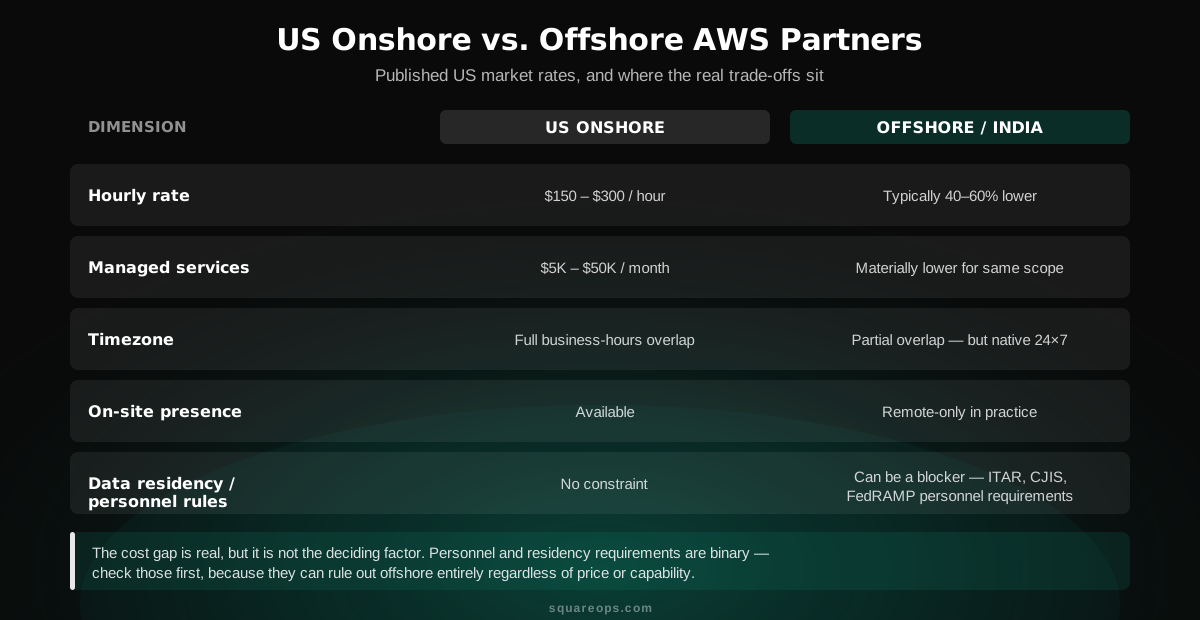
Two of these deserve more than a table row.
Timezone is not the disadvantage it appears to be. Partial business-hours overlap is a real cost for synchronous work — architecture reviews, incident war rooms, planning sessions. But for 24×7 on-call it inverts entirely. Your night is their working day. Building a sustainable US-based night rotation means hiring three to four additional engineers at US rates, or asking your existing team to carry pager duty at 3am indefinitely. Follow-the-sun coverage is both cheaper and healthier.
Personnel and residency rules are binary. ITAR, CJIS and certain FedRAMP programmes require US persons. No amount of capability or price advantage changes that. Check this constraint before you run a procurement cycle, because it can eliminate offshore entirely.
When Offshore Works — and When It Doesn't
We are an offshore provider, which makes this section the one most worth reading sceptically. We have tried to make it genuinely useful rather than self-serving.
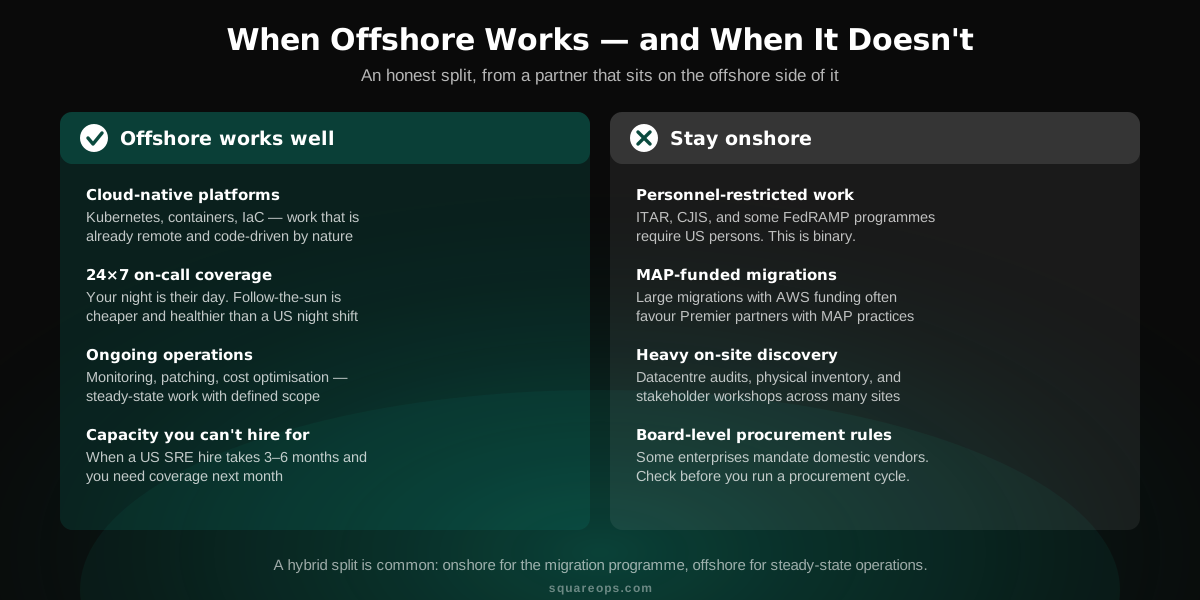
The pattern that holds across most US engagements: offshore is strong for steady-state operations on cloud-native platforms — Kubernetes, containers, infrastructure as code, monitoring, patching, cost optimisation. This is work that is already remote and code-driven, so the delivery model adds little friction.
Offshore is weaker where the work is physical, political or personnel-restricted — datacentre discovery across many sites, MAP-funded migration programmes, board-mandated domestic sourcing, or anything requiring US persons.
Many US companies land on a hybrid: an onshore partner for the migration programme, an offshore partner for the operations that follow. That is a reasonable outcome, and worth considering explicitly rather than by accident.
How to Evaluate an Offshore AWS Partner
If offshore is viable for your situation, the evaluation is stricter than for a domestic vendor, because you cannot walk into their office.
- Verify the partner tier on the AWS Partner Finder. The directory is global — an Indian Advanced Tier partner appears there exactly as a US one does. Check Competencies and Service Delivery designations too, since those require audited customer evidence rather than self-assertion.
- Establish overlap hours contractually. Do not accept "we're flexible". Specify guaranteed overlap with your team's working day, and separately specify who covers your night.
- Confirm security and compliance posture. Ask which certifications the provider holds itself — ISO 27001, SOC 2 — versus which it merely advises on. For a remote partner with production access, this matters more than for a local one.
- Insist that code and runbooks live in your repositories. Terraform, pipeline configuration and runbooks in your GitHub, not theirs. Test it: if the engagement ended tomorrow, could your team operate independently within 30 days?
- Ask for a reference call with a US customer. Not a logo on a slide. A real call with someone who has run this delivery model across timezones.
- Get response-time SLAs by severity in writing, along with who is on call and their seniority level.
Where SquareOps Fits
We will not claim to be a better choice than Mission or Caylent for a US company that needs a domestic partner. They are Premier Tier, they are excellent, and for MAP-funded migrations or personnel-restricted work they are simply the right answer.
What we do is narrower. SquareOps is an AWS Advanced Tier Services Partner with the DevOps Competency and Service Delivery designations for Amazon EKS and Amazon RDS, plus Well-Architected Partner status. We are ISO 27001 certified. We run 24×7 SRE, managed Kubernetes and cloud cost management for cloud-native platforms, with infrastructure managed through Terraform and GitOps rather than console access.
Our US and international customers reflect that profile — SaaS and platform companies where the work is container-based, code-driven and continuous. We have delivered for teams in the US, Europe, Australia and Israel, and our case studies set out what those engagements involved.
We are a reasonable fit if you are running a cloud-native platform, need reliability and cost discipline as an ongoing capability, and have no personnel-restriction constraint. We are the wrong choice for a datacentre exit programme, a MAP-funded enterprise migration, or anything requiring US persons.
Making the Decision
Work through it in this order:
- Check for hard constraints first. Personnel requirements, data residency, procurement policy. These are binary and can eliminate options before you compare anything else.
- Separate the migration from the operations. They are different engagements with different requirements, and there is no rule saying the same vendor must do both.
- Match the partner to the workload, not the tier. Premier signals scale, not fit. A specialist with an EKS Service Delivery designation may serve a container platform better than a much larger generalist firm.
- Shortlist three, verify all on the Partner Finder, and take a reference call at your scale — not the vendor's largest account.
If you are running a cloud-native AWS platform and evaluating whether offshore operations make sense for your team, talk to our AWS team. We will review your environment, give you a Well-Architected assessment, and tell you plainly whether we are the right fit — including when a US onshore partner would serve you better.
For related reading, see our review of AWS managed service providers in India for the offshore side of this comparison, our reviews of managed DevOps and SRE companies in India and FinOps and cloud cost optimisation companies, or our service pages for DevOps consulting in the United States and SRE services in the United States.