By Nitin Yadav · Published May 28, 2026 · Last updated May 28, 2026
In this article
- What are EKS, ECS, and Fargate (and why Fargate is not a peer)?
- Comparison table: EKS vs ECS vs Fargate
- How much does each cost for a 10-service workload?
- When should you choose EKS (Kubernetes on AWS)?
- When should you choose ECS over EKS in 2026?
- When does Fargate (serverless containers on AWS) actually make sense?
- Decision matrix: which AWS container platform to pick
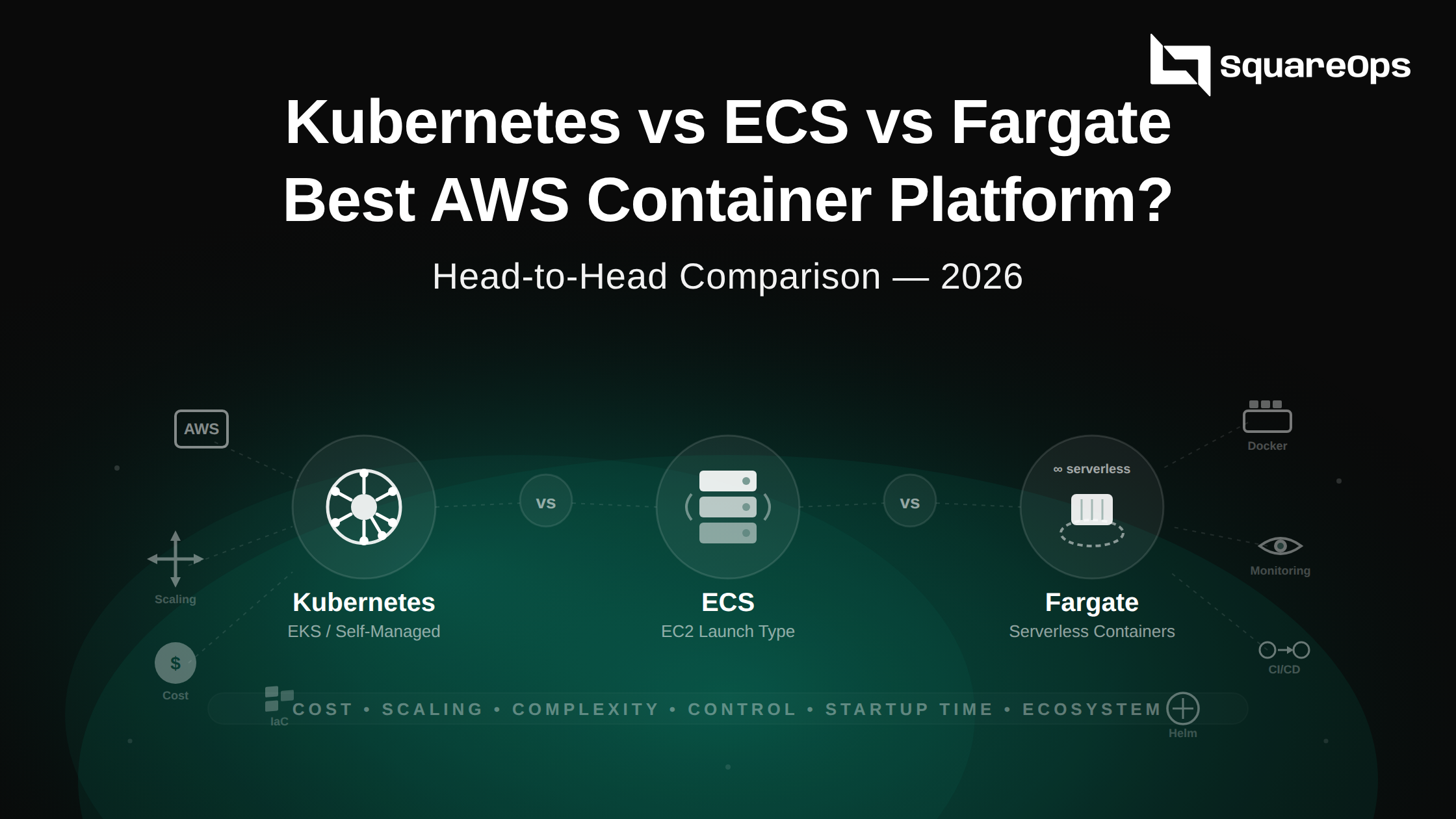
Most "Kubernetes vs ECS vs Fargate" articles get the framing wrong on line one. EKS and ECS are orchestrators. Fargate is a launch type — the compute that runs your containers — and it ships under both ECS and EKS. So the real question for an AWS team in 2026 is two-dimensional: which orchestrator (EKS or ECS) and which launch type (EC2 nodes you manage, or Fargate). Per the 2025 CNCF Annual Cloud Native Survey, 82% of container users now run Kubernetes in production (up from 66% in 2023), so this AWS container platform comparison matters more than ever.
Free 30-minute architecture review by SquareOps — we benchmark all three against your actual workload.
Book your free review
What are EKS, ECS, and Fargate (and why Fargate is not a peer)?
The three names get lumped together because the AWS console surfaces them together, but they live on different axes:
- Amazon ECS — AWS's proprietary container orchestrator. Task definitions, services, and tight integration with ALB/IAM/CloudWatch. No Kubernetes API. Control plane is free.
- Amazon EKS — AWS's managed Kubernetes orchestrator. Same Kubernetes API you'd run on GKE, AKS, or on-prem. Per AWS EKS pricing, the control plane is $0.10/cluster/hour (~$73/month) in standard support, jumping to $0.60/hour if you fall behind to extended support. This is the heart of the K8s vs AWS native container services debate.
- AWS Fargate — A serverless compute engine. You don't pick instance types, you pick vCPU + memory per task/pod. Fargate is selected as a launch type: "ECS on Fargate" or "EKS on Fargate". It is not a standalone orchestrator. Fargate pricing is per-second: ~$0.0405/vCPU-hour and ~$0.00445/GB-hour for Linux x86 in us-east-1 (Graviton ARM is ~20% cheaper).
So you can run ECS on EC2, ECS on Fargate, EKS on EC2, or EKS on Fargate. Four valid combinations with very different cost and ops profiles. Anyone framing "Fargate vs EKS" as a clean either/or is skipping the part where Fargate is one of the launch types for EKS.
Why this matters for your architecture
When you choose ECS, you're picking AWS-only. The task definitions, service discovery, and capacity providers don't translate to any other cloud. When you choose EKS, you keep the standard Kubernetes manifests, Helm charts, and Argo CD pipelines that run on every cluster on earth — including your laptop via Kind. That portability is the single biggest reason most platform teams settle on Kubernetes once they outgrow ~15-20 services. For execution help in either direction, see our Kubernetes cost optimization and broader cloud migration practice.
Comparison table: EKS vs ECS vs Fargate
| Feature | EKS (Kubernetes) | ECS | Fargate |
|---|---|---|---|
| Orchestrator type | Kubernetes (CNCF) | AWS proprietary | Not an orchestrator — compute engine |
| Control plane management | Managed by AWS | Managed by AWS | N/A — rides on ECS or EKS |
| Pricing model | $0.10/cluster/hour + EC2 nodes | Free + EC2 nodes | ~$0.0405/vCPU-hr + $0.00445/GB-hr |
| Cold start | Seconds (EC2) / 30-60s (Fargate) | Seconds (EC2) / 30-60s (Fargate) | 30-60s per task/pod |
| Multi-cloud portability | High — standard K8s | None — AWS-only | None — AWS-only |
| Best for | Scale, multi-cloud, K8s ecosystem | AWS-first, simple microservices | Burst jobs, no-ops, low container counts |
| Typical $/month, small workload* | ~$370 (EC2) / ~$680 (Fargate) | ~$290 (EC2) / ~$610 (Fargate) | ~$610-680 (depends on host) |
| Operational overhead | High (or outsource) | Low | Lowest |
| K8s ecosystem support | Full (Helm, Argo, Istio, Karpenter) | None | Via EKS only (limited DaemonSet support) |
| AWS lock-in level | Medium (portable manifests) | High | High |
*Small workload = 10 services, 2 vCPU + 4 GB each, 24/7 in us-east-1. Math in the next section.
How much does each cost for a 10-service workload?
Specific numbers, not vague "it depends". Assumptions: 10 services, each needs 2 vCPU + 4 GB RAM, running 24/7 in us-east-1, on-demand Linux x86 pricing as of May 2026. We're ignoring data transfer, NAT, EBS, and load balancers (roughly identical across all three).
Option A — ECS on EC2
- Total demand: 20 vCPU + 40 GB RAM — binpack into 3x
m6i.2xlarge(gives 24 vCPU headroom) - EC2 cost: 3 × $0.384/hr × 730 hr = ~$842/month
- ECS control plane: $0
- With a 1-year compute Savings Plan (~40% off): ~$505/month
- Add Spot for half the fleet: ~$290/month
Option B — EKS on EC2 (with Karpenter)
- Same compute as Option A: ~$842/month on-demand
- EKS control plane: +$73/month
- With Savings Plans + Karpenter binpacking + Spot for stateless: ~$370/month all-in
- Karpenter typically saves another 15-25% versus Cluster Autoscaler. See our Karpenter on EKS deep-dive.
Option C — ECS on Fargate (or EKS on Fargate)
- 20 vCPU × $0.04048/hr × 730 = $591/month; 40 GB × $0.004445/hr × 730 = $130/month
- ECS Fargate total: ~$721/month; EKS Fargate adds the $73 control plane: ~$794/month
- With Fargate Compute Savings Plans (~20% off, 1-year): ECS Fargate drops to ~$577/month; EKS Fargate to ~$650/month
- Graviton ARM Fargate is another ~20% cheaper
Headline: at on-demand list, ECS-on-EC2 is ~$842, EKS-on-EC2 is ~$915, ECS-on-Fargate is ~$721. But with realistic optimization (Savings Plans + Karpenter + Spot), EKS-on-EC2 falls below ECS-on-Fargate. A recent 2026 cost analysis found Fargate runs ~3x more expensive than self-managed Kubernetes for identical workloads at the 30+ container range. Once you're past ~15-20 containers running continuously, EKS + Karpenter + Spot is the cost-optimal answer. For the full set of levers, see our AWS cost optimization 2026 guide.
For ongoing visibility into where each option is bleeding money — right-sizing flags, idle EBS, oversized Fargate tasks — teams use SpendZero (the SquareOps Atmosly FinOps tool) to surface 37+ automated waste-detection checks across EKS, ECS, and Fargate workloads.
Free EKS/ECS/Fargate cost audit by SquareOps — 48-hour turnaround.
Request your audit
When should you choose EKS (Kubernetes on AWS)?
EKS is the right answer when any of these are true:
- You're past ~15-20 production services. Kubernetes' deployment, service, and ingress primitives become net-positive at this scale, and EKS + EC2 + Karpenter is the cheapest steady-state option.
- You need multi-cloud portability. Same manifests run on GKE, AKS, or on-prem. ECS task definitions don't.
- Your team already knows Kubernetes. Why pay the learning tax twice?
- You want the CNCF ecosystem. Istio, Argo CD, Crossplane, KEDA, Karpenter, OPA Gatekeeper — none of these exist on ECS.
- You're running AI/ML workloads. Per the 2025 CNCF survey, 66% of organizations hosting generative AI models use Kubernetes to manage at least part of their inference workloads.
For execution help — cluster setup, Karpenter NodePool config, GitOps with Argo CD, multi-AZ HA — see our AWS Managed Kubernetes services. SquareOps is an AWS Advanced Consulting Partner with the EKS Service Delivery Badge, running 50+ EKS clusters in production for clients across India, the US, the UK, and the Middle East.
What about Kubernetes cluster scaling on AWS?
The default is HPA for pods + Karpenter for nodes. Karpenter looks at unschedulable pods and provisions the cheapest valid EC2 instance within ~30-60 seconds — significantly faster than Cluster Autoscaler. Our Kubernetes cluster scaling on AWS guide covers NodePool design, Spot diversification, and how to avoid the most common over-provisioning traps.
When should you choose ECS over EKS in 2026?
ECS wins in a narrow but real set of cases:
- Small team, AWS-only, <15 services. ECS task definitions take an afternoon to learn; the control plane is free. The ECS vs EKS 2026 debate skews ECS for shops at this scale.
- You don't have (and don't want to hire) Kubernetes expertise. ECS's mental model is smaller — no etcd, no CRDs, no networking model to debate.
- Deep AWS-native integration is the priority. ECS auto-wires into ALB, IAM, CloudWatch, App Mesh, and Service Connect with very little YAML.
- Operational overhead is the binding constraint. A running ECS environment typically needs 2-4 hours/week of platform time; an EKS cluster with the same workload often needs 6-12 hours unless heavily automated.
For a longer side-by-side see our existing EKS vs ECS comparison page. The ECS trap: once you cross ~20 services or genuinely need K8s ecosystem tools, migrating ECS to EKS costs roughly 2-4 weeks of platform engineering per environment. Manageable, but you don't want to discover it 18 months in.
When does Fargate (serverless containers on AWS) actually make sense?
Fargate's value prop is real but narrower than the marketing suggests. Pick Fargate when:
- Bursty or scheduled workloads. Batch jobs, nightly ETL, CI/CD runners, event-driven processors. You pay only for the seconds the task ran. Paying $0.04/vCPU-hour for a 5-minute job beats keeping an EC2 node warm.
- You truly don't want to think about nodes. Small teams without a platform engineer. The "serverless containers AWS" pitch is real if your headcount can't justify a dedicated cluster operator.
- Strong workload isolation requirements. Each Fargate task gets its own micro-VM (Firecracker), which makes multi-tenant SaaS easier to defend in a security audit.
- Variable, unpredictable scale. 10x intraday swings where you can't right-size EC2 honestly — Fargate's per-second billing wins on actual spend even though the headline rate looks high.
Where Fargate breaks down
- Steady-state 24/7 workloads above ~15-20 containers. The 2-3x premium versus EC2 with Savings Plans compounds fast.
- DaemonSets on EKS Fargate. Not supported — sidecars must be injected per-pod.
- GPUs. No GPU support on Fargate. AI inference belongs on EKS + EC2.
- Long cold starts. 30-60 seconds per task/pod is meaningful for HPA scale-out events.
For workloads that fit Fargate's sweet spot, pair it with our SRE services to set up the right alerting and budget controls — per-second billing is unforgiving if a runaway job loops overnight. For broader DevOps tooling and pipelines, see our DevOps consulting practice.
Decision matrix: which AWS container platform to pick
| Your situation | Recommended choice | Why |
|---|---|---|
| Early-stage startup, <5 services, no platform engineer | ECS on Fargate | Zero ops, fastest to ship, fine economics at this scale |
| Mid-size SaaS, 5-15 services, AWS-only, no K8s skills | ECS on EC2 + Spot | Cheaper than Fargate at steady state, still low ops |
| 15-50+ services, multi-cloud or considering it | EKS on EC2 + Karpenter + Spot | Cheapest steady-state; full K8s ecosystem; portable |
| AI/ML inference, GPU workloads | EKS on EC2 (GPU node groups) | Fargate has no GPU; ecosystem (KServe, Kubeflow) is K8s-only |
| Nightly batch / ETL / CI runners | ECS on Fargate | Per-second billing crushes a warm EC2 node for short jobs |
| Bursty SaaS with 10x intraday swings | EKS on EC2 + Fargate for spike | Reserved/Spot for baseline, Fargate for spike |
A short rule of thumb
If you can answer "yes" to "will we still want this architecture in three years?" and you expect >15 services or any meaningful K8s ecosystem usage, go EKS. If you're not sure, start on ECS Fargate and migrate when the cost or feature ceiling forces it — that migration is well-trodden and usually a 2-4 week project per environment. Per Datadog's 2025 State of Containers and Serverless, 66% of organizations using serverless functions also use at least one container orchestration service in the same cloud — teams routinely mix Fargate, EKS, and EC2 for different workloads rather than picking one.