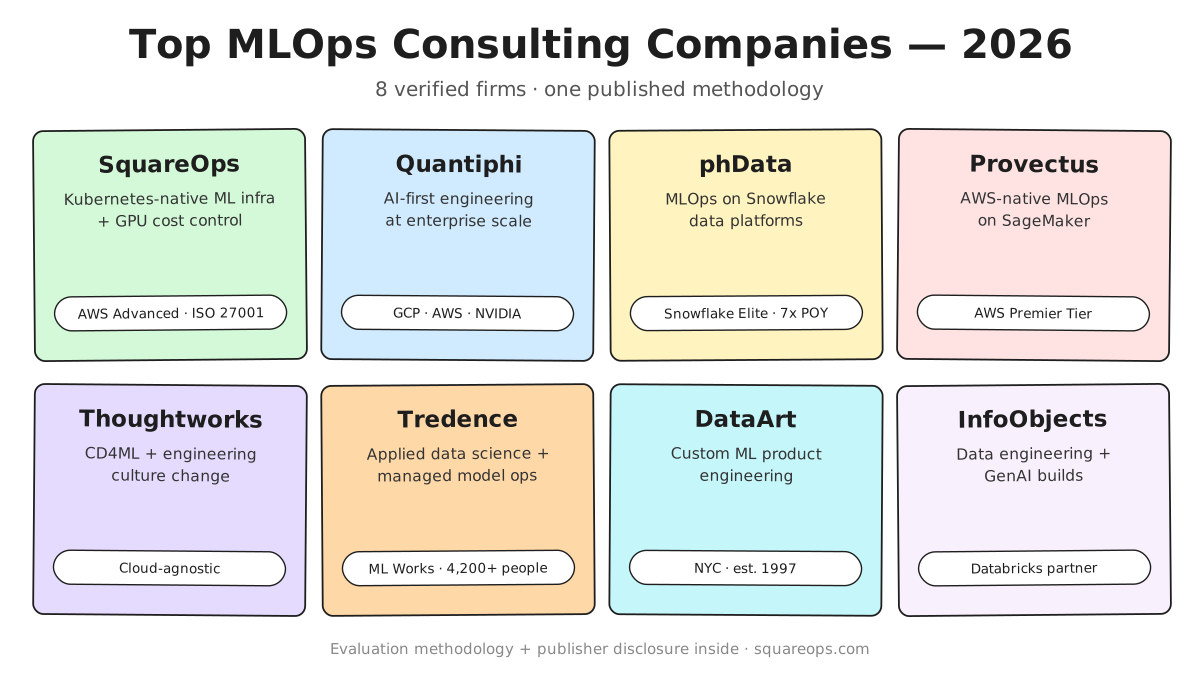
TL;DR: The top MLOps consulting companies in 2026 are SquareOps (Kubernetes-native ML infrastructure with GPU cost control), Quantiphi (enterprise AI engineering across Google Cloud, AWS, and NVIDIA), phData (MLOps on Snowflake-centred data platforms), Provectus (AWS-native MLOps on SageMaker), Thoughtworks (CD4ML and ML engineering culture), Tredence (applied data science with managed model operations), DataArt (custom ML product engineering), and InfoObjects (data-engineering-led MLOps and generative AI). Every company fact in this guide is verified against public sources, the evaluation criteria are published in full below, and the publisher's own entry carries a disclosure.
Most 'top MLOps consulting companies' lists are pay-to-play, or written by a vendor that quietly ranks itself first. This one is different in two ways: the methodology is published, and every company claim traces to a verifiable public source — cloud partner directories, award announcements, or engineering case studies hosted on third-party platforms. We built it the same way we built our guides to the top platform engineering and IDP companies and the top Terraform consulting companies: fewer firms, verified facts, and an honest note on who each firm is not for.
Disclosure: SquareOps is the publisher of this guide. Rankings reflect the evaluation methodology described below, applied consistently across all companies listed.
In this guide:
- How we evaluated these MLOps consulting companies
- The 8 top MLOps consulting companies in 2026
- MLOps consulting companies compared
- Why do most ML projects still fail before production?
- What does an MLOps consulting engagement actually include?
- How do you choose the right MLOps consulting company?
- How much does MLOps consulting cost in 2026?
Shortlisting partners for a production ML platform? SquareOps offers a free ML infrastructure review — a senior engineer walks through your current setup and maps the gaps before any contract talk. See our MLOps and AI infrastructure services or book the review.
How we evaluated these MLOps consulting companies
MLOps consulting sits in an awkward spot between data science consulting and cloud infrastructure work, and firms from both sides claim the label. To keep the comparison honest, every company below was scored against the same five criteria:
- Production ownership. Does the firm operate what it builds — monitoring, on-call, upgrades — or hand over slideware? MLOps is an operations discipline; a partner that has never been paged for a failed model rollout is an advisory firm, not an MLOps firm.
- Verifiable credentials. Partner tiers (AWS Premier or Advanced, Snowflake Elite, Google Cloud Partner of the Year), cloud competencies, and case studies published on third-party platforms — not just claims on the firm's own website.
- MLOps-specific depth. Training pipelines, model registries, serving infrastructure, drift monitoring, and GPU capacity management — not generic 'AI transformation' language.
- Engagement clarity. Can you tell, before the first sales call, whether the firm sells advisory, fixed-scope implementation, managed operations, or all three?
- Honest fit. Every entry includes a 'consider carefully if' note. No firm on this list is the right choice for every team — including the publisher.
The 8 top MLOps consulting companies in 2026
1. SquareOps — best for Kubernetes-native ML infrastructure with GPU cost discipline
SquareOps (Gurugram, India, with clients across India, the US, Europe, and the Middle East) approaches MLOps from the infrastructure side. The firm is an AWS Advanced Consulting Partner, is ISO 27001 certified, and its core business is running production Kubernetes, cloud, and DevOps platforms — the layer most ML projects actually stall on.
Its MLOps practice builds GPU node groups on EKS, GKE, or AKS with the NVIDIA GPU Operator and Karpenter autoscaling, orchestrates training with Kubeflow Pipelines or Argo Workflows, tracks experiments and model versions in MLflow, and serves models through KServe, Triton, or Ray Serve — with vLLM or Hugging Face TGI for LLM inference. Everything is defined in Terraform (the firm also runs a dedicated Terraform consulting practice), which keeps the platform reproducible and portable rather than locked to one cloud. GPU spend is attributed per team, model, and namespace from day one, following the same Kubernetes cost optimization playbook the firm applies to application workloads. Engagements start with a free ML infrastructure review, then run as a fixed-scope implementation or a monthly operations retainer.
Consider carefully if: you need help with model development itself — feature engineering, algorithm selection, model accuracy. SquareOps owns the platform between a trained model and a served prediction; your data scientists keep owning the models. Snowflake-centric analytics stacks are also better served by phData, below.
2. Quantiphi — best for enterprise AI programmes across Google Cloud, AWS, and NVIDIA
Quantiphi (founded 2013, headquartered in Boston, 4,000+ professionals) is an AI-first digital engineering company and one of the most heavily credentialed firms in this category: an Elite- and Premier-tier partner to Google Cloud, AWS, NVIDIA, and Snowflake, with 21 Google Cloud Partner of the Year awards across the past decade. Its ML practice spans cloud-native model development, computer vision, NLP, and generative AI, and the firm has packaged its delivery experience into NeuralOps, a centralised MLOps platform built on Amazon SageMaker. Track record is strongest in healthcare, financial services, media, and retail.
Consider carefully if: you are a startup with one or two models in production. Quantiphi's delivery model is built for enterprise programmes; smaller teams typically get more traction — and smaller invoices — from a specialist infrastructure firm.
3. phData — best for MLOps on Snowflake-centred data platforms
phData (Minneapolis, founded 2014) is the strongest choice when your ML lifecycle lives where your data lives: Snowflake. The firm is a Snowflake Elite Services Partner and has won a Snowflake Partner of the Year award seven consecutive years, most recently 2026 Global Snowflake Services AI Partner of the Year. It is also an AWS Premier Partner and a dbt partner. Beyond project delivery, phData runs Elastic Operations — managed DataOps and MLOps — with a reported 98% average renewal rate, delivering from the US, Uruguay, and India.
Consider carefully if: your platform is Kubernetes-first or heavily GPU-based. phData's centre of gravity is the data platform, not cluster and GPU engineering.
4. Provectus — best for AWS-native MLOps built on SageMaker
Provectus (San Francisco) is an AWS Premier Tier Services Partner holding AWS competencies including Machine Learning, Data & Analytics, DevOps, and Generative AI. What sets it apart on this list is public, third-party-hosted proof: its MLOps builds are documented on AWS's own engineering blogs, including the Earth.com MLOps infrastructure build on Amazon SageMaker and the GoCheck Kids ML infrastructure story on the AWS Partner Network blog. Focus industries include healthcare and life sciences, retail and CPG, and media.
Consider carefully if: you want a cloud-portable platform. Provectus's depth is tightly coupled to AWS and SageMaker — a strength if you are all-in on AWS, a constraint if you are not.
5. Thoughtworks — best for fixing the engineering culture around ML, not just the tooling
Thoughtworks (global) created CD4ML — continuous delivery for machine learning — the approach that reframed MLOps as a software engineering discipline: models, data, and code shipped in small, reproducible, safely releasable increments. If your ML problem is really a ways-of-working problem — data scientists throwing models over the wall, no cross-functional ownership, no automated path to production — Thoughtworks changes how teams work first, then installs the tooling to match.
Consider carefully if: you need a narrowly scoped infrastructure build. Thoughtworks engagements are transformation-shaped, and priced accordingly.
6. Tredence — best for applied data science with managed model operations at scale
Tredence (San Francisco Bay Area, with major delivery centres in Bengaluru; 4,200+ employees) covers the full arc from MLOps advisory to implementation to managed model operations with 24/7 production support. Its ML Works accelerator layers observability on top of client platforms — drift detection, data quality checks, and workflow monitoring — and its published case studies include operating roughly 100,000 production models for a CPG enterprise. Partnerships span Databricks, Snowflake, Google Cloud, Azure, and AWS, with sector strength in retail, CPG, banking, telecom, and manufacturing.
Consider carefully if: you primarily need infrastructure-as-code platform engineering. Tredence leads with analytics and data science delivery rather than cluster-level engineering.
7. DataArt — best for custom ML-powered product engineering with industry depth
DataArt (New York, founded 1997, 6,000+ people) is a software engineering consultancy whose AI and ML practice sits inside nearly three decades of building products for finance, healthcare and life sciences, media, retail, and travel. Choose DataArt when the model is one component of a larger product build: the firm brings the surrounding application engineering, data work, and domain knowledge that pure MLOps boutiques lack.
Consider carefully if: you want a specialist to stand up an opinionated MLOps platform quickly. DataArt's breadth is the draw; platform-specific MLOps accelerators are not its pitch.
8. InfoObjects — best for data-engineering-led MLOps and generative AI builds
InfoObjects (San Jose, California, with delivery centres across seven countries) comes at MLOps from the data engineering side: Spark and Databricks pipelines (it has held Databricks consulting partner status since 2017), analytics platforms, and more recently generative and agentic AI implementation. It partners with AWS, Google Cloud, Azure, Anthropic, and OpenAI, and lists enterprise clients including Toyota and Rockwell Automation.
Consider carefully if: published MLOps case studies matter to your procurement process. InfoObjects has less third-party-verified MLOps proof than the firms above it on this list.
MLOps consulting companies compared
The table compresses the list into the dimensions buyers actually shortlist on. 'Engagement model' reflects what each firm publicly sells, not everything it will negotiate.
| Company | HQ / geography | MLOps focus | Cloud coverage | Engagement model | Best for |
|---|---|---|---|---|---|
| SquareOps | Gurugram, India (global delivery) | K8s GPU platforms, pipelines, serving, cost control | AWS, GCP, Azure | Fixed-scope build + managed retainer | Kubernetes-native ML infrastructure |
| Quantiphi | Boston, US (global) | End-to-end AI programmes, NeuralOps | GCP, AWS (+ NVIDIA) | Enterprise programmes | Large-scale AI transformation |
| phData | Minneapolis, US | MLOps on Snowflake, managed DataOps/MLOps | Snowflake, AWS, Azure | Projects + Elastic Operations | Snowflake-centred platforms |
| Provectus | San Francisco, US | SageMaker MLOps platforms | AWS | Projects + managed AI services | AWS-native teams |
| Thoughtworks | Global | CD4ML, ML engineering culture | Cloud-agnostic | Transformation consulting | Ways-of-working change |
| Tredence | SF Bay Area, US + Bengaluru | Advisory to managed model ops, ML Works | Databricks, AWS, Azure, GCP | Advisory + implementation + managed | Model operations at scale |
| DataArt | New York, US (global) | ML inside custom product engineering | AWS, Azure, GCP | Team-based engineering | ML-powered products |
| InfoObjects | San Jose, US (7 countries) | Data engineering, Databricks, GenAI | AWS, GCP, Azure, Databricks | Projects + staff augmentation | Data-pipeline-heavy ML |
Want the Kubernetes-native option evaluated against your stack? A free ML infrastructure review with SquareOps takes under a week and produces a written gap analysis you can use with any vendor on this list. Request the review.
Why do most ML projects still fail before production?
Because the industry keeps funding models and under-funding the platform they run on. S&P Global Market Intelligence's 2025 enterprise AI survey of more than 1,000 organisations found that 42% of companies abandoned most of their AI initiatives — up from 17% a year earlier — and that the average organisation scrapped 46% of its proof-of-concepts before they ever reached production.
The money keeps arriving anyway. Precedence Research puts the global MLOps market at USD 2.43 billion in 2025, heading to USD 56.60 billion by 2035 — a 37% compound annual growth rate. Soaring spend plus rising abandonment is exactly why MLOps consulting exists as a category: the gap between a notebook that works and a service that survives production traffic is an infrastructure and operations problem, and most data science teams were never staffed to solve it.
It is the same pattern we documented in our guide to the top FinOps and cloud cost optimization companies: platforms fail on operations, not on intent. The fix is treating the ML platform like any other production system — platform engineering discipline, infrastructure as code, real monitoring, and a named owner for every GPU hour.
What does an MLOps consulting engagement actually include?
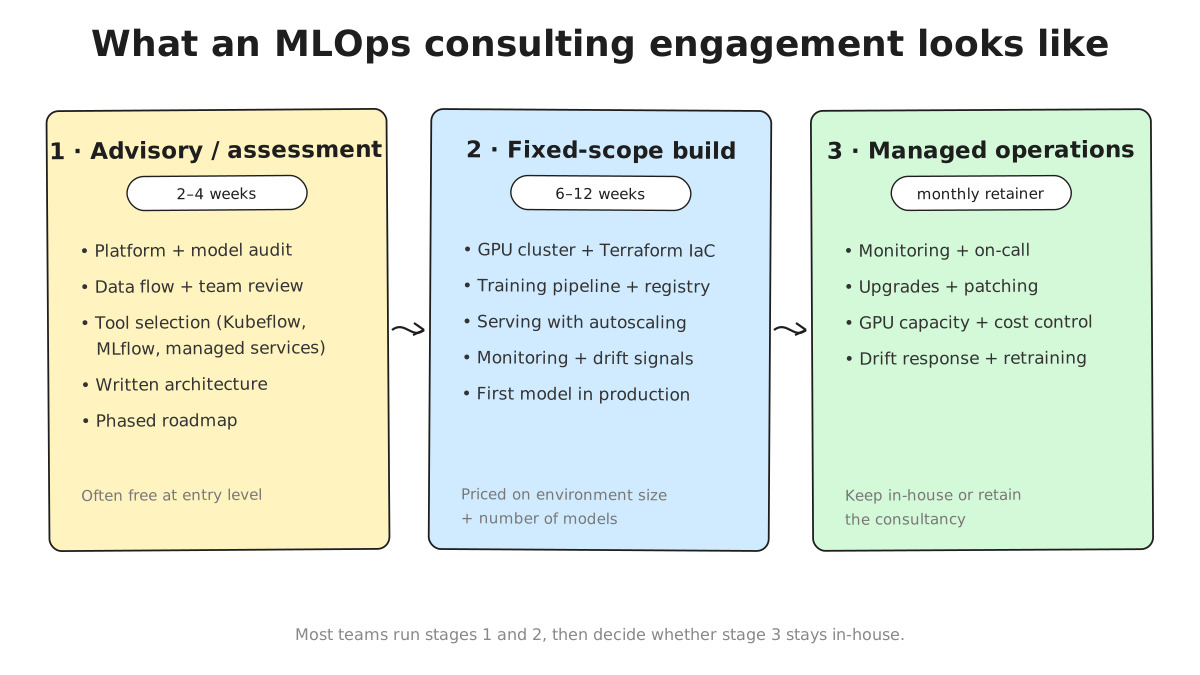
Vendors package it differently, but a credible engagement covers six layers, in roughly this order:
- Assessment. An audit of current infrastructure, models, data flows, and team ownership. Output: a written architecture and a tooling decision — Kubeflow, MLflow, managed services, or (usually) a combination.
- Compute platform. Training and inference compute, typically GPU node groups on Kubernetes with scheduling, quotas, and autoscaling.
- Pipelines and registry. Orchestrated training workflows plus a versioned model registry, so every production model traces back to a run and a dataset.
- Serving. Model endpoints with request-based autoscaling, canary rollouts, and a rollback path.
- Monitoring. Infrastructure metrics plus model-level signals: drift, data quality, prediction latency.
- Handover or operations. Documentation and training for your team — or a managed retainer where the consultancy keeps the pager.
Tooling choices split along cloud strategy. Managed platforms such as Amazon SageMaker's MLOps tooling or Google's Vertex AI bundle the lifecycle inside one cloud. The open-source, Kubernetes-native stack centres on Kubeflow, a CNCF incubating project, which continues to ship major capabilities in 2026, including Kubeflow Trainer for distributed workloads and an expanded SDK. A good consultant tells you which side of that split your constraints put you on before recommending anything.
How do you choose the right MLOps consulting company?
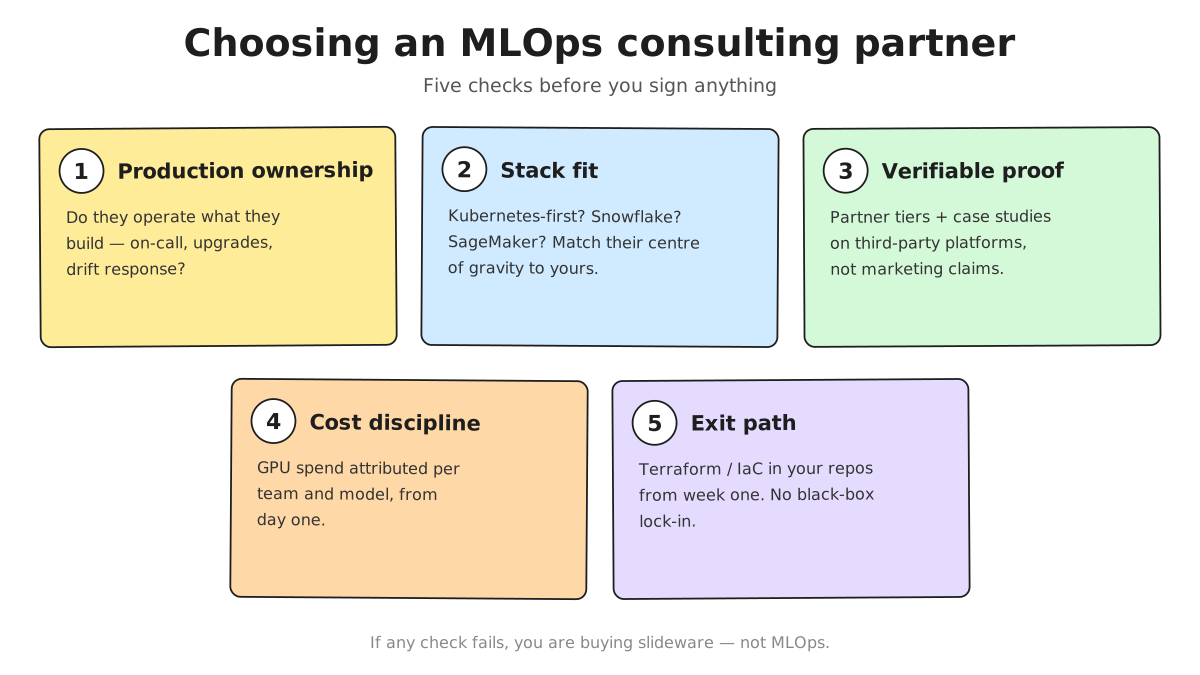
Five checks separate the firms that will still be answering your pages in month nine from the ones that leave after the workshop:
- Ask who operates the platform after go-live. If the answer is 'we hand over documentation', you are buying a build, not MLOps. Models degrade; someone has to own drift response, upgrades, and 2 a.m. rollbacks.
- Match their centre of gravity to your stack. Snowflake-first data estate: phData. All-in on AWS with SageMaker: Provectus. Kubernetes and multi-cloud: SquareOps. Organisation-wide AI programme: Quantiphi or Thoughtworks.
- Demand third-party-verifiable proof. Partner tiers you can check in the cloud provider's own directory, and case studies hosted somewhere the vendor does not control.
- Get the cost model in writing — both of them. The consulting fee, and the infrastructure it produces. Ask how GPU spend will be attributed and who owns cloud cost management once models scale.
- Check the exit path. Everything should land as Terraform or equivalent IaC in your repositories from the first week. If the platform only exists inside the consultancy's tooling, you have swapped cloud lock-in for vendor lock-in.
If AWS is your primary cloud, it is also worth pairing the MLOps work with a partner who can hold the broader account picture — reserved capacity, support tiers, security posture. That is the shape of SquareOps' AWS consulting services engagements, where the ML platform is one workload among several being run properly.
How much does MLOps consulting cost in 2026?
Most firms on this list do not publish rates, but pricing consistently takes one of three shapes:
- Assessments and advisory: short, fixed-fee engagements of two to four weeks. Several firms, including SquareOps, offer the initial infrastructure review free.
- Fixed-scope implementation: priced on environment size, cloud footprint, and the number of models to onboard. Typically six to twelve weeks to a first production path when some platform already exists.
- Managed operations: a monthly retainer covering monitoring, upgrades, GPU capacity management, and on-call.
Two cost realities to plan around. First, geography moves fees significantly: firms with India-based delivery — SquareOps, Tredence, Quantiphi — generally price below US-only boutiques for equivalent scope. Second, the consulting fee is usually not the biggest number on the table; GPU infrastructure is. An engagement that bakes in spot capacity for training, scale-to-zero endpoints, and per-model cost attribution routinely pays for itself out of the GPU line alone — which is why cost discipline is one of our five evaluation criteria rather than an optional extra.
Get a production-grade ML platform without hiring a platform team
GPU clusters, pipelines, serving, and cost control — built on Kubernetes, defined in Terraform, and operated by the SquareOps team.