Most teams start looking for a DevSecOps partner at a specific moment: a customer's security questionnaire arrives, a SOC 2 audit is scheduled, or a federal deal stalls because the platform is not FedRAMP-ready. At that point the requirement is not "better security" in the abstract — it is a specific framework, a specific deadline, and evidence an auditor will accept.
This guide profiles the DevSecOps and compliance partners operating in India in 2026, explains which compliance framework applies to which kind of business, and sets out how to tell a genuine DevSecOps practice from a vendor selling scanning tools. It is written for engineering and security leaders who already know they need help and now need to pick well.
How We Evaluated
DevSecOps is a crowded category where almost every provider claims the same capabilities. We assessed each firm against five criteria and have stated plainly where each is strong and where it is not the right fit.
| Criterion | What we looked at |
|---|---|
| Pipeline coverage | Whether security controls run across the full lifecycle or only as a pre-release scan |
| Framework experience | Named frameworks the provider has actually taken customers through — SOC 2, PCI-DSS, HIPAA, FedRAMP, ISO 27001 |
| Certifications held | What the provider is certified for itself, versus what it only advises on |
| Cloud-native depth | Kubernetes, policy-as-code, and container supply-chain security as core practice |
| Engagement model | One-time remediation project versus continuous ownership of controls and evidence |
Disclosure: SquareOps appears in this list. We have placed ourselves where the evidence supports and named providers that are a better fit than we are for specific situations. Verify every claim independently before shortlisting.
DevSecOps Is Not the Same as Cloud Security
This distinction decides whether an engagement succeeds, and it is worth being precise about.
Cloud security is a posture question: is the environment configured correctly, are permissions tight, is data encrypted, are misconfigurations detected. It is largely assessed against the running infrastructure.
DevSecOps is a delivery question: are security controls embedded in the process that changes the environment. A team can have an excellent cloud security posture on Monday and a poor one by Friday if there is no gate preventing an engineer from shipping an over-privileged IAM role.
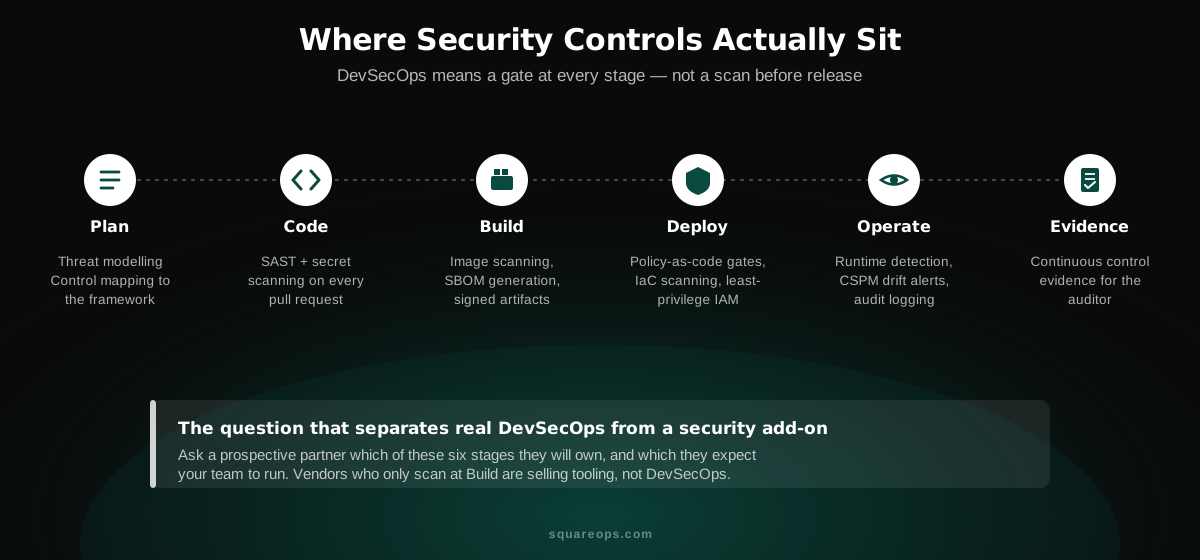
The practical test when evaluating a partner is simple: ask which of those six stages they will own and which they expect your team to run. A provider whose answer is "we scan container images before release" is offering tooling, not DevSecOps. The stages that get skipped most often are Plan — mapping controls to the framework before any code is written — and Evidence, which is what actually determines whether an audit succeeds.
Leading DevSecOps and Compliance Partners in India (2026)
1. SquareOps Technologies
Best for: Compliance-driven DevSecOps for SaaS and FinTech on AWS
SquareOps is an AWS Advanced Tier Services Partner holding the DevOps Competency and Service Delivery designations for Amazon EKS and Amazon RDS. The company is ISO 27001 certified itself — not merely advising on it — and has delivered compliance-driven engagements across PCI-DSS for payment platforms, SOC 2 for B2B SaaS, and FedRAMP-track hardening for platforms selling into US federal.
The practice is built around embedding controls in the pipeline rather than remediating afterwards: policy-as-code gates on deployment, secret and SAST scanning on every pull request, IaC scanning through Terraform, and continuous evidence collection structured for the auditor. That work is delivered through our DevSecOps consulting and CI/CD consulting practices, alongside managed DevOps and SRE rather than as a separate engagement — because compliance drift is an operations problem as much as a security one. For regulated payment workloads specifically, see our FinTech DevOps services.
Strengths: ISO 27001 held in-house, multi-framework delivery experience, EKS Service Delivery designation for container-heavy platforms, controls embedded in CI/CD rather than bolted on.
Consider carefully if: you need a formal audit opinion, penetration testing as a standalone service, or a CMMC engagement. Those need a licensed auditor or a specialist testing firm — see the section below on why that distinction matters.
2. OpsTree Global
Best for: Platform engineering combined with DevSecOps at scale
OpsTree is an AWS Advanced Tier Services Partner operating across India, the USA and global markets, with DevSecOps sitting alongside cloud platform engineering and application modernisation. Their published case work includes migrating production workloads for DeHaat — an AgriTech platform serving more than 1.8 million farmers across 12 states — from GCP to AWS without disrupting live services, including new architecture design, infrastructure as code and CI/CD automation.
Strengths: Substantial delivery scale, proven complex migration experience, breadth across platform engineering, observability and data engineering.
Consider carefully if: you want a narrowly security-focused engagement. DevSecOps is one line in a broad services portfolio rather than the central practice.
3. InfraCloud Technologies
Best for: Cloud-native security and Kubernetes policy enforcement
InfraCloud runs a dedicated DevSecOps consulting practice with genuine depth in cloud-native security tooling — their published expertise covers Open Policy Agent, Falco, Calico, TUF and Notary. They describe themselves as the first Kubernetes service provider in India and second in APAC, have contributed to more than 50 open source projects in the cloud-native and DevOps space, and employ CNCF-certified consultants.
Strengths: Genuine open source contribution record that is publicly verifiable, deep policy-as-code and runtime security expertise, strong Kubernetes credentials.
Consider carefully if: your primary need is audit preparation and evidence collection for a specific framework rather than engineering-led security. Their practice is oriented toward cloud-native security engineering.
4. Wipro
Best for: Regulated financial services at enterprise scale
Wipro's DevSecOps offering is built on its established cybersecurity and risk services division, with frameworks tailored specifically to financial services clients managing regulatory audits and third-party risk. The firm has invested in automated compliance tooling designed to align with RBI guidelines and global banking regulations — relevant for Indian BFSI organisations where RBI compliance is the binding constraint.
Strengths: Deep BFSI regulatory knowledge, RBI-aligned compliance automation, enterprise-scale delivery capacity.
Consider carefully if: you are a growth-stage company. Enterprise SI engagement models are built for a different scale of programme and budget.
5. HCLTech
Best for: DevSecOps bundled with large-scale infrastructure management
HCLTech integrates DevSecOps services with its broader cloud and infrastructure services portfolio, which suits organisations that want security embedded in an existing managed infrastructure relationship rather than contracted separately.
Strengths: Global delivery footprint, integration with wider infrastructure services, established enterprise governance.
Which Compliance Framework Actually Applies to You
Teams often ask for "compliance help" without having settled which framework is binding. The answer changes the scope, the cost and the timeline substantially.
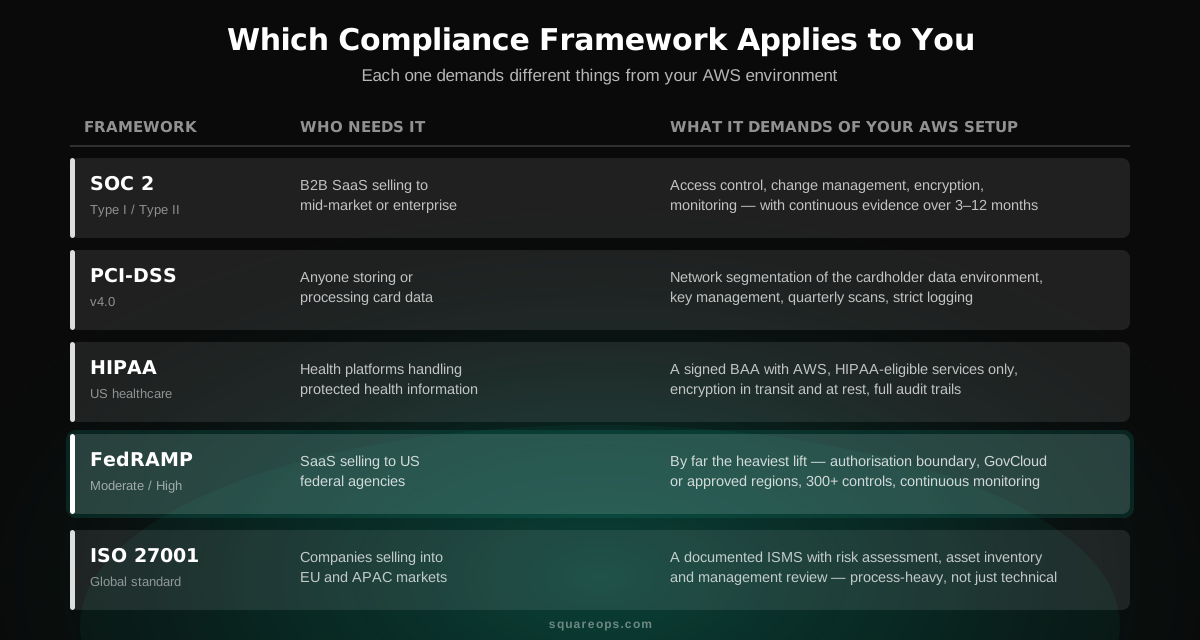
A few points worth drawing out.
SOC 2 has become a procurement default. For B2B SaaS selling to mid-market and enterprise buyers, it is now routinely a condition of closing rather than a differentiator. Type II is the one buyers actually want, and it requires evidence collected continuously over a 3–12 month observation window — which is why starting with the evidence pipeline matters more than starting with a gap assessment. Our guide to AWS SOC 2 compliance for SaaS covers the mechanics.
FedRAMP is a different order of magnitude. Authorisation boundary definition, deployment into GovCloud or approved regions, several hundred controls, and continuous monitoring obligations that persist indefinitely. Teams consistently underestimate it. If US federal is on your roadmap, the architectural decisions that make FedRAMP feasible need to be made well before you start the process.
Multiple frameworks overlap more than they differ. Encryption, access control, logging and change management appear in all of them. A partner who maps controls once and reuses the evidence across frameworks saves substantial effort compared with running each certification as a separate project. Our AWS security checklist for HIPAA, SOC 2 and PCI-DSS sets out where the overlaps sit.
Auditors and Implementers Are Not the Same Thing
This trips up more teams than any other part of the process, and it is worth stating clearly.
An auditor issues the report. For SOC 2 that is a licensed CPA firm; for FedRAMP, an accredited 3PAO. Firms such as Schellman, A-LIGN and Coalfire operate in this space. They assess and attest — and independence rules mean they generally cannot build what they then audit.
An implementer builds and operates the controls: the pipeline gates, the IAM model, the logging architecture, the evidence collection. That is what a DevSecOps partner does.
You will need both. The common failure is engaging an auditor first, receiving a gap assessment listing dozens of findings, and then discovering there is no one to remediate them before the observation window opens. Engage the implementer early enough that controls are operating before evidence collection begins.
How to Evaluate a DevSecOps Partner
Six questions that separate a shortlist:
- Which pipeline stages will you own? Map their answer against the six stages above. Anything less than Plan through Evidence leaves a gap your team must cover.
- Which frameworks have you actually delivered? Ask for the specific framework, the customer's industry and the outcome. "We support compliance" is not an answer.
- What are you certified for yourselves? A partner holding ISO 27001 has been through the process from the inside. One that only advises has not.
- How is evidence collected and stored? If the answer involves screenshots gathered manually before the audit, expect that burden to fall on your team every cycle.
- Who owns remediation? Clarify whether findings come back as a report for your engineers to action, or whether the partner fixes them.
- Where does the code live? Policy definitions, IaC and pipeline configuration should sit in your repositories. If they live with the vendor, you have bought a dependency.
For the underlying practices these questions probe, our guides on CI/CD security best practices and building AWS DevSecOps go a level deeper.
What DevSecOps Engagements Cost in India
Pricing varies more than in adjacent categories because scope varies so much. Three broad shapes:
- Assessment and roadmap — a time-boxed engagement producing a control gap analysis and remediation plan. Useful when you do not know the size of the problem, but it produces a document, not a compliant platform.
- Remediation project — fixed scope to implement controls and prepare for a specific audit. Priced by the framework and the current state of the environment. FedRAMP costs multiples of SOC 2.
- Continuous DevSecOps retainer — ongoing ownership of pipeline security, posture monitoring and evidence collection. The right model if compliance is a permanent obligation rather than a one-time certification, which for SOC 2 Type II and PCI-DSS it is.
Indian providers generally price materially below equivalent US firms for comparable scope. The more important variable is whether the engagement includes ongoing evidence collection, because that is the recurring cost most teams fail to budget for.
Making the Decision
Start from the framework, not the vendor. Establish which one is binding, when the deadline is, and whether you need an implementer, an auditor, or both. Then shortlist partners who have delivered that specific framework for a company at your scale.
Two things are worth insisting on regardless of who you choose: controls defined as code in your own repositories, and evidence collected continuously rather than assembled in a panic before the audit window closes.
If you are running a SaaS or FinTech platform on AWS and need SOC 2, PCI-DSS or FedRAMP-track hardening built into your pipeline rather than bolted on afterwards, explore our cloud security services, review our case studies, or talk to our security team. We will review your current environment against the framework you are targeting and tell you honestly what the gap looks like — including when a specialist firm would serve you better than we would.
For related reading, see our review of AWS managed service providers in India if you are choosing a broader cloud partner alongside your security work, and managed Kubernetes service providers if your compliance scope covers containerised workloads.