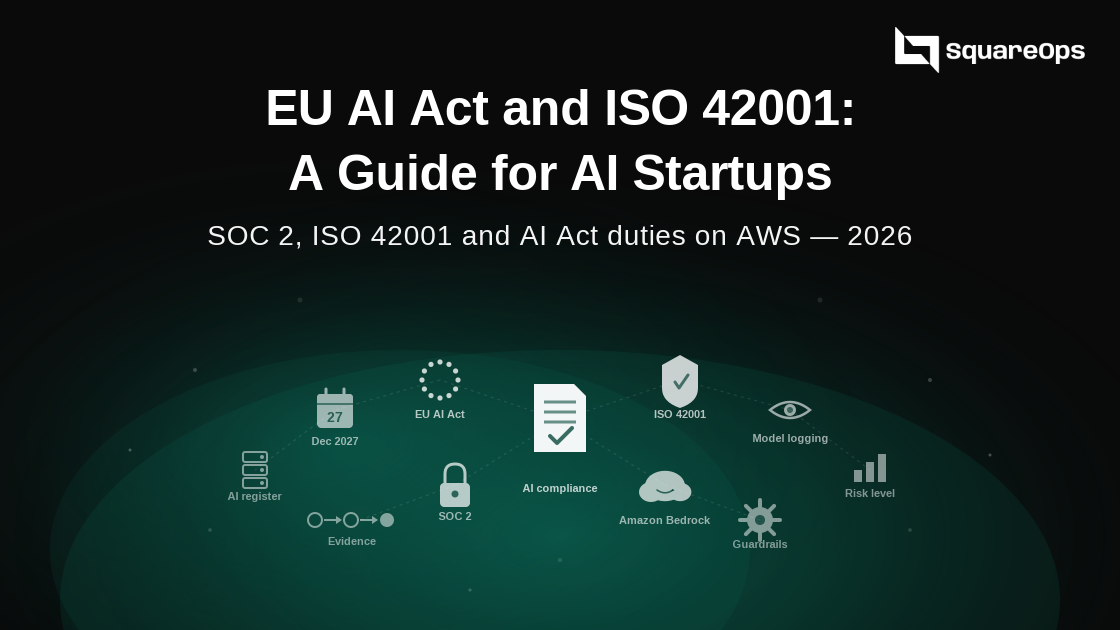
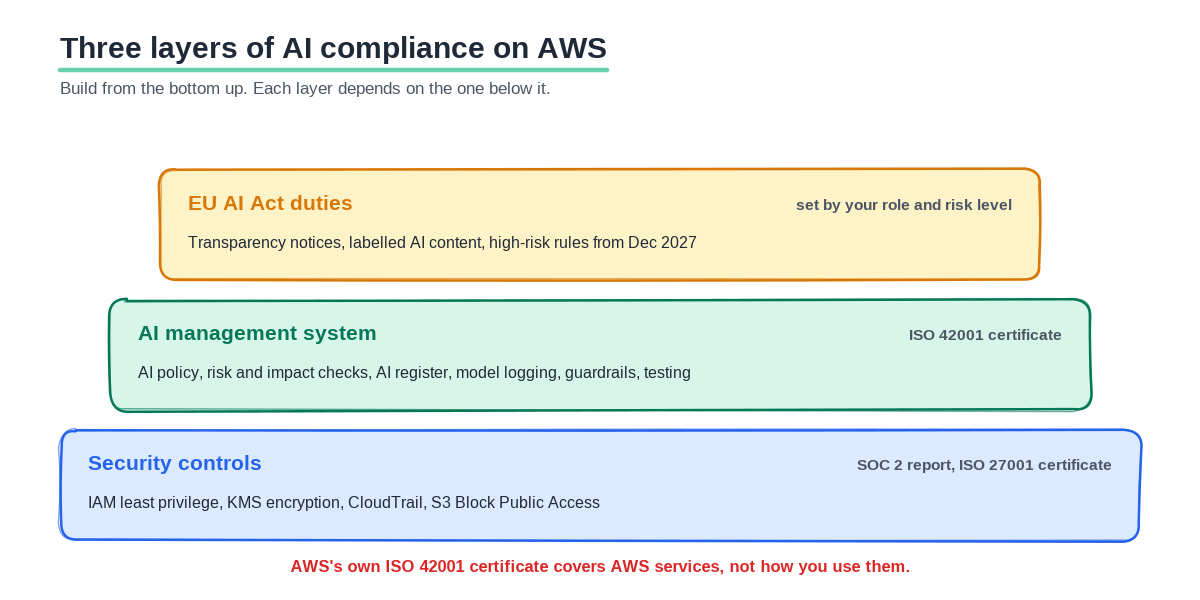
If you sell an AI product into Europe, the EU AI Act already applies to you. Its transparency rules started on 2 August 2026, and the high-risk rules now start on 2 December 2027 after the Digital Omnibus delay. Buyers are also asking for proof: a SOC 2 report, ISO 27001 and, more and more, ISO 42001. On AWS, the sensible order is to build the security controls first, add an AI management system on top, and then map the AI Act duties that fit your role.
Picture a 20-person AI startup selling a meeting notes tool to a German hospital group. The procurement form asks three things. Are you a provider or a deployer under the AI Act? Do you have ISO 42001? Can you share your SOC 2 report? The deal stalls until the startup can answer all three. This guide shows how to get there.
A note before you read. We are cloud engineers, not lawyers, and this is not legal advice. Check your AI Act role and risk class with a qualified adviser. SquareOps also builds Verity, a cloud security tool that appears near the end of this post. We say plainly what it does not cover.
Where the EU AI Act Stands in November 2026
The EU passed a change to the AI Act in 2026, called the Digital Omnibus on AI. It is Regulation (EU) 2026/1744, and it is now in force. It moved the high-risk deadlines back but left most other dates alone.
| Date | What applies |
|---|---|
| 2 February 2025 | Banned AI practices and AI literacy duties |
| 2 August 2025 | Rules for general-purpose AI models, such as large language models |
| 2 August 2026 | Transparency rules, such as telling users they are talking to an AI |
| 2 December 2026 | Labelling of AI-generated content for systems already on the market, plus new bans |
| 2 December 2027 | High-risk rules for stand-alone systems, such as hiring or credit scoring tools |
| 2 August 2028 | High-risk rules for AI built into regulated products, such as medical devices |
The fines are large. The most serious breaches can cost up to €35 million or 7% of global yearly turnover. The Omnibus also gave small and mid-size firms some relief, so check whether you qualify.
First, Work Out Your Role and Risk Level
Your duties depend on two things: your role and how risky your use of AI is.
- Provider. You build an AI system and sell it under your own name. Most AI startups are providers of their own product, even if the model underneath comes from someone else.
- Deployer. You use an AI system inside your business. Your customers are often deployers of your product.
- Model provider. You train and release a general-purpose model. If you call a model through Amazon Bedrock, that duty mostly sits with the model's maker, not with you.
Then check the risk level. Banned uses are off the table. High-risk uses include hiring, credit scoring, education and access to essential services. Chatbots and tools that make text, images or audio have transparency duties. Most other AI, like spam filters, has few new duties.
SOC 2, ISO 27001 and ISO 42001: What Each One Proves
These three get mixed up all the time. They answer different questions for a buyer.
| SOC 2 | ISO 27001 | ISO 42001 | |
|---|---|---|---|
| Question it answers | Do your security controls work? | Do you run security as a managed system? | Do you manage AI risk in a planned way? |
| What you get | An auditor's report | A certificate | A certificate |
| Most asked for in | The US | Europe, India and the Gulf | Enterprise AI deals, more each quarter |
| Covers AI-specific risk? | No | No | Yes |
ISO 42001 was published in December 2023. It sets out how a company should run an AI management system, covering policy, risk and impact checks, data, monitoring and human oversight. It does not replace security controls. It sits on top of them.
AWS earned ISO 42001 certification in November 2024 for Amazon Bedrock, Amazon Q Business, Amazon Textract and Amazon Transcribe. That helps your story, but it does not certify you. You still need your own management system for how you use those services.
What to Build on AWS
Most of the work is the same work a good SOC 2 needs, plus a few AI-specific pieces. Here is what we build first.
- Lock down the basics. Use least-privilege IAM, encryption with KMS, S3 Block Public Access and CloudTrail in every account. Our guide to achieving SOC 2 on AWS covers these in depth.
- Log every model call. Turn on Amazon Bedrock model invocation logging. Keep prompts, responses and model versions where an auditor can find them.
- Filter what goes in and out. Use Amazon Bedrock Guardrails to block harmful content and mask personal data before it reaches the model or the user.
- Test models before and after release. Use Bedrock model evaluation or your own test sets. Record the results each time you change a model or a prompt.
- Keep a register of AI systems. List each AI feature, its model, its data, its owner and its risk level. This one sheet answers half of every procurement form.
- Tell users when AI is involved. Show a clear notice in your app. Label generated images, audio and video, which existing systems must do by 2 December 2026.
- Collect evidence as you go. AWS Artifact gives you AWS's own audit reports. AWS Audit Manager can gather evidence for common frameworks.
The Questions Buyers Will Ask You
Enterprise security reviews for AI products now ask a standard set of questions. Have short, honest answers ready, backed by evidence.
- Which models do you use, and where do they run? Name the model, the provider and the AWS region. Buyers in Europe often want data kept in an EU region.
- Do you train on our data? Say yes or no, and point to the contract clause. With Amazon Bedrock, AWS says your prompts and outputs are not used to train the base models.
- How do you stop harmful or wrong output? Show your guardrails, your tests and how a human can step in.
- Can you show us what the AI did? Show the model call logs and how long you keep them.
- What is your AI Act role and risk level? Give the answer your adviser signed off, in one line.
- Which reports or certificates do you hold? Share your SOC 2 report or ISO certificates, and the date of your next audit.
Keep these answers in one shared document. Sales, security and engineering should all give the same answer every time.
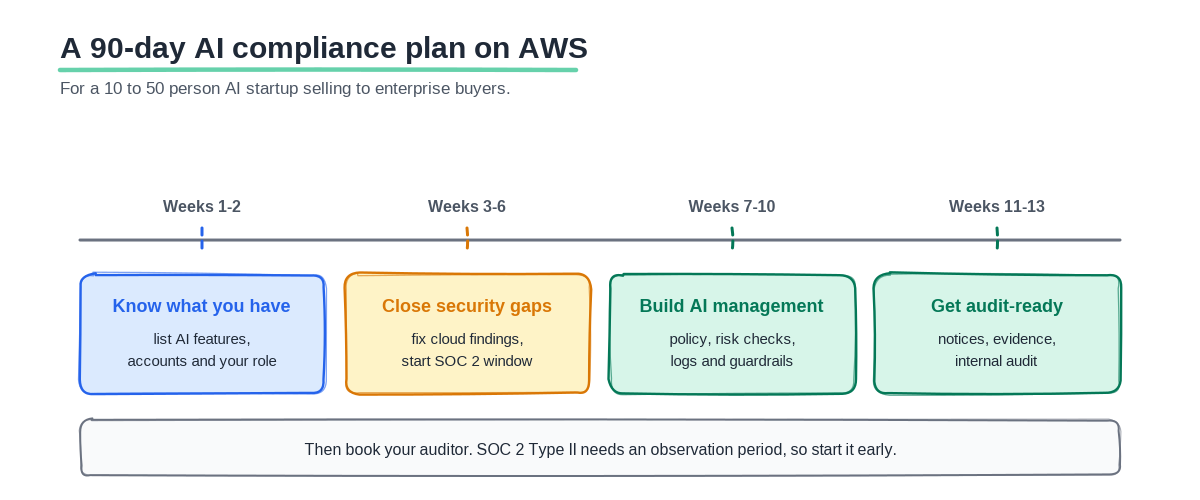
A 90-Day Plan for an AI Startup
This is a realistic plan for a team of 10 to 50 people on AWS that wants to answer enterprise buyers with confidence.
- Weeks 1 to 2: Know what you have. List every AI feature and every AWS account. Work out your role and risk level with your adviser.
- Weeks 3 to 6: Close the security gaps. Fix the cloud findings that block SOC 2 or ISO 27001. Start the SOC 2 observation period if you need a Type II report.
- Weeks 7 to 10: Build the AI management system. Write the AI policy, risk and impact checks, and the AI register. Add logging, guardrails and evaluation on AWS.
- Weeks 11 to 13: Get audit-ready. Add transparency notices, gather evidence and run an internal audit. Then book your certification body.
Where Verity Fits, and Where It Does Not
Verity is a cloud security tool we build at SquareOps. It is in early access. It scans your AWS accounts and Kubernetes clusters, ranks findings by real risk and shows how an attacker could chain them. It maps findings to SOC 2, ISO 27001, HIPAA and PCI DSS controls and keeps that evidence current.
Verity does not map controls to ISO 42001 or the AI Act today. It does not test your models or check your prompts either. Use it for the security layer at the base of your compliance work, and use your AI management system for the rest. See how Verity works.
Mistakes We See
- Treating the delay as a pause. Only the high-risk rules moved. Transparency rules and model rules already apply.
- Assuming AWS's certificate covers you. AWS certifies its own services. Your use of them is your job.
- Starting with ISO 42001 before security. An AI management system on top of weak cloud controls fails the audit anyway.
- Not logging model calls. Without logs you cannot show what the model did, when or why.
- Guessing your risk class. Hiring, lending and education tools are often high-risk. Get advice early.
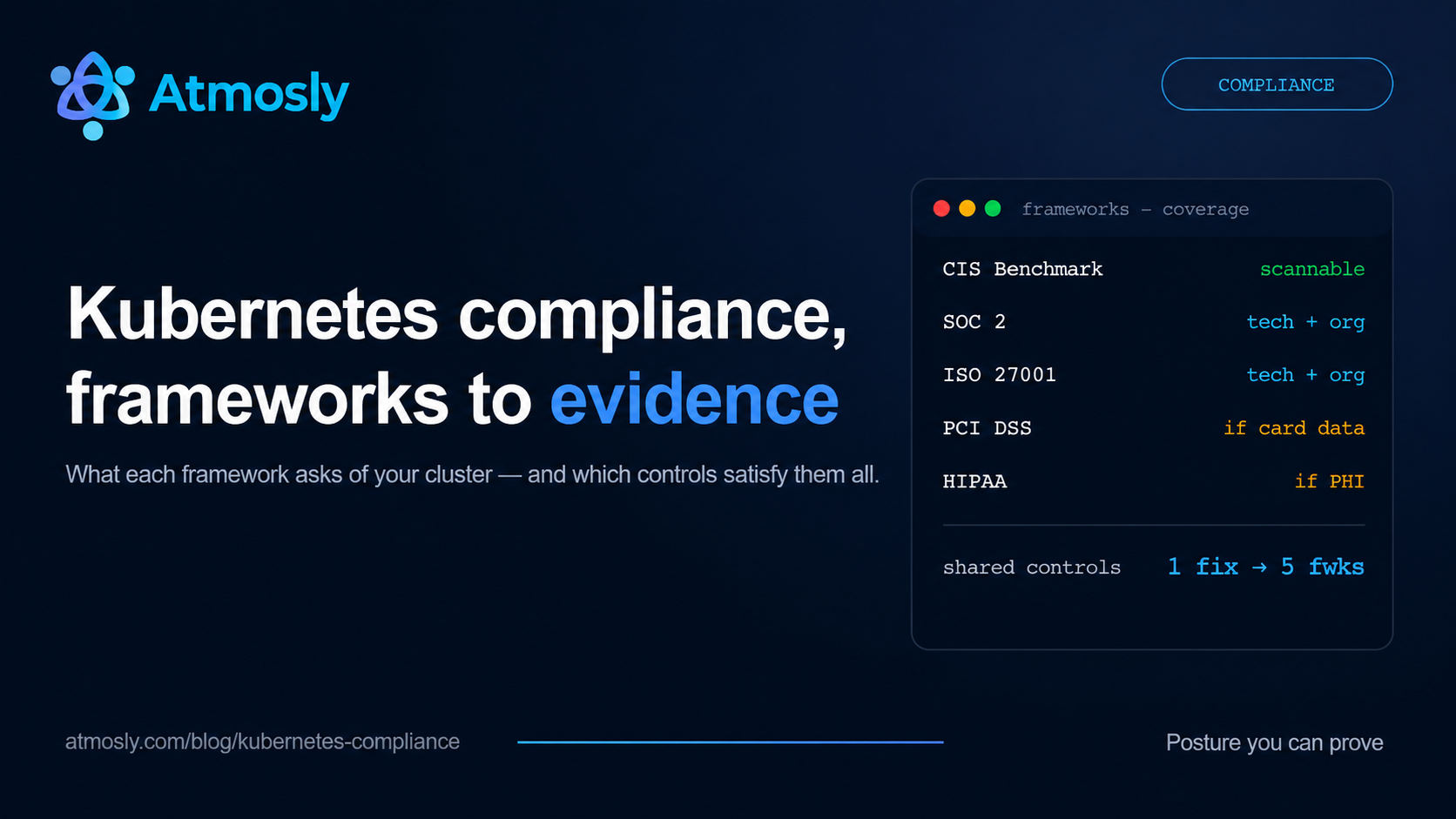
If your platform runs on Kubernetes, our guide to Kubernetes compliance frameworks and evidence covers the cluster side.
Get Your AI Product Ready for Enterprise Buyers
SquareOps helps AI startups on AWS close cloud security gaps, set up logging, guardrails and evidence, and get ready for SOC 2, ISO 27001 and ISO 42001 audits. We work alongside your legal adviser and your auditor. Talk to our cloud security team, or learn more about our cloud security services.