
It's 3:04am and your phone is buzzing itself off the nightstand. Ten pages in ninety seconds — checkout-api pods flapping between OOMKilled and CrashLoopBackOff, each pod firing its own alert. By the time you're at your laptop, you're not debugging yet. You're triaging the alerts: which of these ten are the same problem, which dashboard actually shows the cause, and what change three hours ago set it off.
This is the exact moment the new category of "AI SRE" tools is built for. The problem is that "AI SRE" now means at least four different things, and the tools that share the label do genuinely different jobs. Some sit in Slack and hand you a diagnosis. Some ship their own telemetry. A rare few actually open the pull request that fixes the workload. This guide compares the serious options in 2026 — Cleric, Metoro, Datadog Bits AI SRE, K8sGPT/HolmesGPT, Rootly, and Alert6 (Alert6 is our own product; we say where it fits and where it does not) — on the one axis that decides whether a tool saves you at 3am: does it stop at telling you what's wrong, or does it carry the fix the last mile?
What "AI SRE" actually means in 2026
Strip away the marketing and today's tools fall into four buckets. Most products live mainly in one, even if their landing page implies all four.

The same cluster, three very different jobs. Observability tells you what broke; diagnosis agents tell you why; only fix-shipping agents carry it to a merged change.
- Observability with AI bolted on. Datadog, New Relic, Dynatrace — deep telemetry you already pay for, now with an agent that reasons over it. Great data, and the AI is only as good as your instrumentation.
- Diagnosis-only agents. Cleric, K8sGPT, HolmesGPT. They investigate an alert, form hypotheses, and hand you a ranked root cause with evidence. The fix is still yours to write.
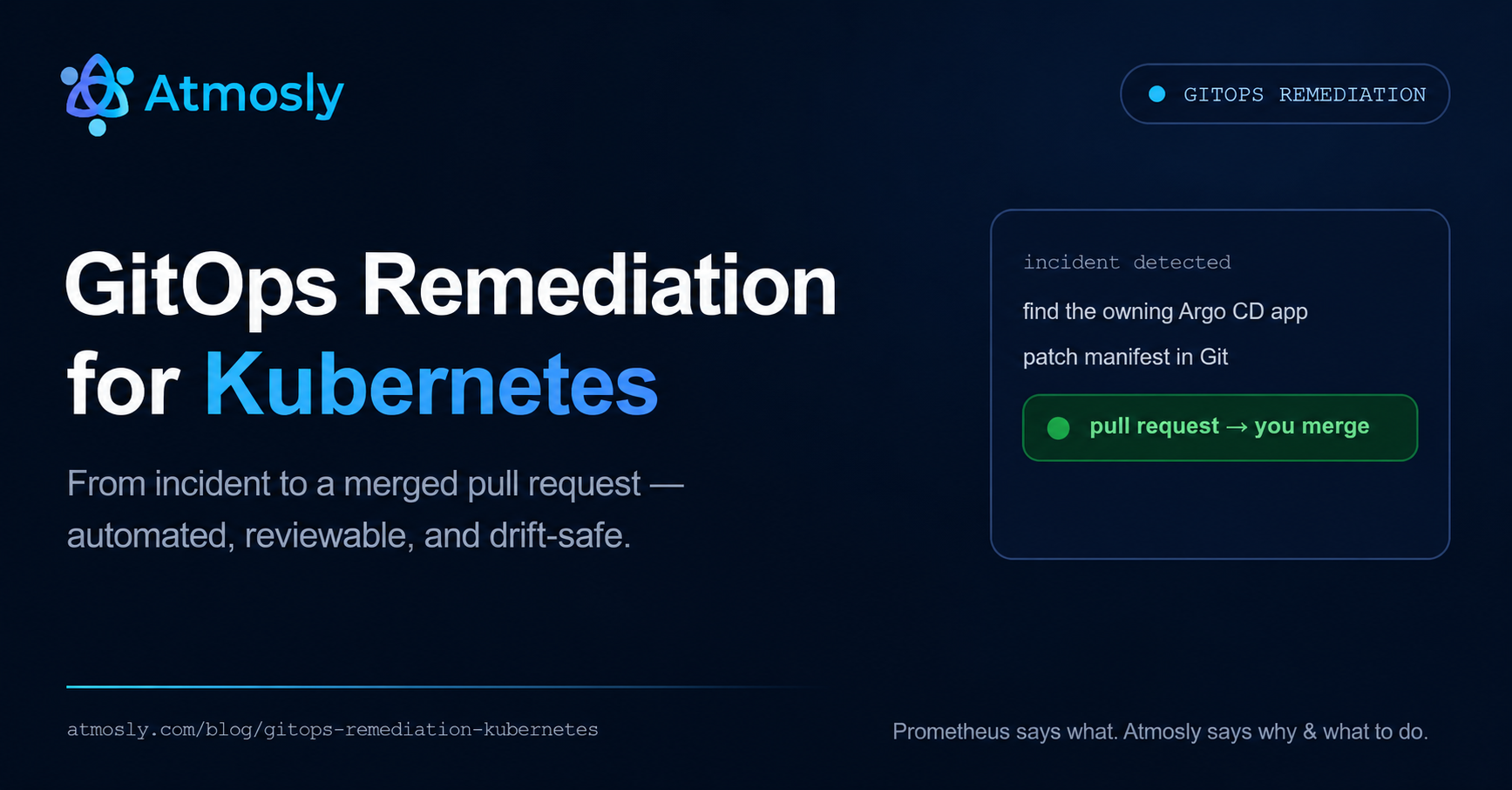
- Fix-shipping agents. Metoro is the clearest example. They go past the diagnosis and open a pull request that changes the workload — which you review and merge.
- Incident-management platforms. Rootly, incident.io. They orchestrate the human response — roles, timelines, retros — and increasingly add AI on top. Different job from finding a root cause in your cluster.
Some products straddle two buckets. Alert6, for example, is an incident-management platform built around AI investigation: it correlates and routes alerts, investigates the probable root cause, and carries remediation through approved or policy-governed runbooks rather than a pull request.
The one question that separates them: diagnose or fix?
Here's the framing that cuts through the noise, and it's worth memorising before you sit through a single demo:
Prometheus tells you what's broken. Most AI SRE tools tell you why. Very few tell you what to do — and then do it.
It's worth being concrete about why that last mile is expensive. A ranked root cause still has to be translated into a manifest change, opened as a PR, reviewed, and merged — and each of those steps happens while the incident is live and the on-call engineer is context-switching under pressure. That's where mistakes creep in: a hand-edited YAML that reformats the whole file, a fix applied directly to a GitOps-managed workload that silently reverts at the next sync, or a change that works tonight but nobody remembers next month when the same alert fires. Tools that only diagnose leave every one of those risks with you.
The practical consequence is that two tools can both claim "AI SRE" and produce wildly different outcomes on the same incident. One hands your engineer a paragraph of analysis at 3am; the other hands them a diff to approve. Both are useful, but only one of them shortens the part of the night that actually hurts. Keep that distinction front of mind as you read the individual tools below.
Nearly every tool in this space has gotten good at the "why." A ranked root cause in three minutes instead of forty is real value. But the last mile — turning "the memory limit is too low" into a reviewed change that's actually merged — is where the category thins out fast. That gap between insight and action is where most of your 3am minutes still go, and it's the single most useful thing to test in an evaluation.
The AI SRE tools, compared
Cleric — the Slack-native diagnostician
Cleric frames itself as an "AI SRE teammate" that takes the first pass on every alert. When something fires, it sweeps logs, metrics, traces, and recent changes, tests multiple hypotheses in parallel, and drops a confidence-backed diagnosis into Slack — often in around five minutes. It runs read-only and connects through APIs rather than deploying agents.
- Where it shines. Reducing alert fatigue and shortening the path to a credible root cause, especially for teams whose incident response already lives in Slack.
- Honest limits. Its output is only as good as your integration coverage and telemetry quality — thin instrumentation means weaker diagnoses. And by design it stops at recommendations: no automated fix generation. You still write and ship the change.
Metoro — the eBPF, Kubernetes-native fixer
Metoro is purpose-built for Kubernetes and is one of the few tools that genuinely carries a fix. Its collector runs as a DaemonSet and captures logs, metrics, traces, and Kubernetes events at the kernel with eBPF — no code changes, SDKs, or sidecars. Its engine detects an issue, root-causes it, and opens a GitHub pull request with a proposed fix; you get pinged with the PR. It's a strong, credible product (YC S23, ex-Palantir/Jump founders) and runs on any CNCF-conformant distribution.
- Where it shines. Teams that want a K8s-native agent that ships its own telemetry layer, so the AI isn't dependent on whatever observability you already have.
- Honest trade-offs. eBPF means kernel-level instrumentation and the privileges that come with it, and it brings its own telemetry stack to run. If you've already standardised on Prometheus and just want action on top, that's a consideration, not a dealbreaker.
Datadog Bits AI SRE — the observability incumbent
If you already live in Datadog, Bits AI SRE is the path of least resistance. It reasons across Datadog's full data surface — metrics, logs, traces, dashboards, changes, source code, RUM, database monitoring, profiler — completes investigations in roughly three to four minutes, and can now initiate automated remediation within the Datadog platform.
- Where it shines. Existing Datadog shops that want AI investigation and remediation without adding another vendor.
- Honest limits. It's most powerful inside the Datadog ecosystem so check how its AI usage is priced before modelling cost at your incident volume. Remediation happens within Datadog's world rather than as a reviewed change in your Git repo. New Relic and Dynatrace occupy a similar position: excellent telemetry, AI layered on, the fix still largely yours.
K8sGPT and HolmesGPT — the open-source scanners
K8sGPT (Apache 2.0, CNCF Sandbox) runs deterministic Kubernetes analyzers and uses an LLM only to explain the findings in plain language. HolmesGPT extends that idea toward multi-step investigation. Both are free, and because they can run in your own environment, incident telemetry stays in your VPC rather than going to a third-party backend.
- Where they shine. A lightweight first-line cluster scanner and a data-sovereignty-friendly starting point. Many teams run K8sGPT as triage and layer a fuller agent on top.
- Honest limits. K8sGPT is a scanner, not an end-to-end incident responder — it explains findings; it doesn't group incidents or open remediation PRs. Treat it as one useful tool in the kit, not the whole workflow.
Rootly and incident.io — incident management, not diagnosis
These belong in the conversation because they're often shortlisted alongside AI SRE agents, but they solve a different problem. Rootly and incident.io orchestrate the human side of an incident — declaring it, assigning roles, keeping a timeline, running the retro — and both are adding AI. Because an incident-management platform already holds rich incident context, it needs fewer external integrations to summarise what's happening.
- Where they shine. Standardising and automating the incident lifecycle across a whole org.
- Honest limits. They're not built to root-cause a crash-looping workload in your cluster or to open the fix. Pair them with a diagnosis or fix-shipping agent rather than expecting one to replace the other.
Alert6 — incident management with AI investigation and governed remediation
Alert6 is SquareOps' AI incident management platform, so read this entry knowing it is ours. It correlates alerts from the monitoring you already run — Prometheus, Grafana, Datadog, New Relic, CloudWatch, Google Cloud Monitoring, Azure Monitor — deduplicates them into one incident, sets severity and routes it to the right on-call team. It then investigates live telemetry, application logs, database statistics and recent deployments or configuration changes, and presents a probable root cause with the queries and evidence behind it. The fix arrives as a remediation runbook with commands, verification steps and a confidence score. We'll go deeper on how it works below.
- Where it shines. Teams that want correlation, investigation, on-call routing and post-incident RCA drafts in one workflow, on top of their existing monitoring rather than a new telemetry stack.
- Honest scope. Investigation is read-only by default, and remediation runs as a runbook an engineer approves — or automatically only for runbooks you explicitly allow-list under policy and confidence thresholds. It does not open GitOps pull requests the way Metoro does, so if your remediation must arrive as a diff in your repo, weigh that.
The AI SRE tools at a glance
A quick side-by-side on the dimensions that actually change your on-call life. "Opens a fix PR" is the column most buyers under-weight and later wish they hadn't.
| Tool | Primary job | Opens a fix PR? | Kubernetes focus | Best fit |
|---|---|---|---|---|
| Cleric | Diagnosis in Slack | No — recommendations only | Multi-stack | Slack-centric IR, fast root cause |
| Metoro | Detect + fix (eBPF) | Yes — GitHub PR | Kubernetes-native | K8s teams wanting a bundled telemetry + fix agent |
| Datadog Bits | Investigate + remediate | In-platform remediation | Multi-stack | Existing Datadog shops |
| K8sGPT / HolmesGPT | Open-source scanning | No | Kubernetes | First-line triage, data sovereignty |
| Rootly / incident.io | Incident lifecycle | No (not their job) | Multi-stack | Org-wide IR orchestration |
| Alert6 | Correlate + investigate + governed remediation | No — approved or policy-governed runbooks | Kubernetes and cloud | On-call teams wanting incidents, investigation and RCA in one workflow |
How to choose the right AI SRE tool
There's no single winner — the right tool depends on where your pain actually is. A few honest decision rules:
- If your incidents live in Slack and you mostly need a faster root cause — start with a diagnosis-first agent like Cleric.
- If you're all-in on Datadog — evaluate Bits AI SRE before adding a new vendor; the integration depth is hard to beat inside that ecosystem.
- If you want data sovereignty or a free starting point — run K8sGPT or HolmesGPT in your own cluster as first-line triage.
- If your real cost is the last mile — writing and shipping the fix — look hard at fix-shipping agents like Metoro, and weigh a PR-based fix against a governed runbook that runs on approval, which is Alert6's model.
- If you need to standardise the human response across teams — that's an incident-management platform (Rootly, incident.io), used alongside, not instead of, a diagnosis or fix agent.
- If you want correlation, investigation and on-call in one place, on top of your existing monitoring — evaluate an incident platform with AI investigation built in, such as Alert6.
The most useful test in any trial: take a real recurring incident and count the minutes from alert to merged change. That number, not the demo's root-cause speed, is what you're actually buying.
Where Alert6 fits
Alert6 is built around the stretch between the first page and the post-incident review. It is worth walking the loop — correlate, investigate, remediate, learn — because each stage maps to a question in the checklist below.
Correlate — the alert-fatigue fix. Related alerts from metrics, logs, infrastructure and application monitoring are combined into one incident, deduplicated, given a severity and routed to the right on-call team. Four alerts about checkout latency, database CPU, queue lag and error rate become one incident with one owner, paged once, instead of four near-identical pages. Alerts arrive from the monitoring you already run, and incidents flow to Slack, PagerDuty, Jira or webhooks.
Investigate. Alert6 checks the relevant telemetry, database statistics, application logs and recent deployments or configuration changes, then presents a probable root cause with a confidence score and an evidence timeline. It shows the queries and results behind the conclusion, so an engineer can check the reasoning instead of trusting a paragraph.
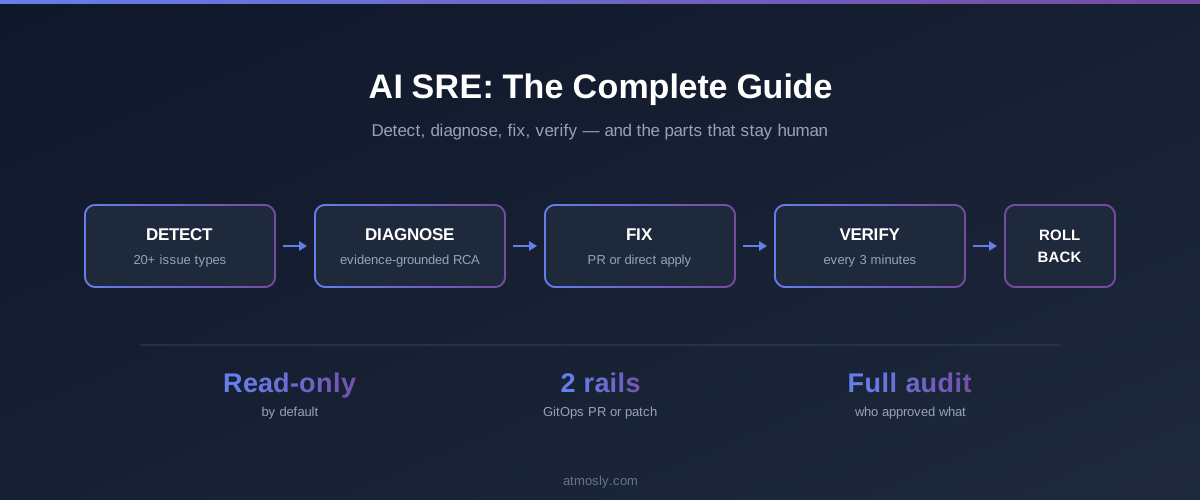
Remediate under control. The proposed fix is a runbook: commands, verification steps and a confidence score. An authorized engineer approves execution, or policy-governed automation runs runbooks you have explicitly allow-listed under configured confidence thresholds. Investigation is read-only by default, and every approval and execution is recorded in an audit log.
Learn. Alert6 auto-drafts the root-cause report with action items, and connects incident history to SLOs, error budgets and on-call schedules, so recurring incidents show up as a reliability trend rather than a string of unrelated nights.
Honest scope. Alert6 does not bring its own telemetry layer, so diagnosis quality depends on the monitoring you connect, and it remediates through runbooks rather than by opening a pull request against your manifests. If GitOps-PR delivery is a hard requirement, test that path specifically. Pricing is per monitored service, with a free tier for up to five services.
What to look for in an AI SRE tool: an evaluation checklist
Demos are optimised to show a fast, clean root cause. Real evaluations should probe the parts that don't demo well. Score every shortlisted tool against these seven dimensions:
- Action depth. Does it stop at a recommendation, remediate inside its own platform, or open a reviewable change in your Git repo? This is the biggest differentiator and the easiest to gloss over.
- Integration model. Agent-based, API-based, or eBPF? Each has a different security and setup footprint. Ask what privileges it needs and whether customer data leaves your environment.
- Noise reduction. Does it group related failures into one incident, or forward every pod's alert? Grouping is what actually cuts pager fatigue at 3am.
- Diagnosis quality under thin telemetry. Agents that lean entirely on your existing observability degrade when instrumentation is sparse. Test on a genuinely messy service, not the happy path.
- Guardrails and reversibility. Is it read-only by default? Is every action auditable and reversible? Who is in the loop before anything touches production? Reviewability should be a feature, not an afterthought.
- Institutional memory. When the same incident recurs next month, does the tool remember how you fixed it last time, or does the next engineer start from zero?
- Operational overhead and cost model. Does it bring its own telemetry stack you now have to run? Is pricing per-node, per-seat, or usage-based credits? Model the fully-loaded cost, not the sticker price.
Common mistakes when adopting an AI SRE agent
The teams that get the most from these tools tend to avoid the same handful of traps:
- Buying on root-cause speed alone. A three-minute diagnosis is impressive, but if your engineers still spend forty minutes writing and shipping the fix, you've optimised the cheap part of the incident. Measure alert-to-merged-change, not alert-to-diagnosis.
- Ignoring the instrumentation dependency. An agent that reasons over your telemetry is only as good as that telemetry. If half your services lack useful logs and traces, fix that first or pick a tool that ships its own data layer.
- Expecting one tool to do every job. A diagnosis agent won't run your incident lifecycle, and an incident-management platform won't root-cause a crash loop. The strongest setups combine categories deliberately rather than forcing one tool to cover all four.
- Letting an agent mutate production autonomously. The appeal of "self-healing" fades the first time an automated change makes an outage worse. Insist on a human approval — a reviewed pull request or an approved runbook — or explicit, narrowly scoped policy before anything alters running workloads.
- Skipping closure discipline. Tools that capture what actually fixed an incident only pay off if your team writes the closure note. Treat each fix as a reusable artifact, not a one-off.
Key takeaways
- "AI SRE" is four categories, not one — observability-plus-AI, diagnosis agents, fix-shipping agents, and incident-management platforms. Match the tool to your actual pain.
- Almost everyone nails the "why." The differentiator in 2026 is whether the tool carries the fix the last mile to a reviewed, merged change.
- Cleric is a strong Slack-native diagnostician; Metoro actually opens fix PRs; Alert6 pairs incident management with AI investigation and governed runbooks; Datadog Bits is the natural pick inside Datadog; K8sGPT/HolmesGPT are great open-source first-line scanners; Rootly/incident.io run the human response.
- Test the alert-to-merged-change time on a real recurring incident — that's the number that changes your on-call life.
- Alert6 correlates alerts into incidents, investigates with evidence, and runs fixes only on approval or under explicit policy — with every action audited and an RCA drafted afterwards.
Want to see correlation, investigation and an approved fix against your own alerts? An Alert6 engineer can connect one alert source and walk an incident through to a proposed fix. Book an Alert6 demo.