
Cloud native architecture is no longer the frontier; it's the default. The Cloud Native Computing Foundation's 2025 annual survey found that 98% of organizations use cloud native techniques, 82% of container users run Kubernetes in production (up from 66% in 2023), and 66% now run generative AI workloads on Kubernetes (CNCF, January 2026).
But adopting the tools isn't the same as getting the benefits. Plenty of teams run Kubernetes and still deploy monthly, fight outages and overpay for idle clusters. This guide explains what cloud native architecture actually is, the principles and components behind it, what a working reference architecture looks like, what changed in 2025–2026, where it goes wrong, and how to move toward it step by step.
What Is Cloud Native Architecture?
Cloud native architecture is a way of designing and running software so it takes full advantage of elastic, automated, on-demand infrastructure. The CNCF's official definition describes technologies that let organizations build and run scalable applications in modern, dynamic environments such as public, private and hybrid clouds, exemplified by containers, service meshes, microservices, immutable infrastructure and declarative APIs.
The original described cloud native as "collections of small, independent services." Microservices are a common pattern, but not a requirement. A well-structured application running in containers, deployed automatically, observed properly and recovering on its own is cloud native whether it's one service or a hundred.
The CNCF, founded in 2015 under the Linux Foundation, is a vendor-neutral foundation that hosts projects such as Kubernetes, Prometheus, Argo, OpenTelemetry and Crossplane. It maintains the definition above, not a framework you must follow.
Cloud native vs cloud hosted
| Cloud hosted (lift-and-shift) | Cloud native | |
|---|---|---|
| How it runs | Existing app on cloud virtual machines | Containers, serverless functions and managed services |
| Scaling | Manual or coarse-grained | Automatic, per service |
| Deployments | Infrequent, often manual | Frequent, automated, low-risk |
| Failure handling | Restore from backup | Self-healing; designed for failure |
| Infrastructure | Configured by hand | Declared in code |
Lift-and-shift is often a sensible first step in a cloud migration; cloud native is where most of the agility and cost benefit comes from.
Six principles of cloud native architecture
The original listed speed, stateless components, managed services and security. Speed is really an outcome; here are the principles that produce it.
- Design for failure. Assume any instance, zone or dependency can fail. Use health checks, retries with backoff, timeouts and multiple Availability Zones.
- Keep services stateless. Store state in managed databases, caches and queues so any instance can serve any request and scale freely.
- Prefer managed services. Let the cloud run databases, queues and Kubernetes control planes so your team runs less undifferentiated infrastructure.
- Declare, don't script. Describe the desired state in code and let controllers reconcile reality to match it.
- Automate everything. Builds, tests, deployments, scaling, certificate renewal and recovery should need no manual steps.
- Observe and secure by default. Every service emits telemetry from day one, and security follows zero trust with defence in depth, as the original noted, extended to the software supply chain
Principles of Cloud Native Architecture
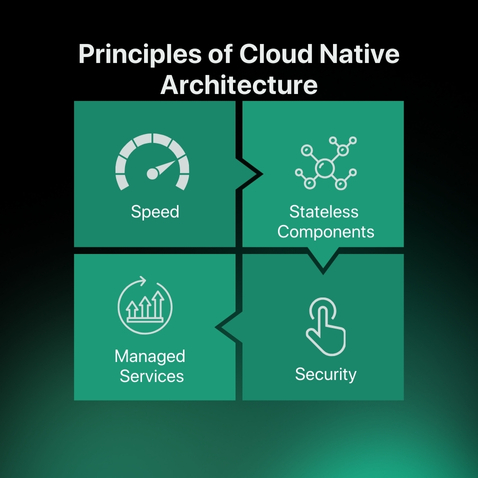
Several guiding principles underpin cloud-native architecture:
- Speed: Cloud native architectures prioritize speed through efficient resource utilization, enabling rapid development. This focus on speed allows businesses to quickly respond to market changes and deliver value to users faster.
- Stateless Components: Services avoid storing state internally. Instead, they rely on external data stores. This simplifies scaling and recovery, as any instance of a service can handle any request.
- Managed Services: Cloud native architectures often use managed services offered by cloud providers. These services handle operational tasks like database management and message queuing, reducing operational overhead.
- Security: Cloud native architectures implement the zero-trust model, assuming no implicit trust. They use defense-in-depth strategies, adding multiple layers of security.
Now, let’s dive into the components of cloud-native architecture that make these principles come to life.
Key Components Of Cloud Native Architecture
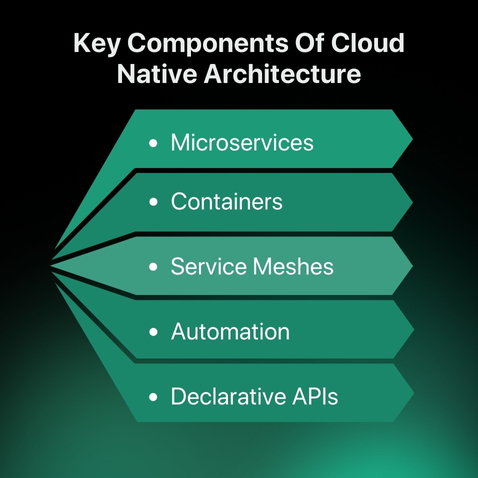
A few key components make up cloud-native architecture. To sum them up is this list:
- Microservices: These small, independently deployable services each perform a specific business function.
- Containers: These lightweight, portable packages contain the application code, runtime, system tools, system libraries, and settings.
- Service Meshes: These dedicated infrastructure layers manage service-to-service communication.
- Automation: Automation can be enabled at every stage of the application lifecycle, from building and testing to deployment and monitoring.
- Declarative APIs: These interfaces define the desired state of the system.
Let’s go through each of these components in some detail now!
1. Microservices
The original's three benefits still hold: independent scaling, loose coupling through APIs, and services focused on one business capability. The cost is distributed-system complexity: network calls instead of function calls, data consistency across services, and many more things to deploy and monitor.
A useful rule: split a service out when a team needs to deploy it independently or scale it differently, not before. Many successful products run a modular monolith in containers and extract services only where it pays off.
- Flexibility and Independent Scaling: Teams can develop, deploy, and scale individual services independently. This allows for faster development cycles and efficient resource use.
- Loose Coupling: Microservices communicate through well-defined APIs. This loose coupling means changes to one service have minimal impact on others. This isolation simplifies development and maintenance.
- Focus on Specific Problems: Each microservice addresses a particular business problem. This specialization leads to simpler code and easier understanding.
2. Containers and Orchestration
Containers package code with its runtime and dependencies so it behaves the same on a laptop, in CI and in production. Kubernetes schedules those containers across a cluster and handles the jobs the original listed: placement, scaling, service discovery, load balancing and restarting failed containers.
Kubernetes releases a new minor version roughly every four months, and the project supports the three most recent; v1.37 shipped in August 2026. Most teams run a managed service such as Amazon EKS rather than operating the control plane themselves, and should plan upgrades so clusters don't fall into paid extended support. See our managed Kubernetes service and Kubernetes upgrade strategy
3. Automation and DevOps
Automation is one component that cloud native architectures largely benefit from. DevOps practices, which emphasize collaboration and automation between development and operations teams, are essential for achieving agility and speed. Key aspects of automation and DevOps include:
- Continuous Integration/Continuous Delivery: CI/CD pipelines automate the building, testing, and deployment of applications. This enables frequent and reliable releases.
- Infrastructure as Code (IaC): IaC treats infrastructure as code, allowing for automated provisioning and management of resources. This increases consistency and reduces errors.
- Automated Testing: Automated tests occur at various stages of the development process, ensuring code quality and reducing the risk of regressions.
Not convinced yet? Let’s take a look at some of the amazing benefits that cloud-native architecture can provide for your operations.
4. Traffic management: Gateway API and service mesh
How traffic reaches services changed significantly in 2026. Kubernetes SIG Network retired Ingress NGINX, one of the most widely used ingress controllers, ending maintenance in March 2026, and recommends Gateway API as its modern replacement. New clusters should start with Gateway API; existing ones should plan the migration.
A service mesh, which the original listed without explanation, manages traffic between services: mutual TLS encryption, retries, traffic splitting for canary releases and per-request telemetry. It's valuable with many services and strict security needs, but adds operational load. Istio's ambient mode removes the per-pod sidecar proxy, reducing that overhead. See our service mesh consulting.
Benefits of Cloud Native Architecture
Adopting a cloud-native approach brings multiple benefits:
- Scalability and Agility: Applications can scale quickly to meet changing demands. This allows businesses to adapt to market conditions and user growth.
- Cost Efficiency: Optimized resource use and reduced operational overhead lead to cost savings. Pay-as-you-go cloud models further enhance cost efficiency.
- Enhanced Developer Productivity: Modularity and faster testing processes improve developer productivity. Independent deployments allow teams to work concurrently.
- Improved Resilience: Microservices architecture combined with container orchestration creates more resilient applications. If one service fails, others can continue to operate.
- Faster Time to Market: Agile development practices and automated deployments reduce the time it takes to release new features and applications.
It’s also important to understand that not all solutions are perfect, so let’s take a look at what challenges cloud native architectures come with.
What changed in 2025–2026
- Kubernetes became the AI platform. CNCF reports 66% of organizations run generative AI workloads on Kubernetes, which now schedules GPUs and inference services alongside ordinary apps. Our MLOps and AI infrastructure team works on exactly this.
- Ingress NGINX retired; Gateway API took over.
- Platform engineering went mainstream. Platform teams package cloud native tooling into self-service golden paths so product teams don't each assemble their own stack. See platform engineering services.
- Culture overtook technology as the main blocker. CNCF found cultural change within development teams is now the top challenge, ahead of technical complexity.
Benefits of cloud native architecture
The original's five benefits remain accurate: scalability and agility, cost efficiency through right-sized, pay-as-you-go resources, developer productivity from independent deployments, resilience because one failing service needn't take down the rest, and faster time to market through automated delivery.
Challenges and trade-offs
- Complexity: many moving parts, more to learn and operate.
- Observability: without OpenTelemetry and SLOs from the start, incidents become hard to diagnose.
- Security: a larger attack surface across services, images and dependencies.
- Operational overhead: Kubernetes upgrades, add-on management and on-call need real expertise.
- Cost sprawl: many small services, idle clusters and over-requested pods quietly inflate bills. Tag everything and review cost per service; our Karpenter and EKS cost work targets this directly.
When cloud native isn't the right choice
Cloud native is not automatically better. A small team with one product and steady traffic may be better served by a well-built monolith on a managed platform. Splitting into microservices before you have the team, tooling and observability to run them often slows delivery rather than speeding it up. Adopt the principles (automation, declarative infrastructure, observability) first; adopt the distributed architecture when a real scaling or team-autonomy problem demands it.
Challenges With Cloud Native Architecture
While cloud-native architecture offers significant advantages, it also presents certain challenges:
- Complexity: Managing many interacting services can be complicated.
For instance, SquareOps helped a client with their microservices architecture by implementing robust monitoring tools and clear communication protocols to manage the complexity and ensure smooth operations.
- Monitoring and Observability: With so many moving parts in a microservices environment, tracking performance and metrics can be tricky. Tools like distributed tracing are essential.
- Security: Securing a distributed system is key. This includes using zero-trust principles, secure communication, and strong access control.
- Operational Overhead: While cloud services reduce some management effort, a cloud-native setup still requires expertise. Automating key processes and providing training ensures operations run smoothly without getting bogged down.
To help you avoid these challenges in adopting cloud-native architecture, we recommend you talk to SquareOps, leaders in cloud development and migrating on-premises infrastructure to the cloud.
Just take a look at our case studies to see how we’ve achieved this!
A Cloud-Ready Solution
Cloud native architecture offers a powerful and effective approach to building and running modern applications. By applying the principles and solutions we’ve outlined in this article, you can achieve greater agility, scalability, and efficiency.
Remember, SquareOps is a leading cloud migration and native architecture expert.
Conclusion
Cloud native architecture is a set of principles before it is a set of tools: design for failure, keep services stateless, declare infrastructure in code, automate everything, and observe and secure by default. Kubernetes, Gateway API, GitOps and OpenTelemetry are today's best implementations of those ideas. Start with one service, measure the results, and expand what works.
Planning a move to cloud native? Get an architecture review from SquareOps.