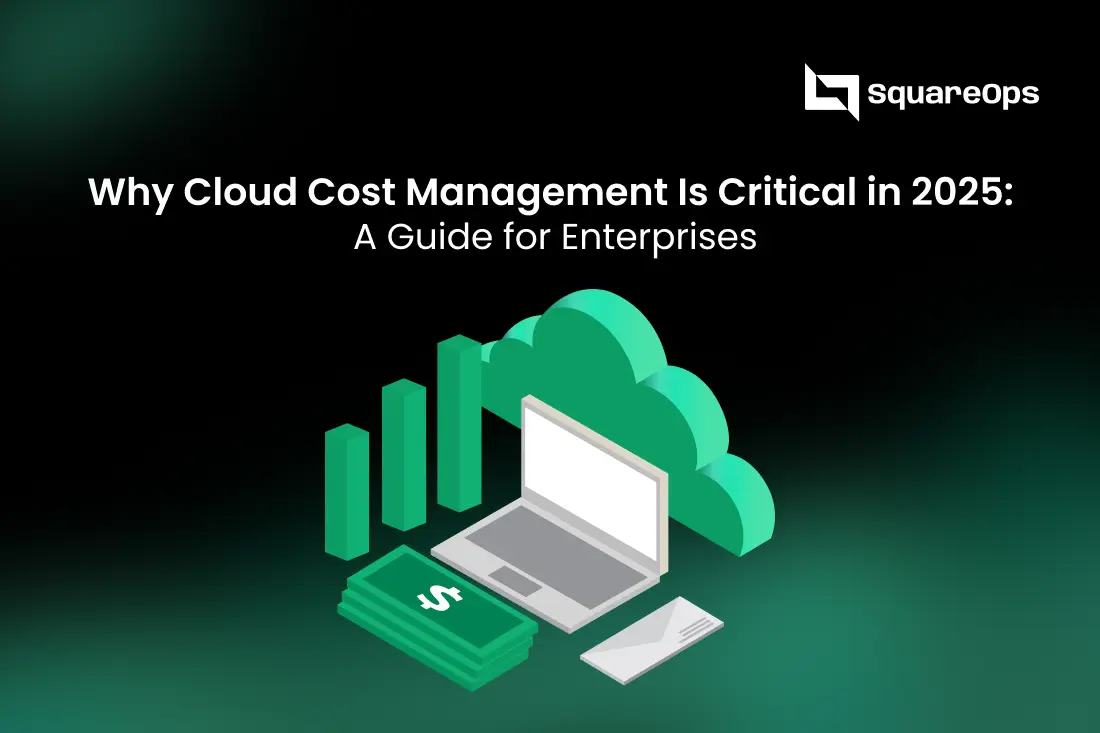
Enterprise cloud cost management has moved from a finance clean-up exercise to a board-level discipline. Gartner forecast worldwide public cloud spending of $723.4 billion in 2025, growing more than 20% a year (Gartner), and AI workloads are now accelerating that growth.
Waste is growing with it. Flexera's 2026 State of the Cloud Report estimates that 29% of infrastructure and platform (IaaS and PaaS) spend is wasted, the first increase after five years of decline, largely because AI workloads and new pricing models make costs harder to predict (Flexera). For an enterprise spending $2 million a month, that's roughly $7 million a year.
This guide explains what cloud cost management means for a large organization in 2026, where the money actually leaks, how to run it as an operating model rather than a one-off project, how to handle AI costs, which metrics to report, and how to mature step by step.
What is Cloud Cost Management?
Cloud cost management is the practice of tracking, allocating, optimizing and forecasting cloud spending so it delivers business value. The original's four pillars remain a good summary:
Core Pillars of Cloud Cost Management:
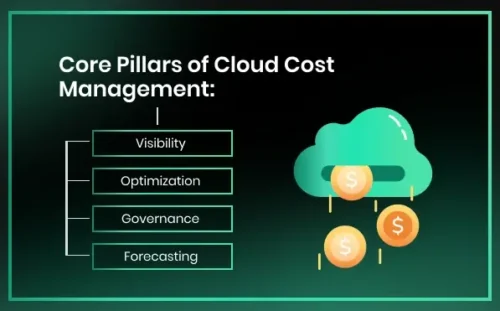
- Visibility: what is being used, by whom, and at what cost.
- Optimization: removing waste through rightsizing, automation and better pricing.
- Governance: policies that prevent overspending and misuse.
- Forecasting: predicting spend so budgets are realistic.
Difference Between Cloud Cost Management and FinOps:
Cloud cost management covers the tactical work: reporting, rightsizing, buying commitments. FinOps is the operating model that makes it stick, bringing engineering, finance, procurement and product together to make trade-offs between speed, cost and quality.
The FinOps Foundation's Framework 2025 broadened the discipline to "Cloud+": it introduced Scopes so the same practices apply to public cloud, SaaS, data centre and AI spending (FinOps Foundation). For enterprises with large SaaS estates and growing AI bills, that's the right lens.
Why Cloud Cost Management is Critical in 2026
- Rising spend. Cloud is now one of the largest lines in many IT budgets, and it grows with usage automatically. Without controls, spend grows faster than revenue.
- AI changes the cost curve. GPU instances, model tokens and vector databases are expensive, spiky and hard to forecast. The FinOps Foundation's State of FinOps 2026 survey names FinOps for AI as practitioners' top forward-looking priority.
- Multi-cloud and hybrid complexity. Each provider has different pricing, discounts and tools. Flexera finds most organizations now run hybrid estates, often as a result of history rather than design.
- Economic scrutiny. CFOs want to know what each dollar of cloud spend returns, not just what it costs.
- Financial governance. The original framed this as a compliance risk. The real issue is control: accurate allocation, chargeback or showback to business units, and auditable approval of large commitments.
- Sustainability. Waste and emissions move together. Providers now publish carbon data, such as the AWS Customer Carbon Footprint Tool, so cost and sustainability reporting can share the same allocation model.
Challenges Enterprises Face Without Cost Management
Enterprises that lack structured cost management encounter several pitfalls:
- Idle Resources: Unused virtual machines, storage volumes, and databases running 24/7.
- Overprovisioning: Buying large instances when smaller ones would suffice.
- Shadow IT: Teams spinning up cloud resources without approval or governance.
- Unpredictable Billing Spikes: Bills fluctuate due to seasonal workloads.
- Lack of Accountability: No clarity on which department owns costs.
These challenges create financial inefficiency and frustrate both engineering and finance leaders.
Benefits of Cloud Cost Management Services
Adopting cloud cost management services delivers measurable business benefits:
- Transparency: Single-pane dashboards across AWS, Azure, and GCP.
- Cost Savings: Typical savings of 20–40% on monthly cloud bills.
- Predictability: Budgets and forecasts aligned with real usage.
- Efficiency: Rightsized resources and optimized utilization.
- Governance: Clear ownership and accountability for spend.
- Enterprise Growth: Ability to scale cloud workloads without uncontrolled costs.
Managing AI and GPU costs
AI spending behaves differently from ordinary cloud spend: GPU capacity is scarce and expensive, inference costs scale with every user request, and token prices differ widely between models. Five practices bring it under control:
- Tag and allocate AI spend separately, by model, feature and team, including managed AI services such as Amazon Bedrock.
- Track cost per inference or per AI feature, not just the monthly total.
- Match the model to the task. Smaller or distilled models often handle routine requests at a fraction of the cost.
- Use batch inference and caching wherever real-time answers aren't needed.
- Shut down idle GPU capacity automatically, and commit to GPU capacity only once usage is steady.
Our MLOps and AI infrastructure team builds these controls into AI platforms from the start.
Metrics that matter: from total spend to unit economics
Total spend tells you little on its own; a growing bill can be good news if the business is growing faster. Enterprises should report a small set of KPIs:
| KPI | What it shows | Typical owner |
|---|---|---|
| Cost allocation coverage | Share of spend with a clear owner | FinOps team |
| Unit cost (per customer, transaction or order) | Whether cloud efficiency improves as you grow | Product and finance |
| Commitment coverage and utilization | Whether discounts are being used well | FinOps team |
| Forecast accuracy | How close spend lands to budget | Finance |
| Waste ratio (idle and unused resources) | How much spend delivers nothing | Engineering |
| Anomalies detected and resolved | How quickly surprises are caught |
Tools and Techniques for Cloud Spend Management
Native Cloud Tools
- AWS Cost Explorer & Budgets: Analyze and forecast AWS spending.
- Azure Cost Management: Provides dashboards, budgets, and recommendations.
- GCP Cloud Billing: Offers real-time insights into Google Cloud costs.
Third-Party Tools
- CloudHealth by VMware – enterprise-grade cost management.
- Apptio Cloudability – FinOps-driven spend optimization.
- Datadog & Finout – unified monitoring + cost tracking.
Optimization Techniques
- Rightsizing: Match instance size to actual workload.
- Reserved Instances & Savings Plans: Commit to usage for discounts.
- Spot Instances/Preemptible VMs: Deeply discounted compute for fault-tolerant workloads.
- Storage Tiering: Move cold data to cheaper storage (e.g., S3 Glacier).
Strategies to Optimize Cloud Costs
Enterprises must adopt structured strategies to optimize cloud costs:
- Implement FinOps Framework
Create cross-functional teams with finance, engineering, and operations sharing accountability. - Automate Scaling
Use auto-scaling groups and serverless technologies to match capacity with demand. - Set Budgets and Alerts
Prevent bill shocks with automated alerts and anomaly detection. - Establish Cost Ownership
Tag resources by team, project, or department to track spend accurately. - Conduct Regular Audits
Quarterly reviews to identify unused resources and optimize instances. - Partner with Cloud Experts
Cloud cost management services, such as SquareOps, provide audits, monitoring, and ongoing optimization.
Case Study: Enterprise Saves 35% With Cost Optimization
Background:
A global e-commerce enterprise was spending $500,000/month across AWS and Azure.
Challenges:
- Overprovisioned EC2 instances.
- Unused storage volumes.
- Multiple accounts without centralized governance.
Solution:
- Implemented FinOps framework.
- Rightsized compute instances.
- Introduced auto-scaling on GCP for peak workloads.
- Applied AWS Reserved Instances and Azure Savings Plans.
Results:
- Saved 35% (~$2.1M annually).
- Improved cost visibility for finance teams.
- Extended cloud budget runway without slowing innovation.
The Future of Cloud Cost Management (2026 and Beyond)
- AI-Driven Optimization
Machine learning algorithms will automatically recommend and implement cost-saving measures. - Real-Time Multi-Cloud Optimization
Enterprises will shift workloads dynamically across AWS, Azure, and GCP for the lowest-cost performance. - FinOps Automation
FinOps will move from manual reporting to automated, predictive financial governance. - Carbon-Aware Cost Management
Cloud providers will integrate sustainability metrics into cost dashboards. - Deeper Integration With DevOps and SRE
Cloud cost optimization will be embedded directly into deployment pipelines.
Conclusion
In 2026, cloud cost management is critical for enterprises not because bills are large, but because they're growing faster and less predictably than ever, driven by AI. The organizations that get it right treat it as an operating model: every dollar allocated to an owner, rates and usage optimized by the right teams, and unit economics reported alongside revenue.
Start with visibility and ownership, then build the habits that keep savings from leaking back. Want a clear picture of where your cloud spend goes? Book a cloud cost review with SquareOps.