
A warehouse management system (WMS) is the operational brain of a distribution center. It directs receiving, put-away, picking, packing, shipping and inventory control, and increasingly it coordinates robots, conveyors and sorters in real time. When it fails, trucks wait at the dock, orders miss carrier cut-offs and customers notice within hours.
That is why many logistics teams treat software releases as dangerous. Updates are bundled into large quarterly drops, scheduled for Sunday nights and frozen entirely during peak season. The result is the opposite of what the business needs: slow delivery of new features, risky big-bang releases and long recovery when something goes wrong.
Continuous integration and continuous delivery (CI/CD) solves this by making releases small, tested, automated and reversible. This guide explains why CI/CD is harder for warehouse software than for typical web apps, how to design a pipeline that respects warehouse operations, how to roll out safely across many sites and edge devices, the 2026 tools and trends that matter, and a step-by-step roadmap, with a real example and answers to common questions.
Why CI/CD is harder for warehouse software
WMS and warehouse execution software has constraints that most SaaS products don't. Each one creates a business problem that a well-designed pipeline must address.
| Business problem | Why it happens in warehouses | What CI/CD must provide |
|---|---|---|
| Downtime stops physical operations | Every minute offline halts picking and shipping | Zero-downtime deploys and instant rollback |
| Releases are tied to shift patterns | Sites run 24/7 or across time zones | Site-aware release windows and staged rollouts |
| Many sites, many versions | Each customer or site may run a different configuration | Per-site configuration as code and version tracking |
| Hardware and robotics integrations | Scanners, PLCs, AMRs, sorters and conveyors depend on exact APIs | Contract tests and hardware-in-the-loop simulation |
| ERP, TMS and carrier integrations | Orders and shipments flow through EDI and APIs | Integration tests against realistic sandboxes |
| Peak season freezes | Black Friday and holidays are no-risk periods | Feature flags so code ships before peak but stays dark |
| Edge and on-premise components | Some services must run on-site for latency or resilience | Pull-based GitOps delivery to edge clusters |
| Slow, monolithic pipelines | One long build rebuilds everything | Decoupled pipelines per service that resume on failure |
The goal isn't to release recklessly. It is to make every release so small and well-tested that the warehouse floor never notices it.
A reference CI/CD pipeline for WMS
The pipeline below balances speed with the caution warehouse operations demand. Each service (inventory, orders, slotting, labour management, robot orchestration and so on) gets its own decoupled pipeline, so one failing component never blocks the others.

Continuous integration
- Commit and pull request. Trunk-based development with short-lived branches and mandatory peer review.
- Build. Container images built once, tagged with the commit and stored in a registry such as Amazon ECR or Harbor.
- Test. Unit tests, API contract tests for scanner, robot and ERP interfaces, and database migration tests against a production-like schema.
- Secure. Secret detection, dependency scanning, image scanning with Trivy, and a software bill of materials (SBOM) for every release.
- Package. Helm charts or Kustomize overlays, with per-site configuration stored as code.
Continuous delivery
- Ephemeral test environment. A full stack spun up per pull request or release candidate with Terraform, then destroyed after tests.
- Simulation and longevity tests. Replay real order and scan traffic, run load tests sized for peak volumes, and exercise robotics through digital-twin or simulator environments.
- Staging. A production-like environment with integrations to ERP, TMS and carrier sandboxes.
- Progressive rollout. Deploy to a pilot site or customer first, then expand by region using GitOps, with automated health checks between each wave.
- Observe and roll back. Watch business metrics such as picks per hour and order error rate, not just CPU, and roll back automatically if they drop.
Tools such as GitHub Actions, GitLab CI/CD or Jenkins handle the CI stages, while Argo CD or Flux handle GitOps delivery. SquareOps' CI/CD consulting team designs pipelines like this for operations-critical platforms.
Rollout strategies that respect operations
| Strategy | How it works | Best for |
|---|---|---|
| Ring deployment | Internal test site, then pilot customer, then region, then all sites | Multi-site WMS rollouts |
| Canary | Small share of traffic or one zone of a warehouse first | Cloud APIs and order services |
| Blue-green | Switch traffic between two identical environments | Major version changes |
| Feature flags | Ship code dark, enable per site or customer | Peak season and gradual adoption |
| Maintenance-window scheduling | Site-specific deploy windows aligned to shift changes | On-premise components |
Combine these with automatic rollback when operational KPIs degrade. A release that slows picking by 5% should roll itself back before a supervisor has to call support.
CI/CD for WMS in practice
Case example: warehouse automation platform on Amazon EKS
In a SquareOps engagement for Tompkins Robotics, a warehouse automation company whose products include sortation systems, autonomous mobile robots and a warehouse execution system, the original pipeline had three core problems:
- It deployed to Docker on EC2 and was tightly coupled, so it could not easily target Amazon EKS.
- One long sequential pipeline rebuilt every component on each release, and any failure meant starting again from scratch.
- Test environments were provisioned by hand, which was slow and error-prone.
The team rebuilt delivery around decoupled declarative pipelines per application, coordinated by an umbrella pipeline that can resume from a failed stage. Security scans ran at commit, build and deploy stages, with image scanning by Trivy. Terraform provisioned complete EKS test clusters on demand, and Argo CD with Helm handled rolling releases, rollbacks and staged deployments by region and customer.
The result: feature delivery dropped from weeks to days or hours, longevity-test environments became one-click, developers could build, test and release their microservices independently, and bugs were caught earlier. The same principles apply to any WMS or warehouse execution platform today, now with stronger GitOps tooling, edge Kubernetes and AI-assisted pipeline troubleshooting available.
For another logistics example, see how SquareOps streamlined multi-region deployments for LocoNav, a fleet and logistics platform with country-specific data rules.
Trends shaping warehouse software delivery in 2026
- Robotics everywhere. As AMRs, automated storage and sortation spread, the WMS increasingly orchestrates machines, which raises the bar for testing and safe rollout.
- Cloud-native and SaaS WMS. More vendors and in-house teams run WMS as multi-tenant cloud services, making continuous delivery and per-tenant configuration essential.
- Edge computing. Latency-sensitive and resilience-critical functions move to on-site clusters managed through GitOps.
- AI in operations and delivery. AI agents help with slotting and labour planning in the WMS, while AI assistants in CI platforms draft pipelines and explain failed builds.
- Platform engineering. Internal platforms give WMS teams self-service environments and golden-path pipelines instead of hand-built infrastructure.
KPIs to track
| KPI | Why it matters to the warehouse |
|---|---|
| Deployment frequency | How quickly fixes and features reach sites |
| Lead time for changes | Time from request to live on the floor |
| Change failure rate | Releases that disrupt operations |
| Time to restore | Minutes the floor is affected when something fails |
| Picks per hour and order accuracy after release | Confirms releases don't harm productivity |
| Site version drift | How many sites run outdated versions |
The first four are the DORA metrics; the last two connect software delivery to warehouse performance. SquareOps works with logistics and mobility teams on exactly these outcomes.
Implementation roadmap
| Phase | Timeframe | Focus |
|---|---|---|
| 1. Assess | 2–4 weeks | Map services, integrations, sites and release pain points; capture DORA and operational baselines |
| 2. Foundations | 1–2 months | Version control for code and configuration, container builds, automated tests, security scanning, Infrastructure as Code |
| 3. Delivery | 1–2 months | Ephemeral test environments, staging with integration sandboxes, GitOps delivery to cloud and a pilot site |
| 4. Scale | Ongoing | Ring rollouts to all sites, feature flags, automated rollback on operational KPIs, peak-readiness testing |
Start with the service that causes the most painful releases, prove the approach at one pilot site, then expand. Aim to have the new pipeline stable well before your next peak season.
Common mistakes to avoid
- Freezing all peak change. Use feature flags and smaller releases instead, so urgent fixes can still ship safely.
- Testing only in the cloud. Hardware and robot integrations need simulation or a test bay, not just unit tests.
- Push-based deployments to edge sites. They fail with flaky connectivity and firewalls; use pull-based GitOps.
- Hand-edited site configuration. Configuration drift across sites causes hard-to-reproduce bugs; keep it in Git.
- Monitoring only infrastructure. Watch picks per hour and order flow, not just CPU and memory.
- One giant pipeline. Decouple services so one failure doesn't block every release.
Customer Challenge
Tompkins wanted to enhance its current CICD pipeline, to support deployments to Amazon’s Elastic Kubernetes Service (EKS). The existing pipeline designed for deployments to Docker running on EC2 instances, exhibited tight coupling. They had a long sequential pipeline building each app/component in a single pipeline on every release. Additionally, any failures at any stage required a complete rebuild from the start, contributing to delays in the development and release processes.
Furthermore, the manual provisioning of temporary environments added to the challenges, introducing errors and consuming valuable time. Tompkins recognized the need to streamline these processes for better agility and reliability in development, deployment, and overall release management.
Proposed Solution
With careful planning of the solution design and successful POCs , SquareOps came up with a solution to significantly improve Tompkins Robotics’ operational efficiency and reduced its IT costs. The Solution comprised of:
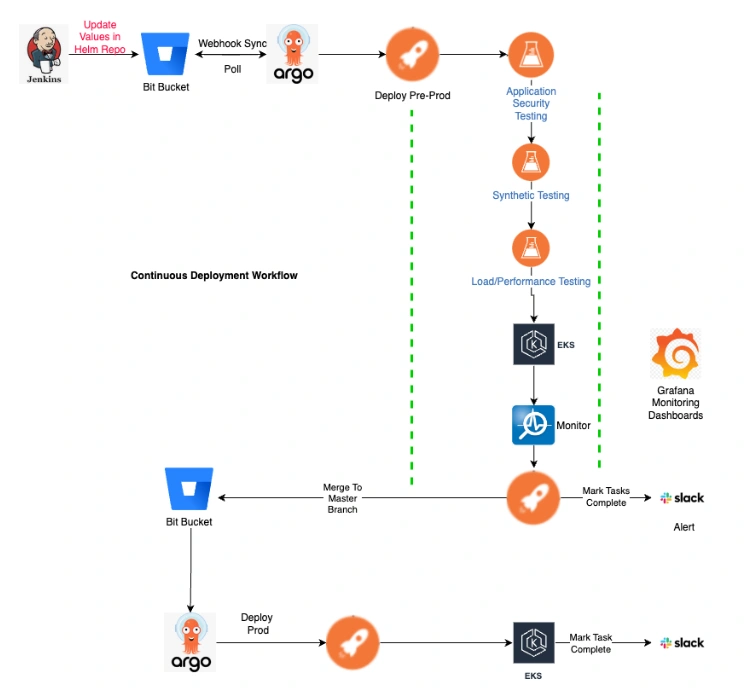
- Decoupled CI CD Pipelines: We decoupled the existing CICD pipeline by breaking it into multiple declarative pipelines for building different applications and dependency. We then introduced an umbrella pipeline which was used to trigger these individual pipelines in a defined manner. In this way, we were able to resume the pipeline from the failed stage and build individual applications as per the requirements. These pipelines would source the source code from git, artifacts from the artifactory, run code scans, build the docker images, run docker scan using trivy and push the images to the docker registry.
- DevSecOps Practices: We introduced automated security scans and assessments at various stages of the development pipeline, including code commits, builds, and deployments. This allowed them to identify and address security vulnerabilities much earlier in the development process, reducing the risk of vulnerabilities making their way into production.
- Automated Provisioning of Dynamic Environments: Terraform was used to spin up EKS clusters, which were equipped with necessary add-ons, controllers, and operators to act as test beds for new releases. The QA team used these environments to run test scripts, perform load tests and longevity tests. After the release to production, these environments were terminated using the pipeline.
- Deployment Automation: The CD part of the pipeline included controlled deployment to production once the changes passed all tests in the staging environment. We used Argo CD and Helm for rolling deployments and rollbacks. This controlled deployment of different application versions to different customers in different regions providing more flexibility to the client.
CICD Implementation

Results and Benefits
- Improved Developer Productivity: Developers enjoyed greater control and ownership of their microservices, which led to increased innovation and quicker issue resolution.
- Reduced feature delivery time : The time required to deliver new features and updates was drastically reduced. What previously took weeks could now be accomplished in a matter of days or hours.
- Continuous Delivery: By breaking down the pipeline into smaller components, Tompkins embraced a microservices-based CICD pipeline. Developers could now independently develop, test, and release their microservices, accelerating feature delivery.
- Higher Quality Software: Automated testing and deployment significantly improved software quality. Bugs and issues were caught early in the development process, reducing post-release bug fixes.
- Enhanced Collaboration: The CI/CD pipeline encouraged collaboration among development and operations teams. The pipeline’s transparency allowed everyone to see the progress of changes from development to production. As the development lifecycle was automated, developers now spend more time on development than operations.
- Improved Customer Satisfaction: With quicker releases and a reduced number of bugs, customer satisfaction soared.
- Single click deployments of environments for Longevity tests: Provisioning new environments to run longevity tests is now a one click process. This ensured the application’s reliability over a long period of time.
About The Partner
SquareOps is a one-stop solution for any enterprise, regardless of size or industry, that wants to grow by taking advantage of the benefits of cloud-native platforms. We are a team of passionate engineers helping businesses set up the right processes and culture of DevOps for different verticals. We help developers understand best practices for coding, security as a basic need, and building pipelines for easy deployments. Our service model feature is a big differentiator from our competitors in the market, as we offer services at affordable prices.
Conclusion
Warehouse software can't afford risky releases, which is exactly why it needs CI/CD. Small, automated, tested and reversible releases protect the warehouse floor far better than big quarterly drops and peak-season freezes. With decoupled pipelines, realistic integration testing, GitOps delivery to cloud and edge, and observability tied to picks and orders, teams can ship faster and safer at the same time.
Whether you build your own WMS, extend a commercial platform or run robotics at scale, SquareOps can help design and operate the pipeline. Talk to a SquareOps engineer about a free CI/CD assessment for your warehouse platform.