Why Cloud Migration Costs Are Consistently Underestimated
According to Gartner, 60% of organizations exceed their initial cloud migration budget. The average overrun sits between 30% and 50% of the original estimate. These are not small miscalculations — they represent hundreds of thousands of dollars in unplanned spending for mid-market companies and millions for enterprises.
The root cause is not poor planning. It is incomplete planning. Most cloud migration cost estimates focus heavily on infrastructure — compute, storage, and networking — while underweighting or ignoring operational costs, data transfer fees, parallel running periods, and risk buffers. Flexera's 2025 State of the Cloud Report found that organizations underestimate their cloud spend by 23% on average, even after migration is complete.
There are three patterns behind these overruns. First, teams estimate based on current on-premises costs rather than cloud-native pricing models. A server that costs $X per month on-prem does not translate directly to $X in AWS or Azure — licensing, data transfer, and managed service premiums change the math. Second, hidden costs like parallel running (maintaining both environments for 3-9 months) and staff training rarely appear in initial estimates. Third, scope changes during migration — discovering legacy dependencies, technical debt, and compliance requirements — add unbudgeted work.
Poor data quality is another root cause that rarely gets discussed. IBM estimates the average annual cost of poor data quality at $12.9 million per organization. During migration, bad data leads to failed ETL jobs, extended testing cycles, and data reconciliation work that was never scoped. Organizations with significant data quality issues should add 15-20% to their data migration budget line item.
A proper cloud migration cost estimation framework accounts for all four cost pillars: infrastructure, data and integration, operations, and risk contingency. The sections below break down each pillar with real cost ranges, so you can build a budget that holds up through execution.
The Four Pillars of Migration Cost Estimation
Every migration cost estimate should cover four distinct categories. Missing any one of them is the primary reason budgets fail. Here is how budget typically distributes across the four pillars:
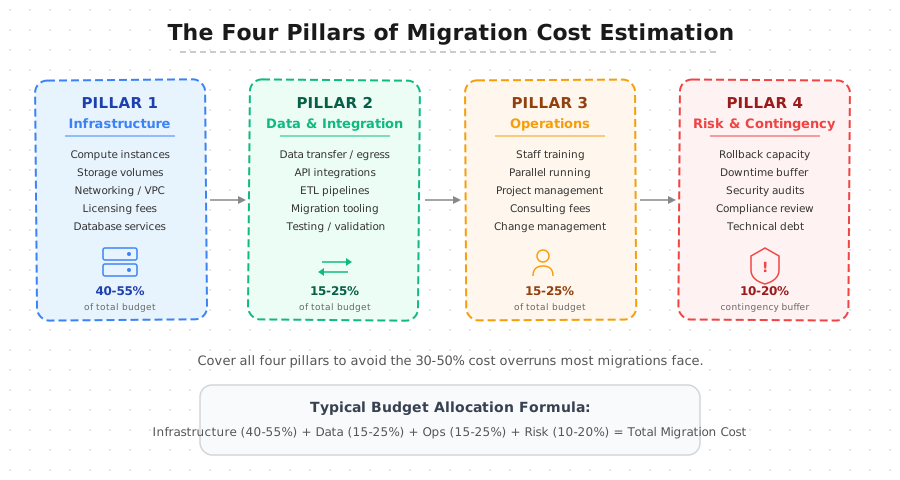
Infrastructure costs cover compute instances, storage volumes, networking, database services, and licensing. This is the pillar most teams estimate well because it maps closest to existing on-premises spending. It typically consumes 40-55% of the total migration budget.
Data and integration costs include data transfer fees, API integrations, ETL pipeline setup, migration tooling, and testing and validation. Data egress charges alone can account for up to 12% of your monthly cloud bill post-migration. This pillar usually takes 15-25% of the budget.
Operational costs encompass staff training, parallel running periods, project management, consulting fees, and change management. These are the costs that catch teams off guard because they sit outside the technical scope. They also consume 15-25% of the budget.
Risk and contingency covers rollback capacity, downtime buffers, security audits, compliance reviews, and technical debt remediation. Most experienced migration teams allocate 10-20% of the total budget here. Skipping this allocation is a direct path to budget overruns when something unexpected surfaces — and something always does.
Infrastructure Costs: Compute, Storage, and Networking
Infrastructure is the most predictable cost category, but it still has pitfalls. The key variables are compute instance sizing, storage type and volume, networking architecture, database services, and software licensing.
Compute Costs
Cloud compute pricing depends on instance type, region, and commitment level. On-demand pricing for a general-purpose instance (like AWS m6i.xlarge) runs roughly $140/month, but reserved instances (1-year commitment) drop that to around $90/month — a 35% saving. Spot instances can reduce costs by 60-90% for fault-tolerant workloads, but they require architecture changes to handle interruptions.
The most common mistake is sizing cloud instances to match on-premises server specs. A physical server running at 15% average CPU utilization does not need a cloud instance of equivalent size. Right-sizing before migration typically reduces compute costs by 25-40%. Tools like SpendZero can identify right-sizing opportunities across your AWS estate with automated waste detection.
Storage Costs
Storage pricing varies dramatically by type. AWS S3 Standard costs around $0.023/GB/month, S3 Infrequent Access is $0.0125/GB/month, and S3 Glacier Deep Archive drops to $0.00099/GB/month. For block storage, EBS gp3 volumes run about $0.08/GB/month.
Organizations with 50TB+ of data need to plan storage tiering early. Moving cold data to archive storage can reduce storage costs by 80-90% compared to keeping everything on standard tiers.
Networking Costs
Networking costs are where estimates frequently break down. Data transfer within the same availability zone is free on most cloud providers, but cross-AZ traffic costs $0.01/GB and internet egress starts at $0.09/GB on AWS. For organizations moving 10TB+ per month, egress alone can exceed $900/month.
Regional pricing also matters. AWS us-east-1 is typically 10-15% cheaper than ap-southeast-1 for the same instance types. If your users are primarily in one region, choosing the right cloud region can materially reduce your monthly bill.
VPN and Direct Connect costs are another networking line item. AWS Direct Connect (dedicated 1Gbps connection) has a monthly port fee of roughly $220/month plus data transfer charges. Site-to-site VPN costs approximately $36/month per tunnel. Organizations needing hybrid connectivity between on-premises data centers and cloud should budget $5,000-$25,000/year for networking depending on bandwidth requirements and redundancy needs.
Licensing
Software licensing is the hidden multiplier in infrastructure costs. Windows Server licensing on AWS (with License Included) adds roughly $0.046/hour per vCPU on top of the base compute cost. SQL Server Enterprise licensing can add $3.50+/hour. For organizations running 20+ Windows or SQL Server workloads, licensing often accounts for 30-40% of total compute costs.
Bring Your Own License (BYOL) options through AWS License Manager or Azure Hybrid Benefit can cut these costs significantly, but they require active Software Assurance agreements and careful tracking.
Open-source alternatives deserve consideration during migration planning. Replacing SQL Server with PostgreSQL or MySQL on Amazon RDS eliminates the licensing premium entirely. Similarly, using Linux instead of Windows Server removes the per-vCPU licensing surcharge. These decisions are best made during the assessment phase, before migration begins, because switching mid-migration adds cost and delays.
Data Transfer and Integration Costs
Data transfer costs are the most underestimated category in cloud migration budgets. They include the one-time cost of moving data to the cloud and the ongoing cost of data flowing between services, regions, and the internet.
Migration Data Transfer
For the initial migration, transferring data over the internet is straightforward but slow and expensive for large datasets. Transferring 100TB over a 1Gbps connection takes roughly 10 days. AWS DataSync or Azure Data Box can accelerate this, but they add their own costs. AWS Snowball Edge (for 80TB batches) costs around $300 per device plus shipping.
For organizations migrating petabyte-scale data, AWS Snowmobile or dedicated AWS Direct Connect links (starting at $0.30/GB for 1Gbps) become necessary — and they need to be factored into the budget months before migration begins.
Database migration adds its own data transfer complexity. AWS Database Migration Service (DMS) handles schema conversion and continuous replication, but it requires a replication instance that runs for the duration of the migration — typically 2-8 weeks for mid-market databases. DMS instance costs range from $50-$500/month depending on the instance size and data volume. Factor in 2-3 weeks of parallel testing where both source and target databases are active, plus engineering time for schema validation, stored procedure conversion, and application connection string updates.
Ongoing Egress Costs
Post-migration, data egress becomes a recurring cost that many teams did not plan for. Industry benchmarks from Flexera indicate egress charges account for roughly 12% of the average monthly cloud bill. For a $50,000/month cloud environment, that is $6,000/month in data transfer fees alone.
Multi-region architectures amplify this cost. Cross-region replication for disaster recovery, CDN origin pulls, and API traffic between services in different regions all incur egress charges. The post-migration cost optimization phase should include an egress audit to identify and reduce unnecessary cross-region data flows.
Integration and API Costs
Connecting cloud services to existing on-premises systems, third-party SaaS platforms, and internal APIs adds integration costs that are hard to estimate upfront. Each integration typically requires 40-80 hours of engineering time for development, testing, and validation. For a mid-market migration with 15-30 integrations, this translates to $60,000-$180,000 in engineering labor alone.
Hidden Costs Most Migration Teams Miss
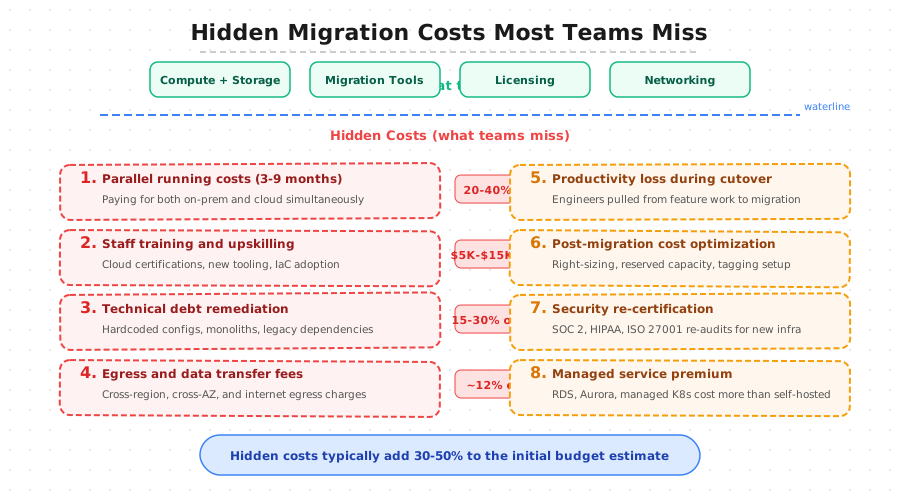
Beyond infrastructure and data transfer, several cost categories consistently blindside teams during migration. These hidden costs typically add 30-50% to the initial budget estimate.
Parallel Running Costs
During migration, you pay for both the existing on-premises or legacy cloud environment and the new cloud environment simultaneously. This parallel running period typically lasts 3-9 months, depending on migration complexity. For a company spending $30,000/month on infrastructure, parallel running adds $90,000-$270,000 in overlapping costs.
Reducing the parallel running window is one of the highest-leverage cost savings in any migration. A well-structured migration checklist with clear cutover milestones can shorten this period by 30-50%.
Staff Training and Upskilling
Moving to the cloud requires new skills across the team. Engineers need training on cloud-native services, Infrastructure as Code with Terraform, container orchestration with Kubernetes clusters, and monitoring and observability platforms. Cloud certifications (AWS Solutions Architect, Azure Administrator) cost $3,000-$5,000 per person including training materials and exam fees. For a team of 10 engineers, training costs alone can reach $30,000-$50,000.
Technical Debt Remediation
Legacy applications often carry technical debt that surfaces during migration. Hardcoded IP addresses, monolithic architectures, deprecated library dependencies, and missing documentation all require remediation before or during migration. Based on industry data, technical debt remediation typically adds 15-30% to the migration scope. For a $300,000 migration budget, that translates to $45,000-$90,000 in unplanned remediation work.
Security and Compliance Re-Certification
Organizations with compliance requirements (SOC 2, HIPAA, ISO 27001, PCI DSS) need to re-certify their cloud security posture after migration. This includes security assessments, penetration testing, policy updates, and audit preparation. Re-certification costs range from $15,000-$75,000 depending on the compliance framework and organization size.
Post-Migration Cost Optimization
After workloads are running in the cloud, right-sizing, reserved instance purchasing, tagging, and governance setup all require dedicated effort. Teams that skip post-migration optimization consistently run 20-30% higher monthly bills than their pre-migration estimates projected. This optimization work typically takes 2-4 weeks of focused engineering time and should be budgeted separately from the migration execution phase.
Productivity Loss During Cutover
Engineers pulled into migration work are not building features. This opportunity cost rarely appears in migration budgets, but it is real. A 4-month migration involving 5 engineers at $150/hour represents roughly $480,000 in engineering time — time not spent on product development or revenue-generating work.
Managed Service Premiums
Cloud-managed services like Amazon RDS, Aurora, EKS, and ElastiCache cost more than self-hosted equivalents on EC2. Amazon RDS for PostgreSQL costs roughly 40-60% more than running PostgreSQL on a bare EC2 instance of the same size. EKS adds a $0.10/hour cluster fee ($73/month) on top of the underlying node costs. These premiums buy reduced operational burden, but they need to be in the estimate. For organizations running 10+ managed services, the premium can add $2,000-$10,000/month to the bill.
Cloud Migration Cost by Company Size
Migration costs scale with organizational complexity. The following ranges are based on industry benchmarks and our experience across 100+ cloud migration projects.
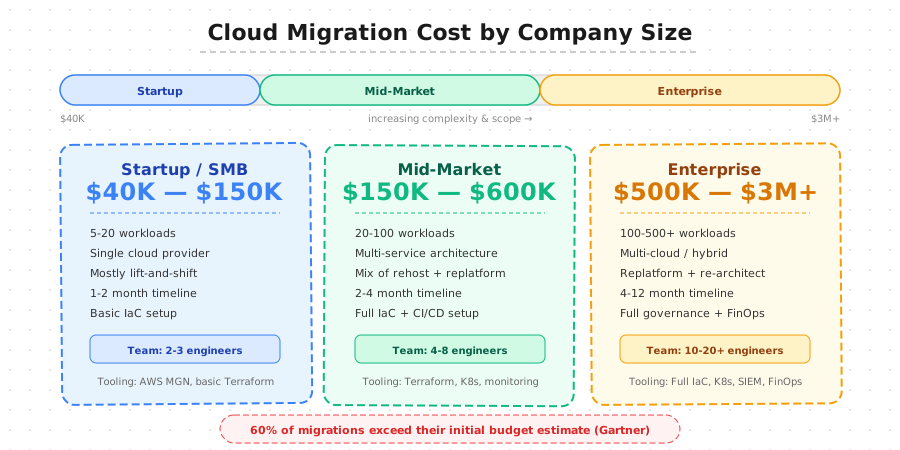
| Parameter | Startup / SMB | Mid-Market | Enterprise |
|---|---|---|---|
| Total Cost Range | $40,000 – $150,000 | $150,000 – $600,000 | $500,000 – $3,000,000+ |
| Workloads | 5–20 | 20–100 | 100–500+ |
| Timeline | 1–2 months | 2–4 months | 4–12 months |
| Team Size | 2–3 engineers | 4–8 engineers | 10–20+ engineers |
| Migration Strategy | Mostly lift-and-shift | Rehost + replatform | Replatform + re-architect |
| IaC/Tooling | Basic Terraform, AWS MGN | Full Terraform, K8s, CI/CD | Full IaC, K8s, SIEM, FinOps |
| Consulting | Optional | Recommended | Required |
A key point on these ranges: lift-and-shift migrations cost less upfront but typically result in 20-30% higher monthly cloud bills compared to re-architected workloads. The migration strategy directly affects long-term TCO. Organizations planning to stay on cloud for 3+ years should factor in ongoing cloud cost management from day one.
The overlap between cost ranges is intentional. A complex mid-market company with strict compliance requirements (healthcare, financial services) will land at the higher end of the mid-market range, potentially overlapping with the lower end of the enterprise range. The key cost drivers are not just company size — they include the number of data sources, the degree of application interdependency, compliance requirements, and the target migration strategy.
For organizations migrating between cloud providers — for example, GCP to AWS or AWS to Azure — add 15-25% to these ranges. Cloud-to-cloud migrations involve service mapping, API translation, and identity federation complexity that on-prem-to-cloud migrations do not have.
Cloud Migration Cost Estimation Tools
Several tools can help estimate cloud migration costs. Each serves a different purpose, and most teams need a combination of two or three for accurate estimation.
| Tool | Provider | Best For | Pricing |
|---|---|---|---|
| AWS Pricing Calculator | AWS | Detailed per-service cost modeling for AWS workloads | Free |
| Azure TCO Calculator | Microsoft | On-prem vs Azure cost comparison with licensing analysis | Free |
| Google Cloud Pricing Calculator | GCP service cost estimation with sustained use discounts | Free | |
| AWS Migration Evaluator | AWS | Agentless discovery + right-sized cost projections | Free (with AWS engagement) |
| SpendZero | SquareOps | Post-migration cost optimization with 37+ waste detection checks across 25+ AWS services | Free initial scan |
| Infracost | Open Source | Cost estimation from Terraform plans before deployment | Free (open source) / paid cloud |
| CloudHealth by VMware | Broadcom | Multi-cloud cost management and optimization | Custom pricing |
For pre-migration estimation, start with the cloud provider's native calculator (AWS Pricing Calculator or Azure TCO Calculator) to model infrastructure costs. Then layer in Infracost if you are using Terraform for IaC — it estimates costs directly from your Terraform plans before you deploy anything.
Post-migration, tools like SpendZero and the best FinOps tools help identify waste and right-sizing opportunities. The free SpendZero scan typically uncovers 28-35% in reducible spend within minutes, which directly validates whether your pre-migration estimate was accurate.
Building a Realistic Migration Budget: Phase-by-Phase Template
A realistic cloud migration cost estimation framework breaks the budget into phases. Each phase has different cost drivers and different levels of uncertainty. Here is a template you can adapt to your own migration.
Phase 1: Assessment and Planning (8-12% of total budget)
This phase covers discovery, workload inventory, dependency mapping, security assessment, and migration strategy selection. Key cost items include migration assessment tools, consultant time for architecture review, and proof-of-concept environments.
For a mid-market migration ($300,000 total budget), expect to spend $24,000-$36,000 on assessment. This phase is where you avoid the most expensive mistakes. Spending 10% of the budget here typically saves 30-40% in the execution phases.
A thorough assessment should answer four questions: which workloads migrate first (based on business criticality and migration difficulty), which migration strategy applies to each workload (rehost, replatform, re-architect, or retire), what dependencies exist between workloads (which determines migration wave sequencing), and what compliance or regulatory constraints apply. Organizations that skip detailed assessment and jump straight to execution almost always face rework later.
Phase 2: Foundation and Landing Zone (15-20% of total budget)
This phase sets up the cloud environment: VPC architecture, IAM policies, networking (VPN/Direct Connect), security controls, logging, and monitoring. It also includes CI/CD pipeline setup, Terraform module development, and container orchestration platform configuration.
For the same $300,000 budget, foundation costs run $45,000-$60,000. Cutting corners here creates technical debt that multiplies costs in later phases. A well-built landing zone with proper IaC, security baselines, and monitoring and observability reduces operational costs for every subsequent workload migration.
Phase 3: Migration Execution (40-50% of total budget)
This is the main work: migrating workloads in priority-ordered waves. Cost drivers include engineering labor, migration tooling (AWS MGN, Azure Migrate, DMS), testing and validation, parallel running costs, and rollback procedures.
Budget $120,000-$150,000 for execution on a $300,000 migration. The key variable here is migration strategy — lift-and-shift is faster and cheaper upfront but creates a larger post-migration optimization workload. Replatforming adds 30-50% to execution costs but results in 20-40% lower monthly cloud bills.
Teams migrating between cloud providers — such as Azure to AWS or AWS to GCP — face additional complexity from service mapping and API differences, which typically adds 15-25% to execution costs compared to an on-premises-to-cloud migration.
Phase 4: Optimization and Stabilization (15-20% of total budget)
After workloads are running in the cloud, this phase covers right-sizing, reserved instance purchasing, cost tagging, performance tuning, security hardening, and decommissioning the old environment. This is also when you implement ongoing cloud cost management processes and post-migration cost optimization practices.
Budget $45,000-$60,000 for optimization. Organizations that skip this phase consistently see 20-30% higher monthly bills than planned. Running a SpendZero scan immediately after migration provides a clear list of cost reduction actions, ranked by savings potential.
Phase 5: Contingency Buffer (10-15% of total budget)
Set aside 10-15% of the total budget for unexpected costs. Common contingency draws include extended parallel running, additional technical debt remediation, compliance re-certification, and scope changes. On a $300,000 budget, reserve $30,000-$45,000 in contingency.
If you have not done a cloud migration before, increase the contingency to 20%. First-time migrations consistently surface more unknowns than repeat migrations.
Track contingency draw-downs weekly during the migration. If you have consumed more than 50% of contingency before reaching the halfway point of migration execution, pause and reassess. Either the scope has expanded significantly (requires a budget revision conversation with stakeholders) or the original estimate missed a major cost category (requires re-estimation of remaining phases).
ROI and Business Case for Cloud Migration
Cloud migration cost estimation is one side of the equation. The other is return on investment. Organizations need both numbers to make an informed decision and to set realistic expectations with leadership.
Direct Cost Savings
Organizations that migrate and optimize properly typically see 20-35% reduction in total infrastructure costs within 12-18 months. The savings come from right-sizing (25-40% of compute costs), reserved instances and savings plans (30-40% discount on committed usage), eliminating on-premises maintenance and hardware refresh cycles, and reducing data center space and power costs.
Operational Efficiency Gains
Cloud infrastructure enables faster deployment cycles, automated scaling, and reduced operational overhead. Teams that adopt IaC with Terraform, container orchestration with Kubernetes, and CI/CD automation report 40-60% reduction in infrastructure provisioning time and 30-50% reduction in incident response time.
These efficiency gains are harder to quantify in dollar terms, but they directly translate to faster time-to-market and reduced engineering overhead. For a DevOps consulting engagement, the ROI calculation should include these operational improvements alongside direct cost savings.
Scalability is another operational benefit that affects ROI. On-premises infrastructure requires capital expenditure 6-12 months ahead of demand. Cloud infrastructure scales on demand, eliminating both over-provisioning waste and under-provisioning risk. For organizations with variable or seasonal workloads, this elasticity alone can reduce annual infrastructure costs by 15-25% compared to maintaining peak-capacity on-premises hardware year-round.
Break-Even Timeline
Most cloud migrations break even within 12-24 months when factoring in the one-time migration cost and ongoing monthly savings. The exact timeline depends on migration strategy (re-architecture breaks even later but saves more long-term), post-migration optimization discipline, and pre-migration infrastructure costs.
For startups and SMBs, break-even typically happens within 6-12 months because the migration scope is smaller and the per-workload savings are proportionally larger. For enterprise migrations ($500K+), break-even usually takes 18-30 months due to higher migration complexity and longer parallel running periods.
Building the Business Case
A strong migration business case includes three numbers: total migration cost (one-time), monthly cloud cost post-migration (ongoing), and monthly cost of current infrastructure (baseline). The formula is straightforward: break-even month = total migration cost / (current monthly cost - projected cloud monthly cost).
Include both hard savings (infrastructure cost reduction) and soft savings (engineering productivity, reduced downtime, faster deployments) in the business case. Leadership teams that see only hard savings often undervalue the migration. Those that see the full picture — including risk reduction and agility improvements — make better-informed decisions.
One often-overlooked ROI factor is disaster recovery. On-premises DR typically requires a secondary data center with near-duplicate hardware — a capital expense that can run $200,000-$500,000+. Cloud-based DR using services like AWS Backup, cross-region replication, and pilot light architectures can achieve comparable or better recovery objectives at 60-80% lower cost. If your current DR infrastructure is due for a refresh, the migration ROI calculation should include avoided DR hardware costs.
Next Steps: Getting Your Migration Cost Estimate Right
Cloud migration cost estimation does not need to be a guessing game. Start with the four-pillar framework to ensure nothing falls through the cracks. Use the company-size benchmarks to sanity-check your numbers. Build in contingency. And plan for optimization from day one — not as an afterthought.
If you are planning a migration and want a detailed cost estimate tailored to your specific environment, our AWS consulting and cloud migration teams can run a full assessment. We have completed 100+ migrations across startups, mid-market companies, and enterprises, and we know where the hidden costs live.
Talk to our migration team for a detailed cost assessment and migration plan specific to your workloads, compliance requirements, and business goals.