Your infrastructure is growing, incidents are eating into engineering time, and leadership is asking why uptime dipped last quarter. You know you need SRE expertise — but should you bring in consultants to advise your team, or hand operations to a managed SRE partner entirely?
The answer depends on your team size, existing SRE maturity, budget structure, and how urgently you need reliability coverage. SRE consulting services and managed SRE are not interchangeable — they solve fundamentally different problems, and choosing the wrong model wastes both money and time.
This guide breaks down both engagement models, compares them head to head, and gives you a decision framework to pick the right one — or combine them — for where your organization is today.
Key Takeaways
- SRE consulting gives your team expert direction — assessments, SLO design, architecture reviews, runbooks — while your engineers execute the recommendations.
- Managed SRE transfers operational ownership to a partner: 24/7 monitoring, incident response, toil reduction, and capacity planning handled externally.
- Consulting fits best when you have 5+ engineers and need a strategic roadmap; managed SRE fits when you lack SRE staff or need immediate 24/7 coverage.
- A hybrid approach — consult first, then transition to managed — is the most common path for mid-size companies scaling reliability.
- Vendor evaluation criteria include cloud-platform depth, Kubernetes expertise, knowledge-transfer process, and the ability to offer both models.
Two Engagement Models, One Goal: Reliability
Both SRE consulting and managed SRE exist to improve system reliability, reduce downtime, and free your engineering team to focus on product work. The difference is who does the work after the engagement begins.
SRE consulting is an advisory engagement. A team of senior SRE practitioners assesses your current reliability posture, identifies gaps, designs SLOs and error budgets, architects observability pipelines, and produces runbooks and migration plans. They hand you a roadmap — your team executes it. Think of it as hiring an architect to design the building; your construction crew builds it.
Managed SRE is an operational engagement. An external team takes ownership of day-to-day reliability operations: they monitor your infrastructure 24/7, respond to incidents on your behalf, manage on-call rotations, automate toil, run capacity planning, and report against SLA commitments. They are the construction crew — and they keep maintaining the building after it is built.
Both models can coexist. Many organizations start with consulting to define "what good looks like," then bring in a managed partner to maintain that standard continuously. But understanding each model individually is essential before you decide how to combine them.
SRE Consulting: What You Get
An SRE consulting engagement is typically project-scoped with a defined start date, end date, and deliverables. The engagement follows a structured methodology:
Phase 1 — Discovery and Assessment (Weeks 1–2): The consulting team audits your current infrastructure, deployment pipelines, monitoring stack, and incident history. They interview on-call engineers, review post-mortems, and map your service dependency graph. The output is a reliability maturity scorecard.
Phase 2 — Architecture and Design (Weeks 3–5): Based on the assessment, consultants design SLO frameworks, error-budget policies, observability architectures, and IaC standards. They identify the top reliability risks — single points of failure, missing runbooks, alert fatigue — and prioritize remediation by business impact.
Phase 3 — Enablement and Handoff (Weeks 6–8): The final phase focuses on knowledge transfer. Consultants conduct workshops with your engineering team on SLO-based alerting, incident management workflows, and chaos engineering practices. They leave behind documented runbooks, architecture decision records, and an implementation backlog prioritized by risk.
The typical deliverables from an SRE consulting engagement include a reliability maturity assessment, SLO/SLI definitions for critical services, observability architecture blueprint, incident response playbooks, toil reduction roadmap, and a prioritized reliability backlog your team can execute quarter by quarter.
Consulting works best when your organization has capable engineers who need strategic direction rather than additional hands. You retain full ownership of your infrastructure — the consultants accelerate your team's ability to operate it reliably.
Managed SRE: What You Get
A managed SRE engagement is an ongoing operational contract. Instead of receiving a roadmap, you receive a team — embedded or remote — that takes responsibility for the reliability of your systems. The engagement is typically structured around monthly retainers with defined SLA commitments.
24/7 Monitoring and Incident Response: The managed partner monitors your infrastructure around the clock using tools like Datadog, Grafana, PagerDuty, or your existing stack. When an incident fires, their on-call engineer responds — triaging, mitigating, and resolving issues before your team wakes up. You receive incident reports and post-mortem summaries, but you do not carry the pager.
Ongoing Reliability Engineering: Beyond firefighting, a good managed SRE partner invests in proactive improvements: automating manual operational tasks (toil), tuning alert thresholds to reduce noise, managing capacity forecasts, and implementing chaos engineering tests. They continuously iterate on your reliability posture rather than delivering a one-time assessment.
Defined SLAs and Reporting: Managed SRE contracts include measurable commitments — response-time SLAs (e.g., P1 incidents acknowledged within 5 minutes, resolved within 30 minutes), monthly uptime targets, and operational dashboards. You receive regular reliability reports that track SLO compliance, error-budget burn, incident trends, and cost-efficiency metrics.
Shared Responsibility and Escalation: The managed partner owns L1/L2 incident response and routine operational work. Complex application-level bugs or architecture decisions escalate to your internal engineering team. This shared responsibility model ensures your engineers focus on product development while the partner handles operational load.
Managed SRE is the right fit when your team does not have — and cannot afford to hire — dedicated SRE engineers, or when outsourcing SRE operations makes more financial and operational sense than building the capability in-house.
Head-to-Head Comparison
The following comparison breaks down the seven dimensions that matter most when evaluating SRE consulting services against managed SRE. Each model excels in different areas — the right choice depends on which dimensions align with your organization's constraints.
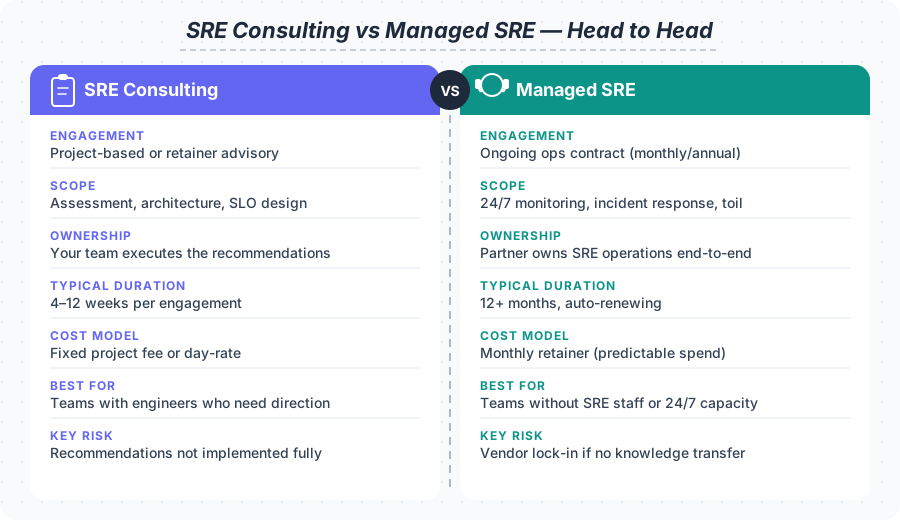
The most significant distinction is ownership. With consulting, you own execution and outcomes — the consultant provides the blueprint. With managed SRE, the partner owns operational outcomes and is contractually accountable for meeting SLAs. This shifts risk from your internal team to the partner, but it also means you depend on the partner's competence and responsiveness.
From a cost perspective, consulting tends to be a one-time or periodic capital expenditure, while managed SRE is a recurring operational expense. Organizations with predictable monthly budgets often prefer the managed model; those with project-based funding cycles lean toward consulting.
| Dimension | SRE Consulting | Managed SRE |
|---|---|---|
| Engagement | Project-based or retainer advisory | Ongoing ops contract (monthly/annual) |
| Scope | Assessment, SLO design, architecture | 24/7 monitoring, incident response, toil |
| Ownership | Your team executes | Partner owns operations |
| Duration | 4–12 weeks per engagement | 12+ months, auto-renewing |
| Cost Model | Fixed project fee or day-rate | Monthly retainer (predictable OpEx) |
| Best For | Teams with engineers who need direction | Teams without SRE staff or 24/7 capacity |
| Key Risk | Recommendations not fully implemented | Vendor lock-in without knowledge transfer |
Which Model Fits Your Organization?
Choosing between SRE consulting services and managed SRE is not about which model is "better" — it is about which model matches your team's current reality. The decision matrix below maps six organizational factors to the model that fits best.
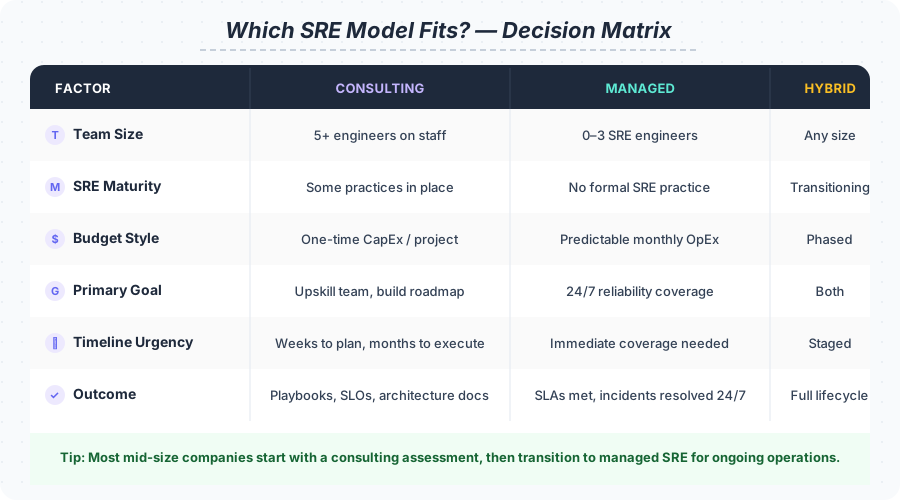
Choose SRE consulting if:
- You have 5 or more engineers who can implement SRE practices once given direction.
- Your organization has some reliability practices in place but needs expert guidance to mature them (e.g., moving from ad-hoc monitoring to SLO-based alerting).
- Your budget is structured around project-based spending rather than recurring operational costs.
- The primary goal is to build internal SRE capability — upskill your team and create institutional knowledge.
Choose managed SRE if:
- You have zero to three SRE-capable engineers and cannot hire fast enough to cover your reliability needs.
- You need 24/7 incident coverage immediately — there is no time to build an internal on-call rotation.
- You prefer predictable monthly operational costs over lump-sum project investments.
- Your primary concern is uptime SLAs and incident resolution speed, not building an internal SRE team.
Consider a hybrid if:
- You want to build internal SRE maturity but also need operational coverage during the transition.
- You are growing fast and expect your needs to evolve within the next 12 months.
- You want a phased investment — start with a bounded consulting project, prove value, then expand to managed operations.
The Hybrid Approach: Consult First, Then Transition
For most mid-size organizations, the optimal path is not choosing one model or the other — it is sequencing them. The hybrid approach uses SRE consulting to establish the foundation, then transitions to managed SRE for ongoing operations.
Phase 1 — Consulting Sprint (Weeks 1–8): Bring in SRE consultants to assess your infrastructure, define SLOs and error budgets, design your observability architecture, and document incident response procedures. This phase produces the artifacts that the managed team will operate against: SLO definitions, runbooks, alert configurations, and escalation policies.
Phase 2 — Managed Transition (Weeks 9–12): The managed SRE partner onboards using the consulting deliverables as their operating baseline. They inherit documented runbooks, tuned alert rules, and clearly defined SLOs — dramatically reducing the ramp-up time that typically plagues managed SRE engagements. If the same partner provides both consulting and managed services, this transition is seamless.
Phase 3 — Ongoing Operations (Month 4+): The managed partner runs day-to-day operations — 24/7 monitoring, incident response, toil automation, and capacity management. Your internal team stays engaged through weekly reliability reviews and architectural decision-making, but they are no longer carrying the pager or drowning in operational toil.
The hybrid approach has three key advantages. First, it de-risks the managed engagement by ensuring the partner starts with well-documented systems rather than inheriting undocumented infrastructure. Second, it gives your internal team a chance to understand SRE principles before handing off operations, making them better collaborators with the managed partner. Third, it provides a natural evaluation point — if the consulting engagement reveals that your team can handle operations internally, you can skip the managed phase entirely.
At SquareOps, we have seen this pattern work particularly well for companies running Kubernetes workloads on AWS or GCP. The consulting phase typically covers infrastructure cost optimization, observability pipeline design, and IaC standardization — creating a clean baseline that the managed team can operate against with confidence.
What to Look for in an SRE Partner
Whether you choose consulting, managed, or hybrid, the partner you select determines the outcome. Here are the evaluation criteria that matter most:
Cloud-Platform Depth: Your partner should have deep expertise in your primary cloud provider — not just general familiarity. Look for AWS Advanced, GCP Partner, or Azure Expert certifications, and ask for case studies on infrastructure similar to yours. A partner who has solved Kubernetes reliability problems on AWS is more valuable than one with generic "cloud experience."
SRE Methodology: Ask how they define and implement SLOs. A credible SRE partner will walk you through their approach to SLI selection, error-budget policies, and alert-threshold calibration. If the conversation stays at a high level ("we improve reliability") without getting specific about methodology, that is a red flag.
Kubernetes and IaC Expertise: Modern SRE is inseparable from Kubernetes orchestration and infrastructure-as-code practices. Your partner should be fluent in Helm, Terraform or Pulumi, GitOps workflows, and container security. Ask how they handle cluster upgrades, namespace isolation, and resource right-sizing.
Knowledge Transfer Process: This is the most overlooked criterion — and the most important one for avoiding vendor lock-in. The best partners document everything, run enablement sessions with your team, and structure contracts so you can bring operations in-house if you choose to. A partner who hoards operational knowledge is not a partner; they are a dependency.
Incident Management Maturity: For managed SRE, ask about their incident management tooling, escalation paths, response-time SLAs, and post-mortem process. Review sample incident reports. A mature partner uses blameless post-mortems, tracks follow-up action items to completion, and shares AI-augmented incident response tooling to accelerate resolution.
Flexibility to Scale: Your needs will change. A partner who offers both consulting and managed DevOps and SRE services gives you the ability to scale up, scale down, or switch models without changing vendors. This flexibility reduces transition costs and preserves institutional knowledge accumulated during earlier engagements.
Making the Decision
The consulting-versus-managed choice is ultimately about where your organization needs external help most. If the gap is strategic — you need someone to tell your team what to do — SRE consulting services close that gap. If the gap is operational — you need someone to do the work because you cannot staff it internally — managed SRE closes that gap.
Most organizations discover that the gap is both strategic and operational, which is why the hybrid approach has become the default path. Start with a bounded consulting engagement, use the deliverables to define SLAs for a managed contract, and let the managed partner execute against a well-documented baseline.
SquareOps offers both SRE consulting and 24/7 managed SRE as a single, integrated service — so the transition from advisory to operations is seamless. Whether your infrastructure runs on AWS, GCP, or a multi-cloud setup, our team brings deep platform expertise and a proven SRE methodology to every engagement.