Site reliability engineering has become a non-negotiable discipline for any company running production workloads at scale. But building an in-house SRE team is expensive, slow, and fraught with hiring challenges — especially when experienced SRE engineers command $166K+ salaries and take 3–6 months to recruit. SRE outsourcing offers an alternative: production-grade reliability, 24/7 on-call coverage, and Kubernetes expertise delivered in weeks rather than quarters, often at 40–60% lower cost than an equivalent in-house hire.
This guide walks you through exactly when SRE outsourcing makes sense, when to keep things in-house, and how to evaluate the trade-offs so you make the right call for your team.
Key Takeaways
- SRE outsourcing costs 40–60% less than building an in-house SRE team — $96K–$240K/year vs. $793K–$990K for a 3-person team.
- Best for teams that need 24/7 on-call coverage, Kubernetes expertise, or rapid scaling without a 3–6 month hiring cycle.
- Start with a focused scope — such as after-hours on-call or incident management for top-tier services — before expanding.
- Always define SLOs before onboarding an outsourced SRE partner to align reliability goals and avoid miscalibrated effort.
- Evaluate partners on capability, not just cost — response time SLAs, Kubernetes depth, and integration with your tools matter more than price alone.
What Is SRE Outsourcing?
SRE outsourcing means contracting an external team of site reliability engineers to own or co-own your production operations — incident response, on-call rotations, observability, infrastructure automation, and reliability improvements. Unlike traditional managed services that focus purely on infrastructure monitoring, an outsourced SRE partner operates at the application and platform layer. They work with your SLOs, participate in blameless postmortems, write runbooks specific to your stack, and push reliability improvements into your CI/CD pipelines.
The engagement model typically falls into one of three categories:
- Fully managed SRE (SRE as a service) — The external team owns your entire production reliability function, from on-call rotations to incident management to capacity planning. Best for teams without any in-house SRE capability.
- Augmented SRE — Your internal team retains ownership, and the outsourced team fills specific gaps like after-hours on-call, Kubernetes operations, or observability buildout. Best for teams that have some SRE maturity but need to scale.
- SRE consulting and enablement — A time-boxed engagement focused on setting up SRE best practices, implementing SLO frameworks, building observability stacks, or migrating to Kubernetes. Best for teams that want to build internal capability with expert guidance.
The common thread across all three models is that you get access to engineers who have seen hundreds of production environments, not just one. That breadth of experience is nearly impossible to replicate by hiring a single SRE engineer or even a small team.
When SRE Outsourcing Makes Sense: 5 Clear Scenarios
SRE outsourcing is not for everyone. But there are specific situations where it delivers dramatically better outcomes than trying to build in-house. Here are the five most common scenarios where outsourcing your SRE function is the right call.
1. You cannot afford or find experienced SRE engineers
The SRE talent market in 2026 remains brutally competitive. Median total compensation for a mid-level SRE in the US sits around $166K, and senior SREs in major metros regularly exceed $200K. Factor in benefits, equity, tooling licenses, and management overhead, and the fully loaded cost of a single SRE engineer approaches $220K–$250K per year. For many mid-market companies and growth-stage startups, that is simply not feasible — especially when you need 24/7 coverage, which requires a minimum of three to four engineers just for on-call rotation.
An outsourced SRE service typically costs 40–60% less than equivalent in-house headcount because the provider distributes their engineering team across multiple clients, achieves economies of scale in tooling, and operates from regions with lower cost of living without compromising on technical depth.
2. You need 24/7 on-call coverage today, not next quarter
Building 24/7 on-call coverage from scratch is one of the hardest operational challenges for engineering teams. You need at least three to four engineers for a sustainable rotation, clear escalation policies, runbooks for every critical path, and an incident management process. Assembling all of this internally takes months. An outsourced SRE partner already has these systems in place and can provide round-the-clock coverage within one to two weeks of onboarding.
3. You are scaling rapidly or going through a cloud migration
Rapid growth creates reliability risks that outpace your team's ability to keep up. If you are doubling your Kubernetes cluster count, migrating from EC2 to EKS, or scaling from 10 microservices to 50, you need SRE expertise immediately — not after a six-month hiring cycle. Outsourced SRE teams have done these migrations dozens of times and bring battle-tested playbooks for each scenario.
4. Your engineering team is burned out from on-call
When your software engineers are pulling double duty as both developers and on-call responders, velocity suffers, morale drops, and attrition spikes. SRE outsourcing can absorb the on-call burden entirely, freeing your development team to focus on shipping features instead of firefighting production incidents at 3 AM. This is often the highest-ROI application of outsourced SRE — the productivity gains from a fully unblocked development team frequently exceed the cost of the SRE service.
5. You need specialized SRE skills your team does not have
Not every reliability challenge is generic. If your stack runs on Kubernetes with service mesh, you need engineers who understand Istio and Envoy at the protocol level. If you are implementing SLO-based alerting, you need someone who has designed SLI/SLO frameworks across multiple architectures. If you are adopting FinOps practices to right-size your cloud spend, you need engineers who understand both infrastructure costs and reliability trade-offs. These specialized skills are nearly impossible to hire for individually, but an outsourced SRE partner brings the full breadth of expertise across their team.
Decision Framework: Outsource vs. In-House SRE
The decision to outsource SRE is not binary — it depends on your current team, budget, timeline, and operational maturity. Use this decision framework to determine which path is right for your organization.
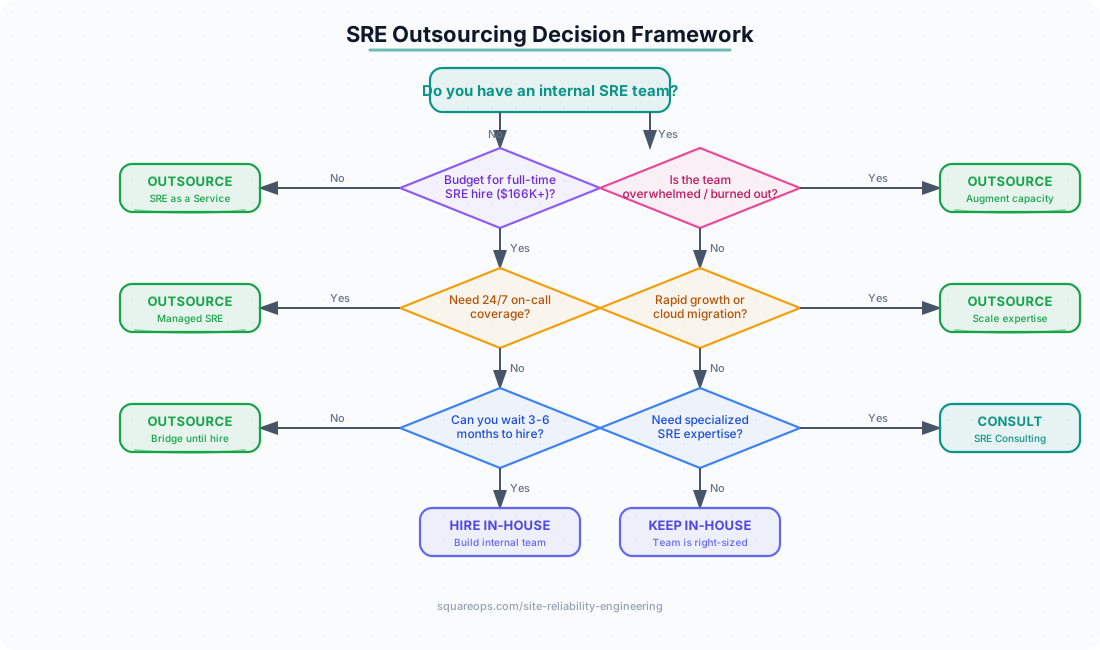
The framework works by asking a series of honest questions about your current situation. If you do not have an internal SRE team, the first question is whether you have the budget for a full-time hire at $166K+ fully loaded cost. If not, outsourcing is the clear path. If you do have the budget but need 24/7 coverage, outsourcing still wins because a single hire cannot provide round-the-clock on-call. Only when you have both the budget and the patience to wait three to six months for a hire does building in-house become viable.
For teams that already have an SRE function, the calculus shifts. If your existing team is overwhelmed, outsourcing provides immediate capacity relief. If you are in the middle of rapid growth or a migration, outsourcing brings specialized expertise that scales with your needs. If your team is well-staffed, not overwhelmed, and does not need specialized skills, then keeping things in-house is the right call.
In-House vs. Outsourced SRE: Full Comparison
Beyond the decision framework, it helps to see the two models side by side across the dimensions that matter most to engineering leaders making this decision.
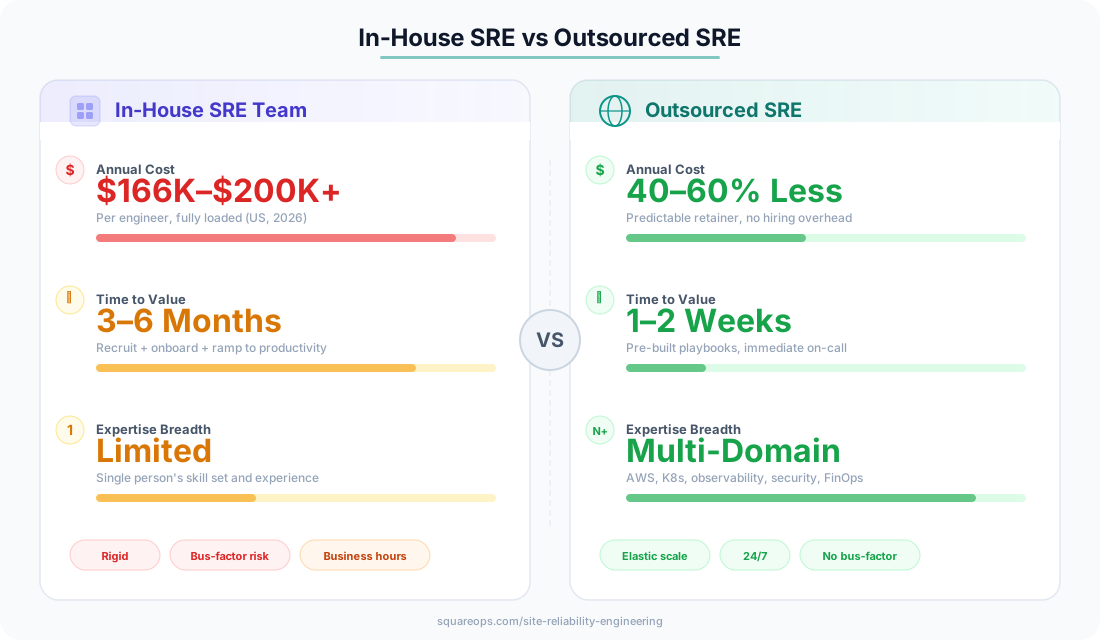
The comparison highlights several structural advantages of the outsourced model. On cost, an outsourced SRE service typically runs 40–60% less than equivalent in-house headcount because you are not paying for recruitment fees (typically 20–25% of annual salary), benefits, tooling licenses per seat, or management overhead. On time-to-value, an outsourced team can begin on-call coverage within one to two weeks because they bring pre-built runbooks, established incident management processes, and tooling already integrated — versus the three to six months it takes to recruit, hire, and ramp up an in-house SRE.
The expertise breadth difference is equally significant. A single in-house SRE hire brings one person's experience — perhaps strong in Kubernetes but weaker in observability, or experienced with AWS but unfamiliar with GCP. An outsourced SRE team brings collective expertise across hundreds of production environments, spanning Kubernetes, Terraform, AWS, GCP, service mesh, CI/CD, FinOps, and security hardening. That diversity of experience translates directly to faster incident resolution and better architectural decisions.
Where in-house SRE holds an advantage is in deep institutional knowledge and long-term cultural integration. An in-house SRE engineer who has been with your company for two years understands your codebase, your deployment quirks, and your organizational dynamics in ways that are difficult for an external team to replicate. The ideal approach for many organizations is a hybrid model — outsource the operational heavy lifting (on-call, monitoring, incident response) while keeping a small internal SRE function focused on reliability culture, SLO governance, and platform strategy.
Cost Analysis: The Real Numbers Behind SRE Outsourcing
Engineering leaders need concrete numbers to make the business case. Here is a realistic cost comparison between building a minimal in-house SRE team and engaging an SRE managed service, based on 2026 US market rates.
| Cost Component | In-House (3 SREs) | Outsourced SRE |
|---|---|---|
| Base compensation | $498K–$600K | — |
| Benefits and payroll taxes (25%) | $125K–$150K | — |
| Recruiting fees (20% of salary) | $100K–$120K (one-time) | — |
| Tooling and licenses | $30K–$60K | Included |
| Management overhead | $40K–$60K | Included |
| Monthly retainer | — | $8K–$20K/month |
| Year 1 total | $793K–$990K | $96K–$240K |
| Year 2+ annual | $693K–$870K | $96K–$240K |
Even at the high end of outsourced SRE pricing, the annual cost is roughly 70% less than the minimum in-house team needed for sustainable 24/7 operations. The gap widens further when you factor in attrition costs — replacing a departing SRE typically costs 50–100% of their annual salary in lost productivity, knowledge loss, and re-recruitment.
The in-house cost model only becomes competitive when you need a large SRE organization (five or more engineers) and plan to retain them for three or more years. For teams that need one to three SREs' worth of capacity, outsourcing is almost always the more cost-effective path.
What to Look for in an Outsourced SRE Partner
Not all managed DevOps and SRE providers are created equal. When evaluating potential SRE outsourcing partners, focus on these criteria:
SLO-driven approach, not just monitoring
The provider should work with your SLOs, not just watch dashboards for red alerts. Ask how they define and track SLIs, how they calculate error budgets, and how they use error budget policies to make reliability-versus-velocity trade-offs. A provider that just pings your health checks is a monitoring service, not an SRE partner.
Deep Kubernetes and cloud-native expertise
Most production workloads in 2026 run on Kubernetes. Your SRE partner should have deep expertise in EKS, GKE, or AKS, along with Helm charts, GitOps workflows (ArgoCD or FluxCD), service mesh (Istio), and container security. Ask for specific case studies of Kubernetes environments they manage and the scale they operate at.
Transparent incident management and postmortems
Demand visibility into how they handle incidents. Do they use structured incident management (ICS-based or similar)? Do they produce blameless postmortems with action items that get tracked to completion? Do they share incident reports with your team within 24–48 hours? Transparency in incident management is the single best proxy for overall SRE quality.
Integration with your engineering workflow
The best outsourced SRE partners embed into your existing tools — your Slack channels, your Jira board, your CI/CD pipelines, your Git repositories. If the engagement model requires you to context-switch into the provider's systems, friction will kill the partnership. Ask for their integration playbook and timeline to full operational integration.
Clear escalation paths and SLAs
Understand exactly what happens when an incident occurs at 2 AM. What are the response time SLAs for P1, P2, and P3 incidents? Who is on call and what is their experience level? What is the escalation path if the first responder cannot resolve the issue? These details separate professional SRE services from basic monitoring shops.
Common Mistakes When Outsourcing SRE
Even teams that make the right decision to outsource can stumble during execution. Here are the most frequent mistakes and how to avoid them.
Treating outsourced SRE as "set and forget"
SRE outsourcing is not a fire-and-forget service. The most successful engagements involve regular sync meetings (weekly or biweekly), shared dashboards, and joint quarterly reviews of SLO performance. Your engineering leadership needs to stay engaged and provide the business context that the external team needs to make good prioritization decisions.
Not defining SLOs before onboarding
If you hand off your production environment without clear SLOs, the outsourced team has no north star for their reliability work. Before onboarding, define your critical user journeys, set SLIs for each one (latency, availability, error rate), and agree on SLO targets and error budget policies. This alignment prevents the outsourced team from either over-investing in reliability (slowing development) or under-investing (missing customer expectations).
Choosing on price alone
The cheapest SRE provider is rarely the best value. A team that charges $5K per month but takes 45 minutes to respond to a P1 incident will cost you far more in downtime than a team that charges $15K per month but responds in under 5 minutes with deep expertise in your stack. Evaluate on capability, response times, and cultural fit — not just monthly cost. Review DevOps consulting cost benchmarks to understand what different pricing tiers actually get you.
Failing to plan for knowledge transfer
Whether you plan to eventually build an in-house team or stay with an outsourced model long-term, knowledge should not be locked inside the provider. Insist on documented runbooks stored in your own repositories, shared access to all monitoring and alerting configurations, and regular knowledge-sharing sessions. If the engagement ends, you should be able to operate independently within 30 days.
How to Get Started with SRE Outsourcing
If the decision framework and cost analysis point toward outsourcing, here is a practical roadmap to get started:
- Audit your current reliability posture. Document your uptime over the last 12 months, your mean time to detect (MTTD) and mean time to resolve (MTTR) for production incidents, and your current on-call structure. This gives the outsourced team a baseline and helps you measure the impact of the engagement.
- Define your SLOs. Identify your three to five most critical user journeys and set measurable SLIs and SLO targets for each. This is the contract between you and your SRE partner — everything they do should be oriented toward meeting these targets.
- Start with a focused scope. Rather than outsourcing your entire production environment on day one, start with a specific scope — perhaps after-hours on-call for your Kubernetes clusters, or incident management for your top-tier services. This lets you evaluate the partner's quality before expanding.
- Integrate into your tools and workflows. Give the outsourced team access to your monitoring stack (Datadog, Grafana, Prometheus), alerting channels (PagerDuty, OpsGenie), communication tools (Slack), and version control (GitHub, GitLab). The faster they are embedded, the faster they deliver value.
- Set up regular reviews. Schedule weekly operational syncs and monthly business reviews from day one. Track metrics like MTTD, MTTR, SLO compliance, number of incidents, and toil reduction. Use these reviews to continuously calibrate scope and priorities.
The build vs. buy decision for cloud and DevOps ultimately comes down to where your team can create the most value. For most organizations, that means focusing internal engineering on product differentiation and customer value — and letting an experienced SRE partner handle the operational reliability that keeps everything running.
Ready to explore SRE outsourcing for your team? SquareOps provides managed SRE services with 24/7 on-call coverage, Kubernetes expertise, and SLO-driven operations for companies running production workloads on AWS, GCP, and Azure. Talk to our SRE team to get a free reliability assessment and see how outsourced SRE can work for your environment.