Hiring full-time SRE engineers is expensive, slow, and increasingly competitive — median US compensation for a mid-level SRE hit $166K in 2026, and building a team large enough for sustainable 24/7 on-call takes three to six months of recruiting. SRE as a service offers a different path: the same production-grade reliability, observability, and incident response you would get from an in-house team, delivered as a managed service at 40–60% lower cost with a time-to-value measured in weeks, not quarters.
This guide breaks down exactly what SRE as a service includes, how it compares to hiring full-time SREs, three common pricing models, and the shared responsibility framework that makes the engagement work.
Key Takeaways
- SRE as a service delivers 24/7 on-call, observability, incident response, and infrastructure automation as a managed engagement — no hiring required.
- Three pricing models: monthly retainer ($8K–$20K/mo), per-incident ($500–$5K/incident), and hybrid (base + variable). Most teams start with a retainer.
- 40–60% cost savings vs. hiring a 3-person in-house SRE team ($793K–$990K/year one).
- Time-to-value is 1–2 weeks from contract to active on-call coverage, compared to 3–6 months for in-house hiring.
- Shared responsibility model: your team owns product and business logic; the SRE Service provider owns operations and reliability engineering.
What Is SRE as a Service?
SRE as a service is a managed engagement model where an external team of site reliability engineers takes responsibility for your production operations. This is not traditional infrastructure monitoring — it is a full SRE function that includes incident response, on-call rotations, SLO management, infrastructure automation, observability, capacity planning, and continuous reliability improvement.
The "as a service" model mirrors the same evolution that turned dedicated infrastructure teams into cloud services and dedicated ops teams into DevOps-as-a-service engagements. Instead of recruiting, training, and retaining SRE engineers internally, you contract with a provider that brings an established team, proven processes, and multi-client expertise to your production environment.
What makes SRE as a service distinct from basic managed monitoring services is the depth of engineering involvement. An SRE service provider does not just watch dashboards — they own incident resolution, write and maintain runbooks, automate toil, tune alerting to reduce noise, implement SLO frameworks, and push reliability improvements into your CI/CD pipelines. They operate as an extension of your engineering team, not a separate monitoring silo.
What Is Typically Included in an SRE Service Engagement
A comprehensive SRE as a service engagement covers the operational domains that an in-house SRE team would handle. While scope varies by provider and pricing tier, most engagements include the following core capabilities.
24/7 on-call and incident response
The most immediate value of SRE as a service is round-the-clock incident coverage. The provider staffs on-call rotations with experienced SRE engineers who respond to production alerts, diagnose issues, and resolve incidents — including at 2 AM on a Saturday. This coverage typically includes defined response time SLAs (under 5 minutes for P1 incidents), structured escalation paths, and blameless postmortem reports within 24–48 hours.
Observability and monitoring
The SRE team builds and maintains your observability stack — Prometheus, Grafana, Datadog, or your preferred tooling. This includes setting up metrics collection, distributed tracing, log aggregation, dashboards, and alerting rules tuned to your SLOs rather than arbitrary thresholds.
Infrastructure automation and toil reduction
A core SRE principle is reducing toil — repetitive operational work that scales linearly with service growth. The SRE team automates deployment pipelines, scaling policies, certificate rotations, backup verification, and other operational tasks using Terraform, Helm, ArgoCD, and custom tooling. The goal is to keep toil below 50% of total SRE work, with the remainder invested in reliability engineering.
SLO management and error budget tracking
The provider implements and tracks SLIs and SLOs for your critical user journeys, calculates error budgets, and enforces error budget policies that govern the reliability-versus-velocity trade-off. When error budgets are healthy, development velocity takes priority. When budgets are depleted, reliability work takes priority. This data-driven approach replaces gut-feel decisions about when to slow down and fix things.
Capacity planning and cost optimization
The SRE team monitors resource utilization patterns, forecasts capacity needs, and right-sizes infrastructure to balance performance and cost. This often includes FinOps integration — identifying over-provisioned resources, optimizing reserved instance coverage, and cleaning up orphaned cloud assets.
SRE as a Service vs Hiring In-House SREs: Full Cost Comparison
The cost difference between SRE as a service and in-house hiring is substantial, especially in year one when recruitment costs compound the gap.
| Cost Factor | In-House (3 SREs, US) | SRE as a Service |
|---|---|---|
| Base compensation | $498K–$600K/year | — |
| Benefits and payroll taxes | $125K–$150K/year | — |
| Recruiting (20% of salary) | $100K–$120K one-time | — |
| Tooling licenses per seat | $30K–$60K/year | Included |
| Management overhead | $40K–$60K/year | Included |
| Service retainer | — | $8K–$20K/month |
| Year 1 total | $793K–$990K | $96K–$240K |
Beyond the direct cost savings, SRE as a service eliminates several hidden costs that erode in-house ROI: attrition risk (replacing a departing SRE costs 50–100% of annual salary), training and upskilling, and the productivity drag of a small team where a single absence breaks on-call coverage. For a detailed breakdown of consulting and managed service pricing, see our cost guide.
The in-house model becomes more cost-competitive at scale — when you need five or more SREs and plan to retain them long-term. For teams needing one to three SREs' worth of capacity, the as-a-service model is almost always the better financial decision.
Three Pricing Models for SRE as a Service
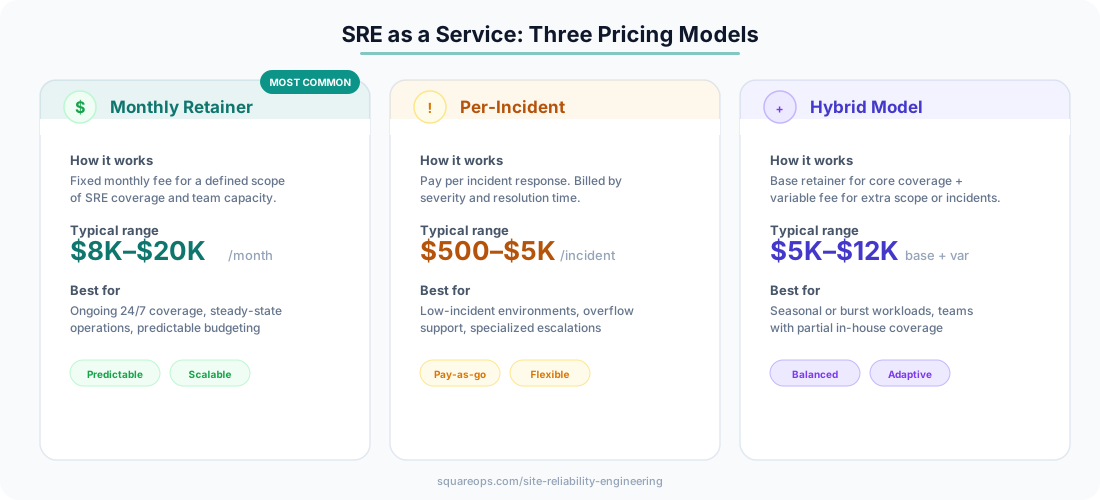
SRE as a service providers typically offer three pricing structures. Understanding the trade-offs helps you match the model to your operational pattern and budget constraints.
Monthly retainer
The most common model. You pay a fixed monthly fee ($8K–$20K depending on scope) for a defined level of SRE coverage — typically including 24/7 on-call, a specified number of engineer-hours per month, observability management, and incident response with defined SLAs. The retainer model provides predictable budgeting and ensures the SRE team is continuously invested in your environment, not just reacting to incidents.
Per-incident
You pay only when the SRE team engages on an incident, with pricing based on severity and resolution complexity ($500–$5K per incident). This model works for low-incident environments or as overflow support for an existing in-house team. The trade-off is unpredictable costs and no proactive reliability investment — the provider has no financial incentive to prevent incidents.
Hybrid
A base retainer ($5K–$12K/month) covers core monitoring and standard-hours coverage, with additional charges for after-hours incidents, extra engineering capacity, or project-based work. This model balances cost predictability with flexibility for teams that have seasonal workload variation or partial in-house coverage.
For most organizations, the monthly retainer model delivers the best value because it aligns the provider's incentives with your reliability goals — they are motivated to prevent incidents and automate toil, not to maximize billable incident hours.
How SRE as a Service Mirrors the DevOps-as-a-Service Model
If you are already familiar with DevOps as a service, SRE as a service follows a similar structure — external experts embedded in your workflow, focused on a specific engineering discipline. The key difference is scope: DevOps as a service focuses on CI/CD pipelines, infrastructure provisioning, and deployment automation. SRE as a service focuses on what happens after deployment — keeping production reliable, responding to incidents, managing SLOs, and reducing operational toil.
Many organizations use both models together: a DevOps service handles build and deploy, while an SRE service handles run and respond. Others consolidate both under a single provider that covers the full lifecycle. Either approach works — the important thing is clear ownership boundaries at each stage.
Who Should Use SRE as a Service?
SRE as a service is not a one-size-fits-all solution. It works best in these scenarios:
- Growth-stage startups that need production-grade reliability but cannot afford or find experienced SRE hires. The service provides enterprise-level operational maturity at startup-friendly pricing.
- Mid-market companies scaling from a small ops team to a full SRE function. The service bridges the gap while you build internal capability.
- Enterprises in cloud migration that need specialized Kubernetes, AWS, or multi-cloud expertise for a defined period without permanent headcount.
- Teams with on-call burnout where developers are pulling double duty. SRE outsourcing absorbs the on-call burden and restores development velocity.
- Post-incident stabilization — after a major outage, an SRE service can rapidly harden your environment, implement proper monitoring, and establish incident management processes.
Where SRE as a service is less appropriate: organizations with deep institutional knowledge requirements that cannot be transferred, heavily regulated environments where all operations must be performed by direct employees, or companies that already have a well-staffed, effective in-house SRE team.
How to Evaluate SRE-as-a-Service Providers
When selecting an SRE as a service partner from the growing field of managed DevOps and SRE providers, evaluate across these dimensions:
- Incident response SLAs: What are the guaranteed response times for P1, P2, and P3 incidents? Sub-5-minute response for P1 is the baseline for serious providers.
- Kubernetes and cloud-native depth: Can they demonstrate experience managing EKS, GKE, or AKS at scale? Do they use GitOps (ArgoCD, FluxCD)? Service mesh experience (Istio)?
- SLO-driven methodology: Do they work with SLOs and error budgets, or just static threshold alerting? The difference separates SRE from monitoring.
- Tooling integration: Will they embed into your Slack, Jira, PagerDuty, and Git repositories, or require you to use their systems?
- Knowledge transfer: Do they document runbooks in your repositories? Can you operate independently within 30 days if the engagement ends?
- Reporting and transparency: Do they produce blameless postmortems, weekly SLO dashboards, and monthly executive summaries?
The Shared Responsibility Model: What You Own vs What the Provider Owns
The most successful SRE as a service engagements operate with a clear shared responsibility model. Ambiguity in ownership is the leading cause of friction between internal teams and external SRE providers.
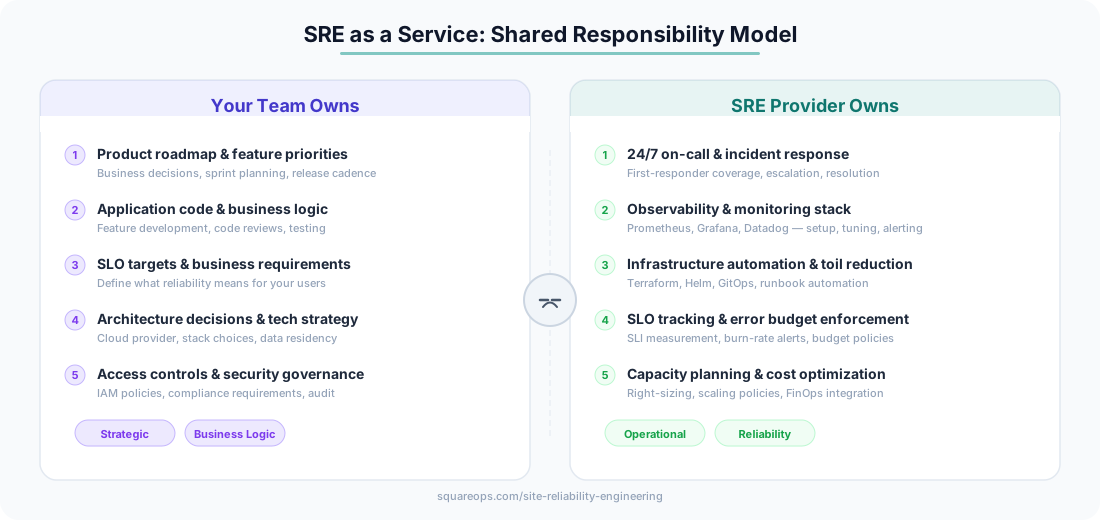
Your team retains ownership of everything strategic and business-specific: product roadmap, application code, SLO targets (the business requirements behind them), architecture decisions, and access control policies. These are areas where your domain expertise is irreplaceable and where the SRE provider adds no unique value.
The SRE provider takes ownership of everything operational and reliability-focused: 24/7 on-call coverage, observability stack management, infrastructure automation, SLO tracking and enforcement, and capacity planning. These are areas where the provider's multi-client experience and operational depth create the most leverage.
The handoff point between the two is well-defined: your team decides what reliability level is required (SLO targets), and the SRE provider figures out how to achieve and maintain it. This separation keeps your engineering team focused on product velocity while ensuring production reliability does not depend on your developers being available at 3 AM.
SRE as a Service in 2026: AI, Automation, and What Is Next
The SRE as a service landscape is evolving rapidly in 2026, driven by three trends that are changing how services are delivered.
AI-assisted incident response is reducing MTTD and MTTR by correlating alerts across services, suggesting likely root causes from historical incident data, and auto-generating postmortem drafts. The best SRE providers are embedding LLM-powered tools into their incident workflows — not replacing human judgment, but accelerating the diagnostic process. See our guide on AI-powered incident response for a deeper look at this trend.
FinOps integration is becoming a standard part of SRE engagements. As cloud costs grow, reliability teams are uniquely positioned to optimize infrastructure spend because they understand utilization patterns and can right-size resources without compromising performance or reliability targets.
Platform engineering convergence is blurring the line between SRE and platform teams. Leading SRE providers now offer internal developer platform (IDP) buildout as part of their service — golden paths, self-service infrastructure, and developer portals that reduce the operational burden on SRE teams over time.
For teams evaluating SRE as a service in 2026, these trends mean more value per dollar spent — the same retainer that covered basic monitoring and on-call three years ago now includes AI-assisted diagnostics, cost optimization, and platform engineering capabilities.
Ready to explore SRE as a service for your team? SquareOps provides SLA-backed SRE services with 24/7 on-call, Kubernetes expertise, SLO-driven operations, and AI-assisted incident response for production workloads on AWS, GCP, and Azure. Talk to our SRE team to get a free reliability assessment and see which pricing model fits your environment.