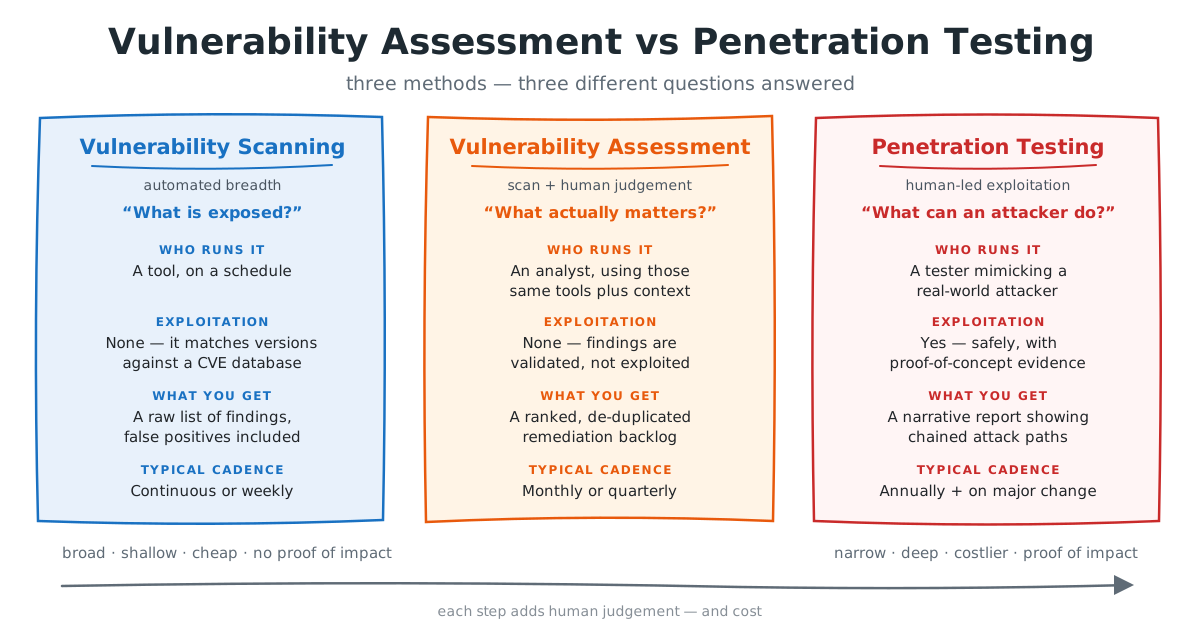
TL;DR: The vulnerability assessment vs penetration testing question is really a three-way distinction. Automated vulnerability scanning is tool-run breadth — it matches what it finds against a database of known flaws and attempts no exploitation. A vulnerability assessment is that scan plus human judgement: an analyst validates each finding, discards false positives, and ranks what is worth fixing in your environment. A penetration test is human-led exploitation — a tester safely chains weaknesses together to prove what an attacker could reach. Scanning tells you what is exposed, assessment tells you what matters, and a pen test tells you what it would cost you.
Almost every security-testing purchase we are asked to review starts the same way: a compliance deadline, three quotes at wildly different prices, and no way to tell whether they describe the same work. They usually do not. Two are often a scan with a report wrapped around it; the third is a real penetration test. This guide draws the line precisely enough that you can read a scope document and know which one you are being sold.
In this guide:
- What is the difference between vulnerability assessment and penetration testing?
- Vulnerability scanning vs vulnerability assessment vs penetration testing compared
- Automated vulnerability scanning: what a tool can and cannot tell you
- What is a vulnerability assessment, and how is it more than a scan?
- What is penetration testing, and what does it actually prove?
- Which security testing does your compliance framework require?
- How do scanning, assessment and penetration testing fit together?
- Four misconceptions that quietly cost security teams money
- Where red teaming and PTaaS fit in the picture
- Offensive testing, cloud posture and shift-left are three different budgets
Not sure whether you need an assessment, a pen test, or both?
SquareOps scopes VAPT engagements around what your framework actually requires — not around what fits a tool licence.
What is the difference between vulnerability assessment and penetration testing?
The cleanest framing is the one NIST SP 800-115, the Technical Guide to Information Security Testing and Assessment, uses. It sorts techniques into two families: target identification and analysis, which includes network discovery and vulnerability scanning, and target vulnerability validation, which includes penetration testing and which the guide describes as techniques that “corroborate the existence of vulnerabilities”.
That is the argument in two words. A vulnerability assessment identifies and prioritises weaknesses. A penetration test validates them by attempting to exploit them.
Where teams get lost is the third term nobody puts in the acronym. Vulnerability scanning is the automated engine inside an assessment, not a synonym for it. Sold on its own, the scan output is a CVE list. Add an analyst who removes false positives, checks whether the vulnerable path is reachable, and ranks what remains against your business, and you have an assessment. Most disappointing security reports are the first thing sold at the price of the second.
VAPT bundles assessment and penetration testing precisely because they answer different questions and most organisations need both. For the full engagement anatomy — scope, phases, deliverables — see our guide to what a VAPT audit actually involves. This article stays on the methodology distinction.
Vulnerability scanning vs vulnerability assessment vs penetration testing compared
| Dimension | Vulnerability scanning | Vulnerability assessment | Penetration testing |
|---|---|---|---|
| What it is | Automated matching of assets against a database of known vulnerabilities | Scanning plus human validation, context and prioritisation | Human-led simulated attack that exploits weaknesses to prove impact |
| Who performs it | A tool, on a schedule or in the pipeline | A security analyst using those tools plus environment knowledge | A tester mimicking a real attacker — tool-assisted, human-driven |
| Exploitation attempted? | No — it fingerprints versions and configurations | No — findings are validated for accuracy and reachability, not exploited | Yes — safely, within agreed rules of engagement, with proof of concept |
| Depth vs breadth | Maximum breadth, minimum depth: every asset, surface level | Broad, with depth applied selectively to what matters | Narrow and deep: a defined scope, taken as far as it goes |
| Typical duration | Minutes to hours per run, unattended | Days, dominated by analyst review time | One to four weeks depending on scope, plus reporting |
| Frequency | Continuous, on every deploy, or weekly | Monthly or quarterly | Annually at minimum, plus after any significant change |
| Output artefact | Raw scanner report: a CVE and severity table, false positives included | Ranked, de-duplicated remediation backlog with owners and context | Narrative report with attack paths, proof-of-concept evidence, business impact |
| Cost driver | Tool licence and asset count | Asset count plus analyst review hours | Tester-days — scope complexity and tester seniority, not IP count |
| Compliance acceptance | Satisfies scanning clauses such as PCI DSS 11.3 where cadence and scope are met | Accepted as vulnerability management evidence under ISO 27001 A.8.8 and SOC 2 CC7.1 | Named outright in PCI DSS 11.4 and the RBI IT Governance direction; expected in practice for SOC 2 and ISO 27001 |
Automated vulnerability scanning: what a tool can and cannot tell you
A scanner identifies the operating systems and applications on a host, then matches them against known vulnerabilities in its database. NIST SP 800-115 puts the value plainly: scanning “can help identify outdated software versions, missing patches, and misconfigurations”. Run continuously, that is genuinely valuable — it is the only method here that keeps pace with an environment changing daily.
It is also the method most often oversold, and the same guide is blunt about why:
- Scanners are noisy in both directions. NIST notes that “as with all pattern-matching and signature-based tools, application vulnerability scanners typically have high false positive rates”, and that they also suffer the high false negative rates characteristic of signature-based tools. A clean scan is not evidence of a clean environment.
- Scanning is not hands-off. The same document calls it “a somewhat labor-intensive activity that requires a high degree of human involvement to interpret results” — which is the entire case for buying an assessment rather than a raw scan.
Then there is the category problem. A scanner is good at anything with a version number and a CVE, and poor at anything requiring an understanding of your application’s intent. Broken access control — the top entry in the OWASP Top 10 — usually looks like two valid HTTP requests where one user reads another user’s data. No signature matches that, nor pricing logic that turns a negative quantity into a refund.
The gap this leaves is not theoretical. The Verizon 2025 Data Breach Investigations Report found exploitation of vulnerabilities accounted for 20% of breach initial access vectors, up 34% year on year, with edge devices and VPNs rising from 3% to 22% of that activity. Its remediation figures are the more damning half: organisations fully remediated only about 54% of those edge vulnerabilities, at a median 32 days. Finding the issue was rarely the bottleneck.
Scanning therefore belongs continuous and automated, wired into delivery rather than run as an annual event — work that sits with DevSecOps and the CI/CD pipeline, not with a point-in-time testing engagement.
What is a vulnerability assessment, and how is it more than a scan?
An assessment takes scanner output and does four things to it that no tool does reliably alone.
- Validation. The analyst confirms each significant finding is real. A back-ported security patch on an enterprise Linux distribution routinely leaves a banner version that scanners flag as vulnerable when the fix is already applied.
- Reachability. A critical CVE on a service that is not exposed, sits behind mutual TLS, or runs on a code path you never call is a different risk from the same CVE on an internet-facing login endpoint.
- Prioritisation with context. A CVSS base score describes the flaw, not your exposure to it — a 9.8 on an isolated internal host can rank below a 6.5 on your authentication service. Evidence of real-world exploitation, such as a CVE appearing in CISA’s Known Exploited Vulnerabilities catalog, moves an item up the list faster than its base score does.
- An owned backlog. The deliverable is not a PDF of findings but a de-duplicated, ranked list where each item has an owner, a fix and a target date.
Assessment is the workhorse of a security programme: cheap enough to run quarterly, broad enough to cover everything you own, and the reason a penetration test does not waste tester-days on unpatched software. Note the boundary, though. An assessment measures known-vulnerability exposure at a point in time. Continuous configuration and identity posture across your cloud accounts — public buckets, over-permissive IAM roles, missing guardrails — is a separate always-on discipline handled by cloud security posture management.
What is penetration testing, and what does it actually prove?
NIST SP 800-115 defines it directly: “Penetration testing is security testing in which assessors mimic real-world attacks to identify methods for circumventing the security features of an application, system, or network.” The next sentence explains why a pen test finds what a scanner structurally cannot: “Most penetration tests involve looking for combinations of vulnerabilities on one or more systems that can be used to gain more access than could be achieved through a single vulnerability.”
Chaining is the product. Three medium findings a scanner reports as three separate rows — an information disclosure endpoint, a weak password policy, an over-privileged service account — become, in a tester’s hands, one critical path from an unauthenticated request to database access. No severity score captures that, because severity is assigned per finding while the risk lives in the combination.
The guide also sets out a four-stage methodology — planning, discovery, attack and reporting, with a loop back into discovery as each foothold reveals new surface. Testers layer published methodologies on that skeleton: the OWASP Web Security Testing Guide for web and API scope, PTES for engagement structure. A proposal that cannot name its methodology is a useful signal.
What you should receive is a narrative, not a table: what was tried, what worked, request captures proving it, what data or privilege was reachable, and what to change. That is also the artefact enterprise customers and auditors ask for by name. For scope-specific depth, see our guide to API penetration testing.
Which security testing does your compliance framework require?
This is where budget decisions are actually made, and where vendors are most likely to paraphrase a mandate into something stronger than it says. The control text matters.
SOC 2
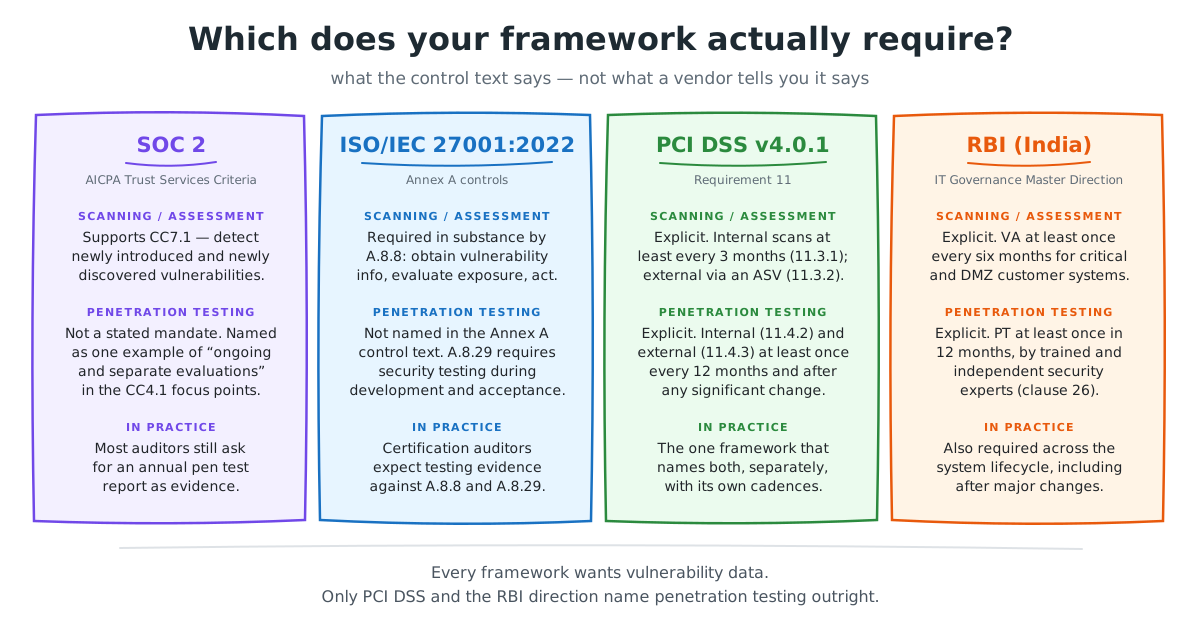
SOC 2 does not mandate a penetration test. The AICPA Trust Services Criteria never state one as a requirement; penetration testing appears in the points of focus for CC4.1, which describe management using “a variety of different types of ongoing and separate evaluations, including penetration testing, independent certifications made against established specifications… and internal audit assessments”. CC7.1 separately expects detection procedures identifying configuration changes that introduce new vulnerabilities and susceptibility to newly discovered ones — which continuous scanning and an assessment programme address directly. In practice most auditors still ask for a recent pen test report, because it is the tidiest evidence for CC4.1.
ISO/IEC 27001:2022
Annex A is similar in shape. Control A.8.8, management of technical vulnerabilities, requires that information about technical vulnerabilities of systems in use is obtained, exposure evaluated, and appropriate measures taken — a vulnerability assessment programme in all but name, with no exploitation implied. Control A.8.29, security testing in development and acceptance, requires that security testing processes are defined and implemented in the development life cycle. Neither control names penetration testing in its text; certification auditors nonetheless expect testing evidence proportionate to your risk assessment. Our guide to VAPT for SOC 2 and ISO 27001 goes deeper on what satisfies each.
PCI DSS v4.0.1
PCI DSS settles the argument, because it names both and keeps them in separate requirements with separate cadences. Under Requirement 11, internal vulnerability scans run at least once every three months (11.3.1), with authenticated scanning a separate requirement (11.3.1.2) that became mandatory on 31 March 2025 and external scans at least once every three months via an Approved Scanning Vendor (11.3.2). Penetration testing sits in 11.4: a documented methodology using industry-accepted penetration testing approaches (11.4.1) — PCI SSC’s own Penetration Testing Guidance points to OSSTMM, NIST SP 800-115, the OWASP Testing Guide and PTES, internal testing at least once every 12 months and after any significant change (11.4.2), and external testing on the same cadence (11.4.3). Clean quarterly scans do not satisfy 11.4 — the single most expensive misunderstanding in this space.
RBI and CERT-In (India)
For Indian regulated entities the requirement is explicit and time-bound. The RBI Master Direction on Information Technology Governance, Risk, Controls and Assurance Practices states at clause 26(a) that for critical information systems and those in the DMZ having a customer interface, “VA shall be conducted at least once in every six months and PT at least once in 12 months”, across the system lifecycle including after major changes. Clause 26(c) requires testing by “appropriately trained and independent information security experts/ auditors”, and 26(e) requires vulnerabilities to be fixed in a time-bound manner. Separately, CERT-In empanels information security auditing organisations, and several Indian regulators expect audits to be performed by an empanelled auditor — worth checking before you shortlist, as our guide to choosing a VAPT company in India explains.
Have an audit date and no test booked?
We scope against the specific clause you need evidence for — PCI DSS 11.4, RBI clause 26, SOC 2 CC4.1 — and deliver the artefact your auditor will accept.
How do scanning, assessment and penetration testing fit together?
The three are not alternatives. They are three lanes running at three speeds against the same environment, and dropping a lane creates a predictable blind spot.
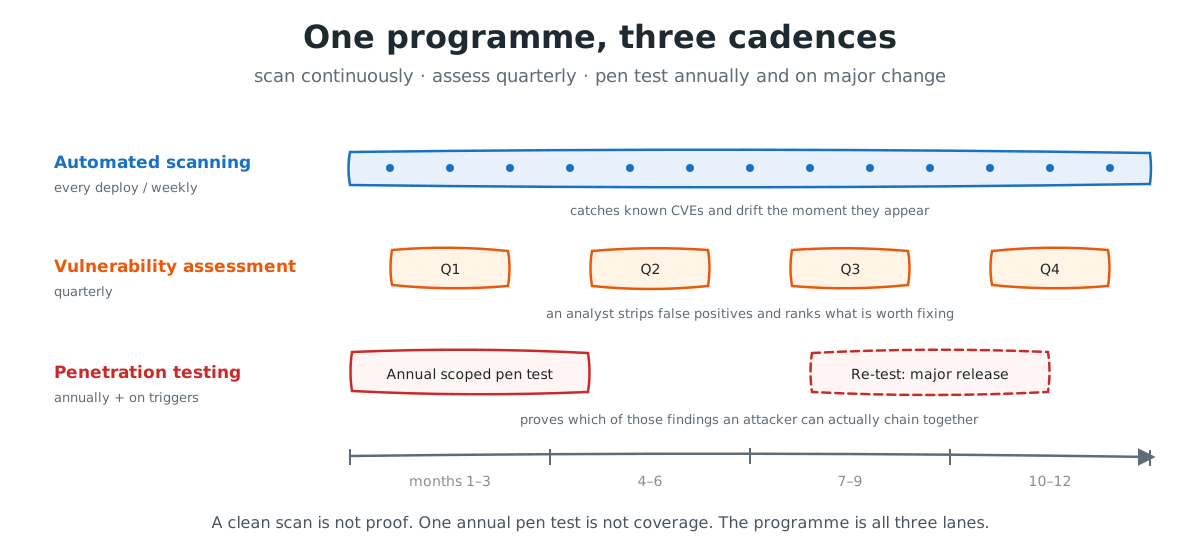
- Scan continuously. In the pipeline on every build, and weekly against running infrastructure and containers. This lane keeps pace with change.
- Assess quarterly. An analyst turns accumulated scanner noise into a ranked backlog and confirms last quarter’s fixes held. This lane turns findings into decisions.
- Pen test annually, and on trigger. The triggers matter more than the calendar: a new internet-facing service, an authentication redesign, a cloud migration, a significant new API, or an acquisition bringing unknown infrastructure into scope.
- Close the loop. Frameworks that mandate testing also mandate remediation and re-testing — PCI DSS 11.4.4 requires exploitable vulnerabilities found in testing to be corrected and the testing repeated to verify the correction. Budget the re-test when you budget the test.
One note on sequencing: run the assessment first and fix what it finds. Testers charge by the day, and spending those days rediscovering an unpatched web server is the most common way teams overpay for a penetration test.
Four misconceptions that quietly cost security teams money
1. “We got a VAPT report, so we had a pen test.” Not necessarily — the tell is in the artefact. A pen test report contains an attack narrative and proof-of-concept evidence. If the deliverable is a table of CVEs with severity ratings and generic remediation advice, you bought a scan with a cover page. Ask for a redacted sample report and the number of tester-days in the quote before you sign.
2. “The scan came back clean, so we are secure.” A clean scan means no known-signature match on the assets in scope, on that day, at the privilege level the scanner had. It says nothing about access control, business logic, or anything it could not authenticate into.
3. “We pen test annually, so we are covered.” An annual test covers the scope you nominated when you nominated it. Everything shipped in the following eleven months — new endpoints, new subdomains, a forgotten staging environment holding production data — is untested by definition. The annual test is a compliance floor, not a coverage strategy.
4. “The report is the outcome.” The outcome is the fix and the verified re-test. Findings discovered and never closed are worse than not testing, because you now hold documented evidence that you knew. That 32-day median remediation time on actively exploited edge vulnerabilities is where breaches happen.
Where red teaming and PTaaS fit in the picture
Red teaming sits beyond penetration testing and tests something different. A pen test asks what vulnerabilities exist in a scope and how far they go. A red team engagement is objective-based — reach a specific crown-jewel asset by any agreed means, often over weeks, usually without telling your defenders. What it really measures is detection and response, not attack surface. It is the wrong purchase if you have never had a pen test: you will pay adversary-emulation rates to discover an unpatched server. Sequence it once your pen test findings come back consistently thin.
Penetration testing as a service (PTaaS) changes delivery rather than method. Instead of one engagement ending in a PDF, testing runs against a platform: findings surface during the window so remediation starts immediately, re-testing is included, and scope can be tested more often than once a year. For a team shipping weekly with a changing external surface, that solves a real problem the annual model does not.
Two honest caveats. The “continuous” label covers a spectrum from genuinely continuous manual testing to automated attack-path tooling with a subscription attached — the difference is tester-days, so ask for the number. And automated exploitation cannot safely be pointed at every asset; fragile and business-critical systems usually stay excluded, and those are often the ones that matter most. Treat PTaaS as a strong complement to a scoped annual test for regulated scope, not an automatic replacement.
Offensive testing, cloud posture and shift-left are three different budgets
Much of the confusion here is not about scanning versus exploitation at all — it is three disciplines sold under one word. They have different cadences, owners and budget lines:
- Point-in-time offensive testing — vulnerability assessment and penetration testing, run on a schedule and on triggers, producing evidence for auditors and customers. This is VAPT.
- Continuous defensive posture — configuration and identity guardrails, CSPM, least-privilege IAM, logging and detection across cloud accounts, always on. This is cloud security, and no periodic test substitutes for it.
- Shift-left in the pipeline — SAST, DAST, dependency and container scanning, SBOM generation and policy gates that stop a vulnerable build before production. This is DevSecOps, running on a well-built CI/CD pipeline and the underlying DevOps platform.
Buy only the first and you get a compliant annual report over an environment that drifts between tests. Buy only the second and third and you get strong day-to-day hygiene with no independent proof it holds against an attacker. SquareOps builds all three as one programme, which mostly means pen test findings feed the pipeline gates and the posture guardrails instead of landing in a PDF nobody reopens.
Not sure whether your compliance deadline needs a scan, a pentest, or both? Book a free consultation with our security team, or read more about our VAPT services.